Key takeaways
- Match CFM to your gun, not your tank: Most HVLP and LVLP guns for furniture want 2–5 CFM at 90 PSI on a continuous basis. Read your gun’s spec sheet first, then buy a compressor that exceeds it by roughly 30% so the motor isn’t running flat-out through an entire tabletop.
- Treat decibels as a real specification: The gap between 60 dB and 90 dB is not a small upgrade — perceived loudness roughly doubles every 10 dB, so a 90 dB unit sounds around eight times louder than a 60 dB one. Anything at or under 70 dB can run beside a conversation; anything above it belongs in a detached space with the door shut.
- Size the tank for duty cycle, not bragging rights: A 2–3 gallon tank suits chair legs, drawer fronts, and touch-ups. Once you’re spraying full dressers, wardrobes, or multiple panels in sequence, 8 gallons and up keeps pressure stable and dramatically reduces how often the motor kicks in.
- Insist on oil-free and clean air: Oil-free pumps eliminate the risk of oil mist reaching your finish, which is the fastest route to fisheyes in lacquer. Budget separately for a water trap and inline filter regardless of pump type — moisture is the more common culprit.
- Plan for where it will physically live: Weight, handle design, wheels, and cord length decide whether the unit ends up in the workshop or shoved in a corner unused. Uprights save floor space; hand-carry models let you spray in a ventilated garage bay and store the compressor elsewhere.
What's inside
Most people shopping for a spray-painting compressor are chasing one number — CFM — and ignoring the one that will actually change how they live in their home: decibels. I spend my working life studying how sound shapes rest and recovery, and the pattern is remarkably consistent. A compressor that cycles at 90 dB in an attached garage will wake a napping toddler two rooms away, rattle a partner working a night shift, and leave you tense long after the finish has cured. Furniture refinishing is slow, patient work; it happens on weekend mornings and late evenings, precisely when the rest of the household is trying to rest.
This guide looks at spray-painting compressors through two lenses at once: whether they can actually feed a gun without sputtering, and whether they can do it without turning your home into a mechanical room. Below you’ll find the models worth your money in 2026, a short buying framework that puts airflow and acoustics on equal footing, and answers to the questions furniture makers ask most often.
As an Amazon Associate we earn from qualifying purchases.


🛒 Best Price Today on Amazon
Prime members get fast, free shipping on everything above, plus member-only deals. New members get a 30-day free trial — cancel anytime.
How to Choose an Air Compressor For Spray Painting (2026)
- Match CFM to your gun, not your tank: Most HVLP and LVLP guns for furniture want 2–5 CFM at 90 PSI on a continuous basis. Read your gun’s spec sheet first, then buy a compressor that exceeds it by roughly 30% so the motor isn’t running flat-out through an entire tabletop.
- Treat decibels as a real specification: The gap between 60 dB and 90 dB is not a small upgrade — perceived loudness roughly doubles every 10 dB, so a 90 dB unit sounds around eight times louder than a 60 dB one. Anything at or under 70 dB can run beside a conversation; anything above it belongs in a detached space with the door shut.
- Size the tank for duty cycle, not bragging rights: A 2–3 gallon tank suits chair legs, drawer fronts, and touch-ups. Once you’re spraying full dressers, wardrobes, or multiple panels in sequence, 8 gallons and up keeps pressure stable and dramatically reduces how often the motor kicks in.
- Insist on oil-free and clean air: Oil-free pumps eliminate the risk of oil mist reaching your finish, which is the fastest route to fisheyes in lacquer. Budget separately for a water trap and inline filter regardless of pump type — moisture is the more common culprit.
- Plan for where it will physically live: Weight, handle design, wheels, and cord length decide whether the unit ends up in the workshop or shoved in a corner unused. Uprights save floor space; hand-carry models let you spray in a ventilated garage bay and store the compressor elsewhere.
The Best Air Compressors For Spray Painting (2026), Reviewed
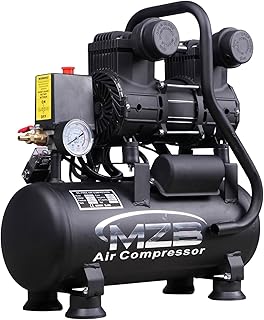
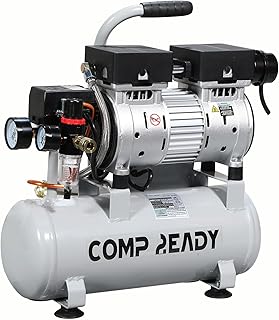
MZB 2.4 Gallon Ultra Quiet Air Compressor
At 70 dB with 5.65 CFM on tap, this is an unusually generous airflow figure for a compressor this small and this civil — it will comfortably feed most gravity-fed HVLP guns on furniture-scale work. The 2.4-gallon tank means the motor cycles often on long passes, so it’s best suited to cabinet doors, chairs, and detail work rather than full wardrobe carcasses.
VEVOR 13-Gallon Air Compressor
Sixty-six decibels from a 13-gallon, 2 HP unit is the standout figure here, and the wheeled steel body makes it genuinely movable between a garage and a driveway spray setup. With 4.6 SCFM at 90 PSI and a large reservoir, it holds pressure through sustained spraying better than anything else at this noise level.
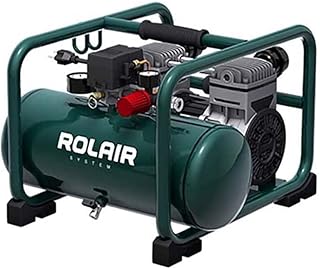
Rolair JC20 Hand Carry
Rolair’s JC20 is the professional’s quiet compressor — 70 dB, 2 HP, and a build quality that shrugs off years of jobsite abuse rather than the two seasons many budget units manage. The small tank limits continuous spray time, but for finish work and touch-ups it is close to faultless.
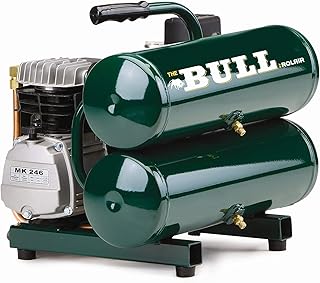
Rolair FC2002 Twin Stack
The twin-stack layout gives you meaningfully more stored air in a footprint you can still carry, and the overload protection with manual reset is a reassuring touch on a compressor you’ll lean on hard. It is louder than the JC20, so plan on a garage with the door closed rather than a basement shop below bedrooms.
MZB 18.5-Gallon Upright
This is the pick for anyone finishing full-size furniture regularly: the upright 18.5-gallon tank keeps pressure steady across large panels, and the oil-free pump protects your topcoat. It takes up more room and needs a dedicated corner, but it removes duty-cycle worries almost entirely.
Frequently Asked Questions
How much CFM do I really need for spray painting furniture?
Plan on 2–5 CFM at 90 PSI for most HVLP and LVLP guns used on furniture. Check your gun’s rating and add headroom; running a compressor at its ceiling causes pressure dips that show up as uneven fan patterns and orange peel.
Is a quiet compressor genuinely worth paying more for?
If it shares a wall, floor, or ceiling with living space, yes. Intermittent loud noise is more disruptive to sleep and concentration than steady noise, and a cycling compressor is the definition of intermittent — quiet models simply expand the hours you can work without friction.
Do I need a moisture trap and filter?
Always. Compressed air carries water vapour and fine particulate, both of which will blemish a finish. An inline desiccant filter and drain valve cost very little relative to stripping and respraying a tabletop.
Can a small pancake compressor handle a whole dresser?
It can, with patience — you’ll pause while pressure recovers, which risks visible lap marks. For anything larger than drawer fronts and doors, an 8-gallon-plus tank makes the job faster and the finish more consistent.
Final Thoughts
For most home furniture makers, the VEVOR 13-Gallon is the sweet spot: enough stored air for real projects, at 66 dB you can live alongside. If your work is finer and space is tight, the MZB 2.4 Gallon delivers remarkable airflow for its size, while the Rolair JC20 is the one to buy if you want a quiet compressor that will still be running a decade from now.