Key takeaways
- Sustained CFM at 90 PSI: This is the only figure that predicts finish quality. Budget HVLP guns want 4–6 CFM continuously; detail and touch-up guns can work on 2–3. Match the compressor’s rating to your gun’s requirement plus roughly 20% headroom, and ignore “peak” or “displacement” CFM entirely.
- Tank volume as a buffer, not a solution: A larger tank buys you longer uninterrupted passes and fewer motor starts, but it cannot manufacture air. Anything under about 6 gallons will cycle constantly during full-panel work; 13 to 30 gallons lets the motor rest between coats.
- Noise level in decibels: Standard direct-drive units run 85–95 dB — loud enough to carry through drywall and disrupt sleep in adjacent rooms. Ultra-quiet models in the 65–70 dB range are roughly a quarter as loud perceptually, which makes evening sessions genuinely viable in an attached garage.
- Oil-free versus lubricated: Oil-free pumps eliminate the risk of oil mist reaching your paint and need almost no upkeep, though they run louder and wear faster. Either type still requires a water separator and inline filter; moisture, not oil, causes most fisheyes.
- Power and placement: Confirm your circuit can carry the motor’s draw before buying — a 120V unit on a shared 15-amp circuit will trip breakers under load. Also check wheel size and weight if the compressor needs to live somewhere other than where you paint.
What's inside
Spray painting a car is one of the few garage jobs where the compressor, not the painter, sets the ceiling on quality. A gun that starves for air mid-panel leaves orange peel, dry edges, and tiger stripes that no amount of wet sanding fully hides. Most buyers discover this the hard way: they pick a compressor by tank size or horsepower, pull the trigger on a full quarter panel, and watch the needle sag below the gun’s working pressure within twenty seconds. The number that actually matters — sustained CFM at 90 PSI — is usually buried at the bottom of the spec sheet.
There’s a second cost that rarely makes it into buying guides: noise. Bodywork happens in evenings and on weekends, often in a garage sharing a wall with a bedroom, and a compressor cycling at 90+ dB will wreck a household’s sleep long before the clear coat flashes. As someone who spends most of my working life on sleep environments, I treat decibel ratings as a real spec, not a footnote. This guide covers what a paint gun genuinely demands, how to read duty cycle honestly, and which of the compressors below can feed an HVLP setup without turning your home into a job site after dark.
As an Amazon Associate we earn from qualifying purchases.


🛒 Best Price Today on Amazon
Prime members get fast, free shipping on everything above, plus member-only deals. New members get a 30-day free trial — cancel anytime.
How to Choose a/an Air Compressor For Car Painting (2026)
- Sustained CFM at 90 PSI: This is the only figure that predicts finish quality. Budget HVLP guns want 4–6 CFM continuously; detail and touch-up guns can work on 2–3. Match the compressor’s rating to your gun’s requirement plus roughly 20% headroom, and ignore “peak” or “displacement” CFM entirely.
- Tank volume as a buffer, not a solution: A larger tank buys you longer uninterrupted passes and fewer motor starts, but it cannot manufacture air. Anything under about 6 gallons will cycle constantly during full-panel work; 13 to 30 gallons lets the motor rest between coats.
- Noise level in decibels: Standard direct-drive units run 85–95 dB — loud enough to carry through drywall and disrupt sleep in adjacent rooms. Ultra-quiet models in the 65–70 dB range are roughly a quarter as loud perceptually, which makes evening sessions genuinely viable in an attached garage.
- Oil-free versus lubricated: Oil-free pumps eliminate the risk of oil mist reaching your paint and need almost no upkeep, though they run louder and wear faster. Either type still requires a water separator and inline filter; moisture, not oil, causes most fisheyes.
- Power and placement: Confirm your circuit can carry the motor’s draw before buying — a 120V unit on a shared 15-amp circuit will trip breakers under load. Also check wheel size and weight if the compressor needs to live somewhere other than where you paint.
The Best Air Compressor For Car Painting (2026)s Reviewed
Klutch 29-Gallon Air Compressor
With 5.1 CFM at 90 PSI and a 29-gallon vertical tank, this is the only unit here I’d trust for a full respray with a conventional HVLP gun — it recovers quickly and the motor gets real rest between coats. The trade-off is volume: it’s a traditional loud compressor, so plan sessions around when the house is awake.
VEVOR 13-Gallon Air Compressor
At 4.6 SCFM at 90 PSI and a claimed 66 dB, this is the sweet spot for most home painters — enough air for panel work with noise low enough that a sleeping child upstairs won’t notice. The thickened steel body and wheels make it practical to reposition around a crowded garage.
California Air Tools CAT-4610AC
The twin aluminum tanks and genuinely quiet oil-free pump make this the most pleasant compressor in the group to work beside for hours. At 4.6 gallons it’s better suited to spot repairs, bumpers, and detail guns than full-body coverage.
MZB 6.4 Gallon Ultra Quiet Air Compressor
A 70 dB rating and dual steel tanks give you a compact, apartment-garage-friendly option that handles touch-ups and small panels cleanly. Expect frequent cycling if you push it toward larger surfaces.
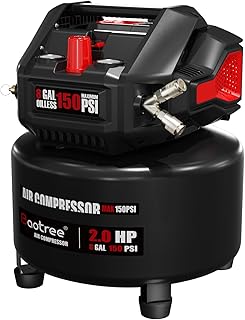
Baotree 8 Gallon Portable Air Compressor
The 150 PSI maximum and 2.8 SCFM at 90 PSI put this squarely in the primer, trim, and small-repair category rather than full paint jobs. It’s a sensible all-rounder if you also want it for nailing and tire duty.
Frequently Asked Questions
How much CFM do I really need to paint a car?
Plan on 4–6 CFM at 90 PSI sustained for a standard HVLP gun, or 8–10 for larger production guns. Detail and mini guns can manage on 2–3 CFM, which is why small compressors work fine for touch-ups but fail on hoods and doors.
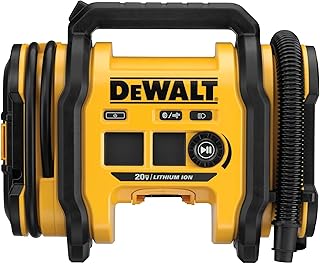
Can I use a portable inflator like the DEWALT DCC020IB for painting?
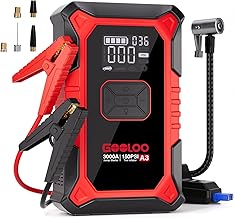
No. Cordless inflators such as the DEWALT 20V MAX unit deliver high pressure at very low volume and have no storage tank, so they can’t sustain a spray gun. They’re excellent for tires and air tools that need short bursts.
Will a quiet compressor actually protect sleep in the house?
Meaningfully, yes. Dropping from 90 dB to around 66–70 dB cuts perceived loudness by roughly three quarters and removes most of the abrupt cycling noise that triggers wakefulness through shared walls. It doesn’t make evening painting silent, but it moves it from disruptive to tolerable.
Do I need a dryer or filter, or is the compressor enough?
Always add filtration. A water separator at the tank plus an inline desiccant filter at the gun is the minimum; compressed air carries moisture that causes fisheyes and blush regardless of how good the pump is.
Final Thoughts
For genuine full-vehicle work, the Klutch 29-Gallon is the honest choice — it’s the only unit with the airflow and recovery to keep a full-size HVLP gun fed through an entire panel sequence. If your garage shares a wall with a bedroom, the VEVOR 13-Gallon delivers nearly the same usable CFM at a fraction of the noise, and it’s the pick I’d make for most home painters. For spot repairs, bumpers, and detail guns where quiet matters more than volume, the California Air Tools CAT-4610AC remains hard to beat.