Key takeaways
- Measured noise, not marketing noise: Look for a published decibel figure and treat anything under 60 dB as genuinely liveable — roughly the level of quiet conversation. Above 70 dB you’re into territory that carries through walls and interrupts a sleeping partner or child down the hall.
- An air tank changes the sound profile: Tankless units run continuously the entire time you spray, producing a constant drone. A 2–3 litre tank lets the motor fill, shut off, and stay silent while you work, which is far less intrusive than uninterrupted operation.
- Pressure range and fine regulation: Airbrushing lives between 15 and 40 PSI. A regulator with a readable gauge and smooth adjustment matters more than a high maximum figure — 125 PSI is useful for tyres, irrelevant for a 0.3 mm needle.
- Moisture trap and oil-free design: Compressed air carries water, and a single droplet ruins a finish. An inline moisture trap is essential; an oil-free pump removes the risk of oil mist contaminating paint and means no maintenance schedule to forget.
- Cooling and duty cycle: If you paint for an hour or more at a stretch, a cooling fan or dual-fan arrangement prevents thermal shutdown and extends motor life. Small tankless compressors without fans are best kept to short sessions.
What's inside
Most people shopping for an airbrush compressor are chasing precision, but the thing that actually derails a hobby is sound. I spend my working life studying how ambient noise fragments sleep architecture, and a piston compressor cycling at 75 decibels in a spare bedroom does measurable damage to the household — it pushes people out of light sleep, spikes cortisol at the wrong hour, and quietly trains a modeler or cake decorator to only paint during daylight hours they don’t have. The result is an expensive kit that sits under a desk untouched.
This guide approaches airbrush compressors the way I’d approach a bedroom fan or a white-noise machine: how loud, what kind of loud, and does it run steadily or cycle in startling bursts. Alongside that, we cover the fundamentals that matter for spray quality — tank capacity, pressure regulation, moisture separation, and duty cycle — so you end up with air that’s clean and consistent as well as a workspace that won’t wake anyone at 11 p.m. Below are six units worth your attention, followed by a buying framework and answers to the questions I get asked most.
As an Amazon Associate we earn from qualifying purchases.


🛒 Best Price Today on Amazon
Prime members get fast, free shipping on everything above, plus member-only deals. New members get a 30-day free trial — cancel anytime.
How to Choose a/an Air Compressor For Airbrushing (2026)
- Measured noise, not marketing noise: Look for a published decibel figure and treat anything under 60 dB as genuinely liveable — roughly the level of quiet conversation. Above 70 dB you’re into territory that carries through walls and interrupts a sleeping partner or child down the hall.
- An air tank changes the sound profile: Tankless units run continuously the entire time you spray, producing a constant drone. A 2–3 litre tank lets the motor fill, shut off, and stay silent while you work, which is far less intrusive than uninterrupted operation.
- Pressure range and fine regulation: Airbrushing lives between 15 and 40 PSI. A regulator with a readable gauge and smooth adjustment matters more than a high maximum figure — 125 PSI is useful for tyres, irrelevant for a 0.3 mm needle.
- Moisture trap and oil-free design: Compressed air carries water, and a single droplet ruins a finish. An inline moisture trap is essential; an oil-free pump removes the risk of oil mist contaminating paint and means no maintenance schedule to forget.
- Cooling and duty cycle: If you paint for an hour or more at a stretch, a cooling fan or dual-fan arrangement prevents thermal shutdown and extends motor life. Small tankless compressors without fans are best kept to short sessions.
The Best Air Compressor For Airbrushing (2026)s Reviewed
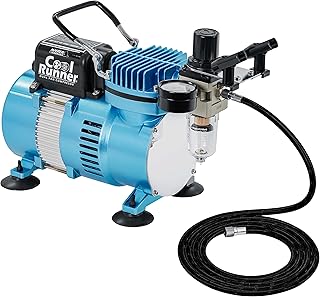
Master Airbrush TC-320 Cool Runner II
The dual-fan cooling is the standout here, letting the unit run long sessions without the heat-related cutouts that plague cheaper mini compressors. It arrives as a complete kit with regulator, water trap and airbrush holder, making it the most sensible starting point for someone entirely new to the craft.
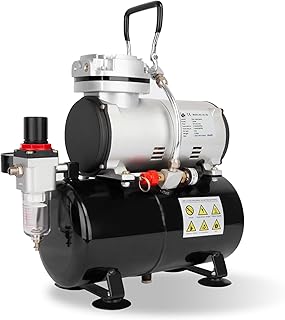
Timbertech AS186 Airbrush Compressor
A 3-litre tank on a single-piston oil-free pump gives you genuinely quiet stretches of work, since the motor rests between fills rather than droning the whole time. Pressure holds steady enough for cake decorating and fine model detail alike, and the moisture trap does its job without fuss.
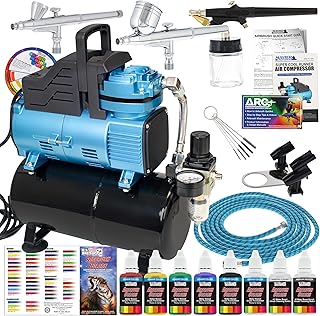
Timbertech ABPST08 Upgraded Compressor
The upgraded sibling adds a cooling fan to the same 3-litre tank formula, which is the combination I’d recommend for anyone working past bedtime or through long detailing sessions. Thermal headroom plus tank buffering is the quietest realistic setup at this price.
SPARMAX ARISM Mini
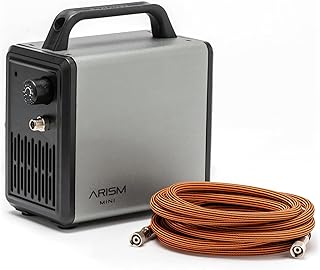
SPARMAX build quality shows in how little vibration transfers to the desk — a surprisingly large factor in perceived loudness, since resonance through furniture travels further than airborne sound. Compact, oil-free, with a braided hose and integrated holder, it’s the pick for a bedroom or shared studio.
Stealth 2 Gallon Oil-Free Compressor (SAQ-1234)
Rated under 60 dB with a 2-gallon tank, this is the choice if you also want a compressor for tyres, brad nailing and general DIY. You’ll need to dial the regulator well down for airbrush work, but the low noise floor and long quiet periods between refills make it unusually house-friendly for a shop compressor.
Frequently Asked Questions
How quiet does an airbrush compressor need to be for evening use?
Aim for 60 dB or below at a metre. Sleep disruption research consistently shows arousals beginning around 40 dB at the sleeper’s ear, so a sub-60 dB unit behind a closed door in another room is generally safe.
Do I really need a tank?
For anything beyond occasional touch-ups, yes. A tank smooths pressure pulsation for better atomisation and, just as importantly, silences the motor between cycles instead of running it continuously.
What PSI should I set for airbrushing?
Start at 15–20 PSI for fine lines and thin inks, and move up to 30–40 PSI for thicker acrylics or broad coverage. Adjust with paint thinning rather than pressure wherever possible.
Is an oil-free compressor worth it?
For airbrushing, absolutely. Oil-lubricated pumps can pass fine mist into the airline, and no filter is perfectly reliable — oil-free removes the variable entirely and needs no maintenance.
Final Thoughts
If you want one recommendation, the Timbertech ABPST08 hits the best balance of tank buffering, cooling and low noise for regular evening work. The SPARMAX ARISM Mini is the refined option for tight or shared spaces where vibration matters, and the Master Airbrush TC-320 remains the most complete entry kit for anyone starting from scratch.