Key takeaways
- Measured noise, not marketing noise: Look for a stated figure in decibels and treat anything at or under 40 dB as genuinely liveable in a shared home. A 47–60 dB piston unit is fine in a garage but will carry through a bedroom wall and fragment someone’s sleep cycle without ever fully waking them.
- Tank or tankless: A 3-litre tank stores pressurised air so the motor cycles on briefly and then falls silent, giving you long stretches of quiet spraying. Tankless models run continuously, which means constant sound and heat for as long as you work.
- Pressure range for your medium: Fine detail on models and makeup wants 15–25 PSI; cake glazes, textiles and automotive clear coats want 30–48 PSI. Buy a regulator with a clear gauge rather than guessing.
- Heat and duty cycle: Cooling fans and oil-free pistons let you work for an hour or more without thermal cut-off. Overheating mid-session is the most common reason cheap units get returned.
- Vibration and placement: A compressor sitting directly on a hollow desk or hardwood floor turns the furniture into a speaker. Rubber feet, a dense mat, or a low shelf away from the wall you share with a bedroom will cut perceived noise more than any spec sheet upgrade.
What's inside
Most people shopping for an airbrush compressor are focused entirely on PSI charts and nozzle sizes — and they end up buying a machine that turns their spare room into a small industrial site. I come to this from an unusual direction: I spend my working life helping people protect their sleep, and a surprising number of my clients are hobbyists who paint miniatures, decorate cakes, or do makeup work in the evenings, in apartments, in a corner of a bedroom, or in a room that shares a wall with a sleeping child. The compressor they chose is often the reason they’re winding down at midnight with their nervous system still buzzing.
This guide looks at airbrush compressors through that lens as well as the usual performance one. Noise output, vibration transfer through furniture, duty cycle (how long the motor has to run before it can rest), and whether a tank lets the pump switch off entirely all matter enormously if your studio doubles as living space. Below you’ll find the models worth your money in 2026, what separates them, and how to match one to your room, your craft, and your bedtime.
As an Amazon Associate we earn from qualifying purchases.


🛒 Best Price Today on Amazon
Prime members get fast, free shipping on everything above, plus member-only deals. New members get a 30-day free trial — cancel anytime.
How to Choose a/an Air Compressor For Airbrush (2026)
- Measured noise, not marketing noise: Look for a stated figure in decibels and treat anything at or under 40 dB as genuinely liveable in a shared home. A 47–60 dB piston unit is fine in a garage but will carry through a bedroom wall and fragment someone’s sleep cycle without ever fully waking them.
- Tank or tankless: A 3-litre tank stores pressurised air so the motor cycles on briefly and then falls silent, giving you long stretches of quiet spraying. Tankless models run continuously, which means constant sound and heat for as long as you work.
- Pressure range for your medium: Fine detail on models and makeup wants 15–25 PSI; cake glazes, textiles and automotive clear coats want 30–48 PSI. Buy a regulator with a clear gauge rather than guessing.
- Heat and duty cycle: Cooling fans and oil-free pistons let you work for an hour or more without thermal cut-off. Overheating mid-session is the most common reason cheap units get returned.
- Vibration and placement: A compressor sitting directly on a hollow desk or hardwood floor turns the furniture into a speaker. Rubber feet, a dense mat, or a low shelf away from the wall you share with a bedroom will cut perceived noise more than any spec sheet upgrade.
The Best Air Compressor For Airbrush (2026)s Reviewed
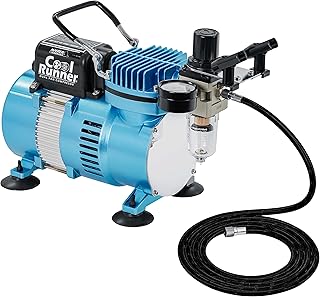
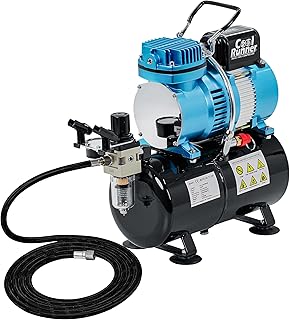
Master Airbrush TC-320 Cool Runner II Kit
The twin-fan cooling design is the standout here: it holds temperature through long sessions where single-fan rivals cut out, and the included regulator, water trap and airbrush holder mean you’re spraying the day it arrives. It’s a workhorse rather than a whisper, so give it rubber feet and a shelf of its own if it lives near sleeping quarters.
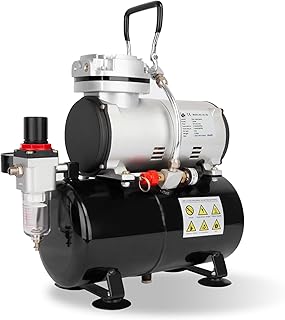
Timbertech AS186 with 3L Tank
The 3-litre tank is what makes this one a favourite for home studios — the piston fills the tank, shuts off, and you get several minutes of near-silent, perfectly steady air with no pulsation in your fine lines. Ideal for cake decorating and tattoo work where consistency matters more than raw output.
Timbertech ABPST08 Upgraded
Essentially the AS186 with a dedicated cooling fan added, which is the upgrade that matters if your sessions run past the hour mark. Oil-free, tank-buffered and stable, it’s the one I’d point a serious hobbyist toward for daily use.
Gaahleri Ambition GTS-06 Kit
A genuinely well-matched kit rather than a compressor with an airbrush thrown in — the air control is responsive and the build quality punches above its price bracket. A strong first serious setup for model painters moving on from a starter airbrush.
Portable 27PSI Ultra-Quiet Airbrush Kit
At around 35 dB this is the model to choose if noise is your primary constraint: quiet enough to use in the same room as a sleeping partner, with seven pressure levels covering makeup, nail art and detail work. The 27 PSI ceiling rules out heavy coatings, so know your medium before buying.
Frequently Asked Questions
How quiet does an airbrush compressor need to be for evening use?
Aim for 40 dB or below. Sleep is disrupted by intermittent noise above roughly 40 dB even when the sleeper doesn’t remember waking, so an ultra-quiet or tank-buffered unit is the practical choice for shared homes.
Do I really need a tank?
You don’t need one, but it delivers two real benefits: pulse-free air for smoother gradients, and long silent intervals while the motor rests. For anyone working near living or sleeping space, it’s the single best upgrade.
What PSI should I start at?
Begin at 18–20 PSI for thinned acrylics and detail passes, then climb only as far as your paint and nozzle demand. Higher pressure gives you overspray and a rougher finish, not better coverage.
Is a high-PSI compressor worth it for hobby work?
Only if you’re spraying thicker media — primers, varnishes, automotive or textile paint. A 40–48 PSI unit like the Gocheer kit gives you that headroom, though it will run louder than a low-pressure alternative.
Final Thoughts
For most home studios the Timbertech ABPST08 is the balanced pick, pairing a 3-litre tank with active cooling for long, low-noise sessions; the AS186 is the same idea at a slightly lower price if you work in shorter bursts. If your setup shares a room or a wall with someone who’s asleep, the 35 dB ultra-quiet portable kit is the one that will keep both your painting and your household’s rest intact — and if you need sheer stamina and airflow instead, the Master Airbrush TC-320 remains the durable, well-equipped choice.