Key takeaways
- Load capacity with headroom: Add up your monitors, arms, PC tower, and the desktop slab itself, then choose a frame rated at least 50% above that figure. A 264 lb or 330 lb rating isn’t overkill — it’s what keeps travel smooth and quiet years in.
- Dual motors, not single: Two motors distribute the lift across the frame, reduce racking under uneven loads, and raise the desk fast enough that you’ll actually change position mid-task rather than putting it off.
- Height range against your elbows: Standing height should put your forearms roughly parallel to the floor. Shorter users need frames dipping toward 28 inches; taller users should confirm the ceiling reaches 46 inches or more with the desktop thickness included.
- Memory presets and quiet operation: Programmable heights remove the friction that kills the habit, and anything near 55 dB won’t puncture a shared room or a late call. Silence matters more if your desk sits in a bedroom, where noise conditioning affects wind-down.
- Frame-only versus complete desk: If you already own a slab you like, buy the frame and save meaningfully. If not, a bundled 55″x28″ or 71″ surface removes guesswork on bracket spacing and grommet placement.
What's inside
Most people shopping for a standing desk are chasing focus, not sleep — but the two are wired together more tightly than the average buyer realizes. Daytime posture and movement drive how much light you catch, how your spine loads, and how tired your body actually feels at bedtime. A wobbly desk quietly sabotages all of it: you stop raising it, you sit for nine hours, and you wonder at 11 p.m. why your body has no interest in shutting down. Stability is the hidden variable that determines whether a sit-stand desk becomes a habit or an expensive shelf.
That is why four-leg frames deserve a closer look. Two extra columns cut lateral sway dramatically, hold heavier monitor arms and gaming rigs without shimmy, and keep the desktop calm at full extension — the exact height where most cheap frames start to feel unsafe. Below, I’ve assessed the strongest four-leg options available in 2026 on load capacity, motor configuration, height range, and real-world steadiness, plus how to match a frame to your body and your daily rhythm.
As an Amazon Associate we earn from qualifying purchases.


🛒 Best Price Today on Amazon
Prime members get fast, free shipping on everything above, plus member-only deals. New members get a 30-day free trial — cancel anytime.
How to Choose a/an 4 Leg Standing Desk (2026)
- Load capacity with headroom: Add up your monitors, arms, PC tower, and the desktop slab itself, then choose a frame rated at least 50% above that figure. A 264 lb or 330 lb rating isn’t overkill — it’s what keeps travel smooth and quiet years in.
- Dual motors, not single: Two motors distribute the lift across the frame, reduce racking under uneven loads, and raise the desk fast enough that you’ll actually change position mid-task rather than putting it off.
- Height range against your elbows: Standing height should put your forearms roughly parallel to the floor. Shorter users need frames dipping toward 28 inches; taller users should confirm the ceiling reaches 46 inches or more with the desktop thickness included.
- Memory presets and quiet operation: Programmable heights remove the friction that kills the habit, and anything near 55 dB won’t puncture a shared room or a late call. Silence matters more if your desk sits in a bedroom, where noise conditioning affects wind-down.
- Frame-only versus complete desk: If you already own a slab you like, buy the frame and save meaningfully. If not, a bundled 55″x28″ or 71″ surface removes guesswork on bracket spacing and grommet placement.
The Best 4 Leg Standing Desk (2026)s Reviewed
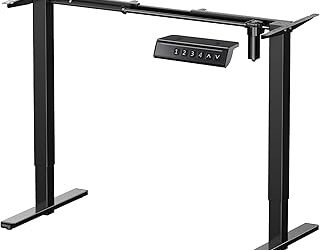
JWX 4-Leg Electric Frame, Dual Motor, 330 lb
The highest capacity here, and the one I’d hand to anyone running a triple-monitor arm plus a full tower. Dual motors and four columns make 330 lb feel unremarkable, which is precisely the point — you stop thinking about the desk and start using its full range.
4-Leg Electric Frame, Dual Motor, 264 lb
A well-judged balance of price and rigidity for heavy but not extreme setups. At full standing height the deck stays composed under typing pressure, the failure point where most four-post budget frames reveal themselves.
FLEXISPOT 4-Leg Standing Desk, 55″x28″
The most complete out-of-box option, pairing a genuinely stable four-leg frame with a memory LED controller and a sensible ergonomic height band. FLEXISPOT’s motor tuning is refined enough that transitions feel controlled rather than lurching, which encourages frequent posture changes.
X-Win 71″ Electric Standing Desk
Choose this if surface area is the constraint. Seventy-one inches invites a dual-monitor spread with room left for notes or a keyboard tray, and the four-leg architecture keeps that long span from flexing at the center.
ErGear Electric Standing Desk Legs, 39.4–63.3″
The smartest pick for DIY builders and anyone reusing a favorite tabletop. Four memory settings, anti-collision detection, a 28.3–46.5 inch range, and roughly 55 dB operation cover the essentials without paying for a surface you don’t need.
Frequently Asked Questions
Can a standing desk really improve my sleep?
Indirectly, yes. More upright time typically means more incidental movement and more daylight exposure at the window, both of which strengthen circadian signaling and increase the physical tiredness that supports deeper early-night sleep.
Are four legs meaningfully more stable than two?
Noticeably so, particularly above 40 inches and across surfaces wider than 60 inches. The added columns resist front-to-back sway, which is the wobble most people find distracting while typing standing up.
How long should I stand each day?
Alternate rather than endure. Roughly 15 to 30 minutes standing per hour of desk work suits most people, and transitioning before fatigue arrives beats pushing through it.
Should I put a standing desk in my bedroom?
It’s workable if the desk is quiet and you protect the psychological boundary — keep work off it after your wind-down hour, and ideally position it so it isn’t the last thing in your sightline from bed.
Final Thoughts
For heavy, permanent setups the JWX 330 lb frame is the most confident buy in this group, while the FLEXISPOT 55″x28″ is the easiest complete desk to recommend to someone who wants it assembled and working the same afternoon. If you already own a tabletop worth keeping, the ErGear legs deliver four-leg stability and memory presets for considerably less — and any of the three will hold a rhythm of standing, moving, and sleeping better than the desk you’re replacing.