Key takeaways
- Recline geometry over recline degrees: A big number on the box means little if your head drops backward unsupported. Look for a headrest that stays in contact with your skull through the full arc, and a tilt that opens the hip angle rather than folding you at the ribs. Somewhere between 130° and 155° is the sweet spot for genuine downshifting without the disorientation of lying flat at your desk.
- A footrest that actually reaches: Dangling calves are the single most common reason a nap in a chair leaves you achy. Measure from the back of your knee to your heel and compare it against the extended footrest length. Continuous support from seat pan to ankle is what allows your leg muscles to genuinely release.
- Lumbar support that moves with you: Fixed foam lumps often press hardest precisely when you recline. Pocket-spring or independently adjustable lumbar systems track the changing curve of your spine instead of fighting it, which matters enormously if you plan to stay reclined for twenty minutes or more.
- Heat and massage, used deliberately: Warmth applied to the low back encourages peripheral blood flow and helps the body’s core temperature drift downward afterward, which is a real cue for drowsiness. Vibration is best treated as a tension-release tool for the hour before a break, not something you leave running. Prioritise chairs with independent zone controls and an auto-shutoff.
- Capacity, footprint and armrest travel: Check the stated weight rating against your own with a comfortable margin, since load capacity governs frame rigidity and how confident the chair feels at full tilt. Then confirm the arms drop or swing clear of your desk edge, and that you have roughly two feet of clearance behind the chair.
What's inside
Anyone who has drifted off mid-afternoon in a chair that wasn’t built for it knows the aftermath: a stiff neck, a numb arm, and a strange grogginess that lingers until dinner. As someone who spends most of my working life studying rest architecture and daytime recovery, I’ve come to see the reclining office chair as one of the more misunderstood pieces of home furniture. It isn’t a bed. But it is a legitimate recovery surface, and when it’s poorly designed it teaches your body all the wrong lessons about how to relax.
This guide looks at reclining desk chairs through that lens. Rather than ranking them purely on how imposing they look on a video call, I’ve weighed the things that actually determine whether a chair supports genuine restoration: how the backrest transfers load when it tilts, whether the footrest closes the gap between hip and heel, how heat and vibration influence downshifting, and how easily you can come back upright without a surge of adrenaline. Below are six models worth your attention in 2026, followed by the selection criteria I’d apply before spending a dollar.
As an Amazon Associate we earn from qualifying purchases.


How to Choose an Office Chair Recliner (2026)
- Recline geometry over recline degrees: A big number on the box means little if your head drops backward unsupported. Look for a headrest that stays in contact with your skull through the full arc, and a tilt that opens the hip angle rather than folding you at the ribs. Somewhere between 130° and 155° is the sweet spot for genuine downshifting without the disorientation of lying flat at your desk.
- A footrest that actually reaches: Dangling calves are the single most common reason a nap in a chair leaves you achy. Measure from the back of your knee to your heel and compare it against the extended footrest length. Continuous support from seat pan to ankle is what allows your leg muscles to genuinely release.
- Lumbar support that moves with you: Fixed foam lumps often press hardest precisely when you recline. Pocket-spring or independently adjustable lumbar systems track the changing curve of your spine instead of fighting it, which matters enormously if you plan to stay reclined for twenty minutes or more.
- Heat and massage, used deliberately: Warmth applied to the low back encourages peripheral blood flow and helps the body’s core temperature drift downward afterward, which is a real cue for drowsiness. Vibration is best treated as a tension-release tool for the hour before a break, not something you leave running. Prioritise chairs with independent zone controls and an auto-shutoff.
- Capacity, footprint and armrest travel: Check the stated weight rating against your own with a comfortable margin, since load capacity governs frame rigidity and how confident the chair feels at full tilt. Then confirm the arms drop or swing clear of your desk edge, and that you have roughly two feet of clearance behind the chair.
The Best Office Chair Recliners (2026) Reviewed
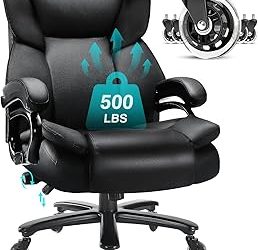
500LBS Massage Office Chair with Footrest
The most substantial frame here, with a genuinely wider and thicker seat that distributes pressure across the sit bones instead of concentrating it. Six vibration points and low-back heat make it my pick for anyone who uses their chair as a deliberate midday recovery station rather than an occasional slouch.
Heated Recliner Office Chair with Massager
A 155° recline paired with height-adjustable arms means you can dial in shoulder position before you tilt, which is exactly the right order of operations. The PU leather wipes clean easily, though I’d add a breathable throw if you run warm.
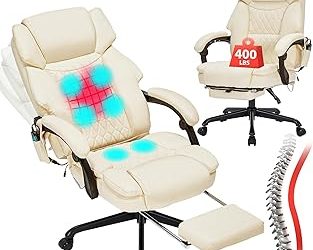
Massage & Heated Office Chair with Foot Rest
The beige leather and softer visual profile make this one of the few models that doesn’t announce itself as a piece of equipment. Independent lumbar adjustment and a smoothly progressive backrest give it a calmer, more controlled recline than most in its price band.
COMHOMA Big and Tall Gaming Chair with Pocket Spring Lumbar
The pocket-spring lumbar section is the standout feature, flexing under load in a way that solid foam simply can’t match over long sessions. Outward fixed armrests suit broader shoulders well, but confirm your desk clearance before ordering.
GYI 160 Reclining Office Chair with Footrest
The cross-legged seat design is unusually thoughtful, letting you shift out of a static posture without abandoning back support entirely. A heavy-duty base and clean white faux leather make it a strong choice for lighter, more open home offices.
Frequently Asked Questions
Is napping in an office chair recliner actually good for you?
A short nap of ten to twenty minutes can meaningfully sharpen alertness, and a well-supported recline is a perfectly reasonable place for one. Keep it brief and keep it before mid-afternoon, since longer or later naps tend to blunt your night-time sleep drive.
Does the heat function help or hinder sleep?
It helps, indirectly. Warming the surface of your back dilates peripheral vessels and encourages heat to leave the body, and that subsequent temperature drop is one of the strongest physiological cues for drowsiness. Fifteen minutes is plenty.
Can one chair genuinely work for both focused work and rest?
Yes, provided the transition between modes is quick and effortless. If adjusting the tilt or footrest requires wrestling, you’ll simply stop bothering, and the chair reverts to being an ordinary seat with unused features.
How much space do I need behind the chair?
Allow roughly 24 to 30 inches of clearance behind the backrest, plus another 12 to 18 inches ahead of the seat for the extended footrest. Verify this before you commit, particularly in a narrow room or alcove.
Final Thoughts
If your chair doubles as a recovery space, the 500LBS Massage Office Chair offers the most stable platform and the broadest seat of anything here. For a more refined room, the Massage & Heated Office Chair in beige balances real support with furniture-grade looks, while the COMHOMA Big and Tall remains the smartest choice for anyone whose lower back needs support that adapts rather than simply pushes back.