Key takeaways
- Match wattage to cubic feet, not square feet: Crawl spaces are shallow and oddly shaped. A 600W unit handles a well-insulated pocket or pump house; a 1000W handles a moderately sealed crawl; anything over roughly 1,500 cubic feet of leaky, vented space needs a gas-fired unit rather than a plug-in heater.
- Insist on a built-in thermostat with a low set point: You want the heater cycling on around 38–42°F, not holding 65°F. A dedicated freeze-protection thermostat is the single biggest factor in your operating cost, and it’s the difference between $8 and $80 on a January bill.
- Verify circuit capacity before you buy: Most crawl spaces have one lonely 15A receptacle. A 1500W heater consumes 12.5A and should not share that circuit with a sump pump, dehumidifier, or lighting. Confirm this first, or plan for 240V.
- Prioritize sealed, moisture-tolerant construction: Crawl spaces run humid. Look for enclosed elements, corrosion-resistant housings, and mounting brackets so the unit sits off the vapor barrier rather than on damp ground.
- Consider noise transmission upward: A blower directly beneath a bedroom joist bay is audible at night. If sleep quality matters, mount the unit toward the center of the crawl, away from bedroom footprints, or choose a lower-decibel model for the room above instead.
What's inside
Most people don’t think about their crawl space until something goes wrong at 3 a.m. — a burst supply line, a knocking pipe, or that unmistakable cold draft rolling across the bedroom floor because the unheated cavity below is sitting at 28°F. As someone who spends most of my working hours on the sleep-environment side of home comfort, I can tell you the crawl space is one of the most overlooked variables in overnight thermal stability. Floor surface temperature drives how quickly your body dumps heat while you sleep, and a frigid subfloor quietly sabotages that process all night long.
This guide focuses on freeze protection first and comfort second, because the two are linked more tightly than most homeowners realize. Below you’ll find the specific units worth considering in 2026 — from thermostat-controlled utility heaters sized for tight vented crawl spaces and well houses, to a high-output forced-air unit for large sealed foundations, plus a couple of quiet portables for the finished rooms sitting directly above. I’ve noted where each one genuinely earns its place and where it doesn’t.
As an Amazon Associate we earn from qualifying purchases.


How to Choose a/an Crawl Space Heater (2026)
- Match wattage to cubic feet, not square feet: Crawl spaces are shallow and oddly shaped. A 600W unit handles a well-insulated pocket or pump house; a 1000W handles a moderately sealed crawl; anything over roughly 1,500 cubic feet of leaky, vented space needs a gas-fired unit rather than a plug-in heater.
- Insist on a built-in thermostat with a low set point: You want the heater cycling on around 38–42°F, not holding 65°F. A dedicated freeze-protection thermostat is the single biggest factor in your operating cost, and it’s the difference between $8 and $80 on a January bill.
- Verify circuit capacity before you buy: Most crawl spaces have one lonely 15A receptacle. A 1500W heater consumes 12.5A and should not share that circuit with a sump pump, dehumidifier, or lighting. Confirm this first, or plan for 240V.
- Prioritize sealed, moisture-tolerant construction: Crawl spaces run humid. Look for enclosed elements, corrosion-resistant housings, and mounting brackets so the unit sits off the vapor barrier rather than on damp ground.
- Consider noise transmission upward: A blower directly beneath a bedroom joist bay is audible at night. If sleep quality matters, mount the unit toward the center of the crawl, away from bedroom footprints, or choose a lower-decibel model for the room above instead.
The Best Crawl Space Heater (2026)s Reviewed
600W Utility Heater with Dual-Screen Display
The dual-screen readout is genuinely useful here — you can verify both ambient temperature and set point without crawling under the house with a flashlight. At 600W it’s the right call for insulated crawl spaces, well houses, and pump enclosures where you only need to hold above freezing.
600W Pump House Heater with Thermostat
A stripped-down, do-one-thing-well unit that maintains stable low temperatures through cold snaps without fuss. I recommend this for homeowners who want reliable freeze protection and have no interest in displays, timers, or modes they’ll never touch.
Mr. Heater 125,000 BTU Forced-Air Unit Heater
This is the serious option for large, sealed, encapsulated crawl spaces or attached shop foundations where electric resistance heat simply can’t keep up. It requires proper venting, gas supply, and ideally professional installation — but nothing in the plug-in category comes close to its output.
KING U24100 Utility Pump House Heater
The 1000W/240V configuration is the sweet spot for mid-size crawl spaces, and running it on 240V keeps amp draw sensibly low. Build quality is what you’d expect from KING: unglamorous, well-sealed, and still working in a decade.
DREO Space Heater, 2026 Upgraded
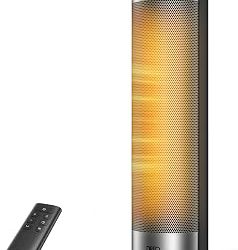
Not a crawl space unit — and I’d never recommend it as one — but at 34dB with a 12-hour timer it’s the model I point sleep clients toward for the bedroom directly above a cold floor. PTC ceramic heat plus remote control means you can take the edge off without a noisy cycle waking you.
Frequently Asked Questions
What temperature should I keep my crawl space at?
For pipe protection, 40°F is sufficient. If you’re chasing warmer floors and better sleep comfort, 50–55°F noticeably changes subfloor surface temperature — but insulate and air-seal first, or you’re heating the outdoors.
Is a crawl space heater safe to leave running unattended?
A hardwired or bracket-mounted utility heater with overheat protection, on its own circuit, kept clear of insulation and vapor barrier, is designed for exactly this. Portable milkhouse-style heaters are not intended for unattended long-term duty in a crawl space.
Would a milkhouse heater work down there instead?
The BEYOND HEAT 1500W with its anti-freeze setting, tip-over shut-off, and overheat protection is a reasonable emergency stopgap during a hard freeze. As a permanent solution, a mounted utility heater is safer and more efficient.
Will heating my crawl space actually improve my sleep?
Indirectly, yes. Cold subfloors create radiant asymmetry and cold drafts at ankle height, both of which fragment early-night sleep. Stabilizing the space below is often more effective than turning up the bedroom thermostat.
Final Thoughts
For most homeowners, the KING U24100 is the best all-around choice — durable, appropriately sized, and efficient on 240V. Choose the 600W Utility Heater with Dual-Screen Display for smaller insulated crawls, well houses, and pump enclosures, and step up to the Mr. Heater 125,000 BTU forced-air unit only when you’re heating a large encapsulated foundation and can support proper gas venting.