Key takeaways
- Start at the lowest level: Basements and ground floors hold the coldest, dampest air and feed moisture upward through the stack effect. Treating the bottom of the house first often drops upstairs humidity by several points without a second machine.
- Respect the clearance envelope: Compressor units need roughly 12–18 inches of open space on the intake and exhaust sides. Tucking one against a wall, behind a sofa, or inside a closet starves it and inflates your run time.
- Match capacity to the air volume, not the floor plan: A 2,500 sq. ft. rating assumes open, connected space. Closed doors, split levels, and long hallways fragment that coverage, so size up if you’re asking one unit to serve two floors.
- Plan the drainage before you plug in: Continuous gravity drainage via hose is the only realistic option for a basement or utility room you rarely visit. Reserve tank-only operation for upstairs rooms where you’ll actually notice the full indicator.
- Prioritize noise floor for sleeping areas: Anything above the mid-40 dB range tends to fragment light sleep. If the unit will share a bedroom, look for a quoted 40 dB low setting and place it across the room rather than beside the headboard.
What's inside
Moisture in a two-story home rarely behaves the way homeowners expect. Warm, vapor-heavy air climbs, cool air sinks, and the stairwell acts like a chimney that shuttles humidity between floors all day long. That’s why so many people run a dehumidifier for weeks, watch the tank fill, and still find musty closets upstairs, condensation on basement windows, or that faintly damp smell clinging to upholstered furniture. The unit usually isn’t the problem — its address in the house is.
As a sleep-wellness consultant, I spend most of my time diagnosing bedrooms that feel clammy at 3 a.m., and placement is almost always the lever that fixes it. This guide walks through where a dehumidifier actually earns its keep in a multi-level home, how airflow and stack effect change the math, and which capacities make sense for whole-house versus single-room duty. Below you’ll find the units I’d recommend for basements, hallways, and sleeping spaces, along with the placement rules that make each one perform closer to its rated numbers.
As an Amazon Associate we earn from qualifying purchases.




How to Choose a/an Place To Put Dehumidifier In 2 Story House (2026)
- Start at the lowest level: Basements and ground floors hold the coldest, dampest air and feed moisture upward through the stack effect. Treating the bottom of the house first often drops upstairs humidity by several points without a second machine.
- Respect the clearance envelope: Compressor units need roughly 12–18 inches of open space on the intake and exhaust sides. Tucking one against a wall, behind a sofa, or inside a closet starves it and inflates your run time.
- Match capacity to the air volume, not the floor plan: A 2,500 sq. ft. rating assumes open, connected space. Closed doors, split levels, and long hallways fragment that coverage, so size up if you’re asking one unit to serve two floors.
- Plan the drainage before you plug in: Continuous gravity drainage via hose is the only realistic option for a basement or utility room you rarely visit. Reserve tank-only operation for upstairs rooms where you’ll actually notice the full indicator.
- Prioritize noise floor for sleeping areas: Anything above the mid-40 dB range tends to fragment light sleep. If the unit will share a bedroom, look for a quoted 40 dB low setting and place it across the room rather than beside the headboard.
The Best Place To Put Dehumidifier In 2 Story House (2026)s Reviewed
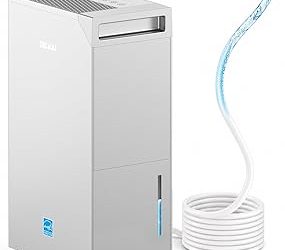
4500 Sq. Ft Quilt Compressor Dehumidifier
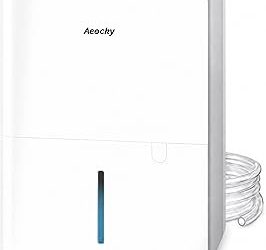
This is the unit I’d position at the base of the stairwell or in a central basement bay, where its larger rated coverage can pull moisture from the whole lower level before it migrates up. The drain hose and intelligent humidity control make it genuinely set-and-forget, which matters for a machine you’ll walk past twice a week.
34 Pint/Day 2500 Sq. Ft. Dehumidifier
The 40 dB low setting and 24-hour timer make this the most bedroom-friendly option here — park it on the upstairs landing overnight and it will service adjacent rooms with the doors cracked. The 0.53-gallon tank is modest, so pair it with the included hose if you’re running it continuously.
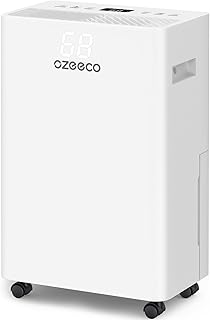
ozeeco 34 Pint Dehumidifier
Child lock plus ultra-quiet operation makes this a sensible pick for a second-floor nursery or a shared hallway where curious hands reach the control panel. The ionizer is a nice extra, though I’d still rely on placement and airflow rather than filtration to solve a musty-room complaint.
KNKA 2500 Ft² 34 Pint Dehumidifier
The dry-clothes mode earns this one a spot in a laundry area or utility room, which is often the hidden moisture source in a two-story home. Three modes and a 24-hour timer give you enough control to run it hard during wash days and gently the rest of the week.
Waykar 34 Pint Energy Star Dehumidifier
Automatic defrost is the standout feature for unheated basements, where cheaper compressors ice over and quietly stop removing water in cold months. Its 0.66-gallon tank is the largest of the group, making it the most forgiving choice for a spot you can’t easily plumb.
Frequently Asked Questions
Should I put my dehumidifier upstairs or downstairs?
Downstairs first, in nearly every case. The lowest level generates and holds the most moisture, and drying it there reduces the humid air rising through your stairwell. Add an upstairs unit only if bedroom readings stay above 55% after the basement stabilizes.
Do I need two dehumidifiers in a two-story house?
Often yes, if your floors are separated by doors or the layout is long and narrow. A single high-capacity unit can handle an open floor plan, but two right-sized machines usually beat one oversized one on both comfort and energy use.
Where exactly in a room should it sit?
Roughly central, off the wall, and away from curtains or furniture that block intake. Near a doorway or the foot of a staircase is ideal, since you’re capturing air already in motion rather than fighting a dead corner.
What humidity level should I target for sleep?
Between 40% and 50% is the sweet spot for most sleepers — dry enough to discourage dust mites and mold, humid enough to avoid a scratchy throat. A small hygrometer on the nightstand tells you more than the unit’s built-in sensor.
Final Thoughts
If you’re solving this with one machine, the 4500 Sq. Ft Quilt Compressor unit at the base of your stairwell gives you the most reach for the money, while the Waykar Energy Star model is the smarter choice for a cold, unheated basement thanks to automatic defrost. For a second unit upstairs, the 34 Pint/Day 40 dB dehumidifier is quiet enough to earn a permanent spot on the landing or in a bedroom corner — and in a two-story home, that combination of low-level bulk capacity plus a quiet upstairs supplement is what finally makes the whole house feel dry.