Key takeaways
- Airflow volume (CFM): Treat this as your primary spec, not blade count. A bedroom under 200 square feet is well served by 4,000–5,000 CFM; open-plan living areas and covered patios want 7,000 CFM or more to generate perceptible movement at the seating level rather than just stirring the ceiling.
- DC motor over AC: DC motors draw substantially less power, offer more granular speed steps, and — critically for sleep — hold a genuinely quiet low setting instead of buzzing. Six speeds gives you a “barely there” setting that AC fans typically can’t reach.
- Blade span matched to room size: Undersizing is the most common mistake. Measure the longest wall: rooms up to 12 feet suit a 52-inch span, 15 to 18 feet calls for 60 inches, and anything larger or with high ceilings justifies a 72-inch sweep.
- Tunable light color, or none at all: If the fan lives in a bedroom, 3CCT or 6CCT switching lets you drop to 2700K in the evening, reducing the short-wavelength light exposure that suppresses melatonin. In a garage or gym, a light-free model keeps the fixture simpler and cheaper.
- Reversibility and mounting height: A reverse setting pulls warm air down from the ceiling in winter, which matters more than most buyers expect. Confirm your ceiling height supports the included downrod with at least seven feet of clearance beneath the blades.
What's inside
Air movement is the most underrated variable in a good night’s sleep. Core body temperature has to drop roughly a degree for sleep onset to happen cleanly, and stagnant air stalls that process — the thin layer of warm, humid air sitting against your skin acts like an invisible blanket you can’t kick off. Most people respond by dropping the thermostat two degrees and paying for it monthly, when what they actually needed was moving air across the mattress. The catch: plenty of fans marketed as “high performance” push modest volumes of air while generating exactly the kind of mid-frequency hum and blade wobble that fragments light sleep.
This guide approaches ceiling fans the way a sleep clinician would — prioritizing measurable airflow, low acoustic output, and motor technology that stays quiet at the low speeds you’ll actually run overnight. I’ve focused on models spanning 52 to 72 inches, covering everything from a standard bedroom to a vaulted great room or covered patio, and I flag where each one earns its keep and where it doesn’t.
As an Amazon Associate we earn from qualifying purchases.


How to Choose a Ceiling Fan To Move Air (2026)
- Airflow volume (CFM): Treat this as your primary spec, not blade count. A bedroom under 200 square feet is well served by 4,000–5,000 CFM; open-plan living areas and covered patios want 7,000 CFM or more to generate perceptible movement at the seating level rather than just stirring the ceiling.
- DC motor over AC: DC motors draw substantially less power, offer more granular speed steps, and — critically for sleep — hold a genuinely quiet low setting instead of buzzing. Six speeds gives you a “barely there” setting that AC fans typically can’t reach.
- Blade span matched to room size: Undersizing is the most common mistake. Measure the longest wall: rooms up to 12 feet suit a 52-inch span, 15 to 18 feet calls for 60 inches, and anything larger or with high ceilings justifies a 72-inch sweep.
- Tunable light color, or none at all: If the fan lives in a bedroom, 3CCT or 6CCT switching lets you drop to 2700K in the evening, reducing the short-wavelength light exposure that suppresses melatonin. In a garage or gym, a light-free model keeps the fixture simpler and cheaper.
- Reversibility and mounting height: A reverse setting pulls warm air down from the ceiling in winter, which matters more than most buyers expect. Confirm your ceiling height supports the included downrod with at least seven feet of clearance beneath the blades.
The Best Ceiling Fan To Move Air (2026)s Reviewed
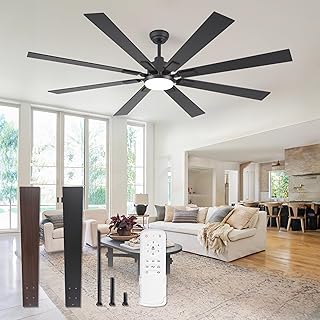
60 in Ceiling Fan, 7400+ CFM with Light & Mute Remote
At 7,400-plus CFM from a 60-inch span, this is the airflow-per-inch leader here, and the three-blade DC design keeps that output remarkably quiet across all six speeds. The 3CCT light plus timer makes it a legitimate primary bedroom fixture — set it warm, set the timer for two hours, and let the room cool as you fall asleep.
Minislak 72 Inch Ceiling Fan, No Light
Eight aluminum blades on a 72-inch industrial DC motor produce serious, room-scale air movement without the fixture bulk of a light kit. This is the pick for garages, workshops, home gyms, and large covered patios where you want volume and durability rather than ambiance.
ZMISHIBO 72″ Ceiling Fan with Lights
The 72-inch counterpart for living spaces: high CFM, a quiet DC motor, and a 24W 3CCT LED, with a dual-finish body that reads considerably more expensive than it is. Damp-rated construction means it holds up under a covered porch or in a humid sunroom.
OPONL 52 Inch Ceiling Fan with Light
Six color temperatures and full dimming give you unusually fine control over evening light, which is exactly what you want in a room you sleep in. Reversible, genuinely noiseless at low speed, and the flat black modern profile disappears against most ceilings.
52 Inch Modern Ceiling Fan, DC Reversible
A clean, well-executed all-rounder — DC reversible motor, 3CCT lighting, remote control, and low acoustic output in a 52-inch package sized for standard bedrooms and apartments. If you want the sleep-friendly essentials without paying for a larger span you don’t need, start here.
Frequently Asked Questions
Does sleeping with a ceiling fan on cause problems?
For most people, no — but direct airflow can dry the eyes, nose, and throat overnight and may aggravate sinus symptoms or allergy responses by keeping dust airborne. Run a lower speed, aim for indirect circulation rather than a jet across your face, and keep blades dusted.
What speed should I run overnight?
The lowest setting that still produces a perceptible drift. Sleep is more sensitive to variability than to absolute temperature, so a steady gentle current beats a strong one you’ll wake up and turn off. This is precisely where six-speed DC motors outperform three-speed AC fans.
Should the fan spin counterclockwise or clockwise?
Counterclockwise in warm months — it drives air downward and creates the evaporative cooling effect on skin. Clockwise on low in winter gently redistributes warm air pooled at the ceiling without producing a draft.
Is a bigger fan always better for airflow?
Only if the room supports it. An oversized fan in a small bedroom produces turbulence and visible blade shadow flicker rather than comfortable circulation. Match span to your longest wall and let CFM, not diameter alone, tell you about performance.
Final Thoughts
For a bedroom where sleep quality is the priority, the 60-inch 7400+ CFM model delivers the rare combination of high airflow and a truly quiet low speed, with the OPONL 52-inch as the smaller-room equivalent thanks to its 6CCT dimmable light. If you’re cooling a great room, gym, or covered patio, step up to the Minislak 72-inch for raw air movement or the ZMISHIBO 72-inch when you want that scale with integrated tunable lighting.