Key takeaways
- Match span to square footage: A 42-inch fan suits rooms up to roughly 100 sq ft (guest rooms, kitchens, home offices), while 44 to 52 inches covers primary bedrooms and living areas. Oversizing a small room creates turbulent, drafty air; undersizing means running high speed all night, which is where noise complaints start.
- Prioritize low-speed quietness: Sleep quality depends on the fan’s quietest setting, not its loudest. Look for sealed, well-balanced motors and check that the fan you choose is rated for continuous overnight operation — a faint, steady hum is fine, but clicking, wobble, or pitch changes are the sounds that fragment sleep.
- Choose your mount before you choose your fan: Ceilings under eight feet need a low-profile flush mount to keep blades safely overhead and airflow smooth. Standard downrod mounts belong on eight-foot ceilings and higher, where the extra drop actually improves circulation.
- Decide on light honestly: Integrated LEDs simplify installation but add a second pull chain and a fixed brightness you can’t easily warm up. If the room already has lamps or overhead lighting — and especially if you’re managing evening light exposure for better sleep onset — a no-light fan is the cleaner choice.
- Confirm reversible blades and chain access: A reversible motor switch lets you push warm air down in winter, effectively extending the fan’s usefulness year-round. Also picture where the chains will hang: you want them reachable from beside the bed or doorway, not stranded over furniture.
What's inside
Most ceiling fan shopping advice assumes you want more technology, not less. But if you’ve ever fumbled for a lost remote at 2 a.m., replaced a coin cell battery in the dark, or watched a fan wake the whole house because someone’s universal remote crossed signals with yours, you already understand the appeal of a pull chain. From a sleep-wellness standpoint, the bedroom should hold as few small frustrations as possible — every micro-annoyance at bedtime is a cue that keeps the nervous system slightly alert instead of letting it downshift.
A pull-chain fan is refreshingly literal: you tug it, air moves, and the setting stays put until you change it. No pairing, no firmware, no receiver module tucked into the canopy waiting to fail three summers from now. This guide covers what actually matters when you skip the remote — blade span versus room size, motor noise at low speed, mount height, and whether you want integrated light or none at all — followed by the models that hold up best in real bedrooms, living rooms, and kitchens.
As an Amazon Associate we earn from qualifying purchases.


How to Choose a Ceiling Fan Without Remote (2026)
- Match span to square footage: A 42-inch fan suits rooms up to roughly 100 sq ft (guest rooms, kitchens, home offices), while 44 to 52 inches covers primary bedrooms and living areas. Oversizing a small room creates turbulent, drafty air; undersizing means running high speed all night, which is where noise complaints start.
- Prioritize low-speed quietness: Sleep quality depends on the fan’s quietest setting, not its loudest. Look for sealed, well-balanced motors and check that the fan you choose is rated for continuous overnight operation — a faint, steady hum is fine, but clicking, wobble, or pitch changes are the sounds that fragment sleep.
- Choose your mount before you choose your fan: Ceilings under eight feet need a low-profile flush mount to keep blades safely overhead and airflow smooth. Standard downrod mounts belong on eight-foot ceilings and higher, where the extra drop actually improves circulation.
- Decide on light honestly: Integrated LEDs simplify installation but add a second pull chain and a fixed brightness you can’t easily warm up. If the room already has lamps or overhead lighting — and especially if you’re managing evening light exposure for better sleep onset — a no-light fan is the cleaner choice.
- Confirm reversible blades and chain access: A reversible motor switch lets you push warm air down in winter, effectively extending the fan’s usefulness year-round. Also picture where the chains will hang: you want them reachable from beside the bed or doorway, not stranded over furniture.
The Best Ceiling Fans Without a Remote (2026), Reviewed
Hunter Builder Elite 52″ (Brushed Nickel, No Light)
This is the purist’s pick — a full 52-inch span, no light kit, no receiver, just a strong three-speed motor and a single chain. It’s the fan I’d put in a bedroom that already has good lamp lighting, because there’s nothing to glare, buzz, or fail.
Hunter Builder Deluxe 52″ (New Bronze, LED)
Same generous 52-inch airflow as the Elite, but with a bulb-included LED fixture for rooms that need a functional ceiling light. The bronze finish reads warm rather than trendy, which matters when a fan has to live on your ceiling for fifteen years.
Honeywell Glen Alden 52″ Low Profile
The strongest value in a large low-profile fan, with five reversible blades in oil-rubbed bronze and a genuinely quiet motor at speed one. Ideal for eight-foot ceilings in a living room where a downrod would feel intrusive.
Hunter Anisten 44″ (Fresh White, LED)
A well-proportioned mid-size fan for bedrooms in the 150-to-225 sq ft range, with bulbs in the box and a crisp white finish that disappears against most ceilings. The 44-inch span is the sweet spot for gentle, even circulation without a forceful draft over the bed.
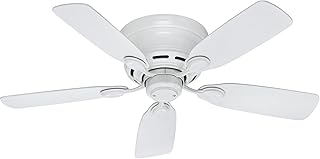
Hunter Low Profile IV 42″ (Snow White, No Light)
Purpose-built for tight ceilings and smaller rooms, this flush-mount fan keeps blades close to the plane of the ceiling while still moving useful air. My default recommendation for nurseries, guest rooms, and kitchens with limited headroom.
Frequently Asked Questions
Are pull-chain fans really more reliable?
Generally, yes — fewer electronic components mean fewer failure points. Remote receivers are among the most common ceiling fan service issues, and replacing a stretched or broken pull chain is a far simpler repair.
Can I add a wall switch later?
Often yes, if your ceiling box has the necessary conductors. A licensed electrician can install a dedicated fan-speed wall control, which gives you remote-free convenience without any batteries.
Is sleeping with a fan on all night safe?
For most people it’s fine and even helpful, since gentle air movement and steady broadband sound both support sleep continuity. If you wake with dry eyes, a stuffy nose, or a stiff neck, aim the airflow away from your head or drop a speed.
Does the Hunter 51091 work on low ceilings?
Yes — the 42-inch Builder flush-mount model is designed specifically for ceilings under eight feet. Its bronze finish and integrated LED make it a tidy single-fixture solution for compact rooms.
Final Thoughts
For most bedrooms and living rooms with standard ceilings, the Hunter Builder Elite 52″ is the fan I’d buy first — maximum airflow, minimum complexity. Choose the Builder Deluxe 52″ instead if you need overhead light in the same footprint, and reach for the Hunter Low Profile IV 42″ when low ceilings or a small room call for something more compact and unobtrusive.