Key takeaways
- Color temperature: Stay at or below 2700K for any fixture used in the evening; 2500K is warmer still and closer to candlelight, which is gentler on late-night alertness. Reserve 3000K and above for task areas, never a bedroom or dining chandelier.
- Base and bulb shape: Nearly all chandeliers take an E12 candelabra base, but the glass profile changes the look — B10 and B11 are straight-sided torpedoes, while CA10 flame-tip mimics a flickering candle. Check whether your shades sit upward or downward before committing.
- Dimming quality: Look for explicitly dimmable models and, ideally, a compatibility list for your dimmer. A bulb that only reaches 20% brightness before cutting out defeats the purpose of a chandelier in a wind-down room.
- Color rendering (CRI): Anything at 90+ CRI will make a dining table, artwork, and food look considerably better than the budget 80 CRI standard. It costs a little more and is the single most noticeable upgrade in a visible fixture.
- Lumens over wattage: Multiply lumens by the number of sockets. Six 450-lumen bulbs give roughly 2,700 lumens — plenty for a mid-size dining room, potentially too much for a bedroom unless you’re dimming.
What's inside
A chandelier is usually the last light burning in a home before bed, which makes it one of the most influential fixtures in your circadian environment — and one of the most commonly mis-bulbed. Buyers tend to shop by shape and socket alone, then wonder why the dining room feels clinical at 9 p.m., why the dimmer buzzes, or why one arm of the fixture runs noticeably cooler in color than the rest. The culprit is rarely the chandelier. It’s the six to twelve small candelabra bulbs screwed into it, chosen for wattage instead of color temperature, color rendering, and dimming behavior.
This guide approaches chandelier bulbs from a sleep-wellness perspective: what to look for if you want a fixture that reads warm and restful after dark, dims smoothly to a low glow rather than snapping off at 20%, and still renders wood, textiles, and skin tones honestly. Below you’ll find the specifications that actually matter in 2026, followed by hands-on notes on the strongest E12 candelabra options — incandescent and LED filament alike — so you can match the bulb to how the room is genuinely used.
As an Amazon Associate we earn from qualifying purchases.



How to Choose a Light Bulb For Chandelier (2026)
- Color temperature: Stay at or below 2700K for any fixture used in the evening; 2500K is warmer still and closer to candlelight, which is gentler on late-night alertness. Reserve 3000K and above for task areas, never a bedroom or dining chandelier.
- Base and bulb shape: Nearly all chandeliers take an E12 candelabra base, but the glass profile changes the look — B10 and B11 are straight-sided torpedoes, while CA10 flame-tip mimics a flickering candle. Check whether your shades sit upward or downward before committing.
- Dimming quality: Look for explicitly dimmable models and, ideally, a compatibility list for your dimmer. A bulb that only reaches 20% brightness before cutting out defeats the purpose of a chandelier in a wind-down room.
- Color rendering (CRI): Anything at 90+ CRI will make a dining table, artwork, and food look considerably better than the budget 80 CRI standard. It costs a little more and is the single most noticeable upgrade in a visible fixture.
- Lumens over wattage: Multiply lumens by the number of sockets. Six 450-lumen bulbs give roughly 2,700 lumens — plenty for a mid-size dining room, potentially too much for a bedroom unless you’re dimming.
The Best Light Bulb For Chandelier (2026)s Reviewed
Hizashi 90+ CRI LED Candelabra Bulb, 4W CA10 Flame Tip (12-Pack)
This is the pick I’d hand to someone who cares how the room feels: 90+ CRI at 2700K gives LED output that stops looking like LED, and the flame-tip CA10 glass suits exposed-socket fixtures. UL listing and reliable low-end dimming make it the best all-around choice for a chandelier you actually sit under.
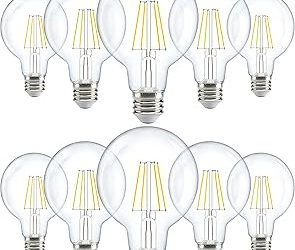
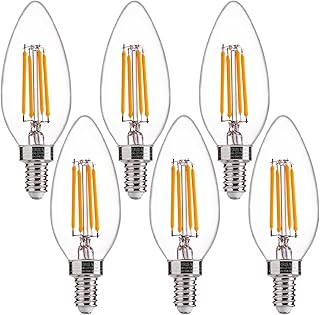
60W Equivalent Clear B11 LED Filament Candelabra Bulbs (6-Pack)
The brightest LED option here, and the right call for a large dining room or entryway where 40W-equivalent bulbs simply disappear into the space. The clear filament construction reads as genuine glass-and-tungsten from across a room, with none of the heat load.
E12 Candelabra LED Flame Tip Candle Bulbs, 4W 460 LM (12-Pack)
A strong value play at 460 lumens and 2700K, with the flame-tip silhouette most chandeliers were designed around. Buying twelve at once also guarantees color consistency across every arm — a detail people badly underestimate until they mix batches.
12-Pack Dimmable E12 LED Filament B11 Vintage Bulbs, 4W
Clear glass, visible filament, and a slightly softer 450-lumen output make these well suited to bedroom and ceiling-fan fixtures where you want warmth without glare. They dim gracefully on most modern LED-rated dimmers.
60W Candelabra Incandescent Clear B10 Bulbs, 2700K (12-Pack)
Genuine incandescent still wins on dimming feel — a continuous, amber-shifting fade to near-zero that LEDs only approximate. Efficiency and lifespan are the trade-off, so I recommend these for a statement fixture on a dimmer rather than a fixture that runs for hours.
Frequently Asked Questions
Does bulb color temperature really affect sleep?
Yes. Warmer, dimmer light in the two to three hours before bed reduces evening light exposure that can delay sleep onset. A 2700K or 2500K chandelier on a dimmer is a genuinely useful piece of sleep hygiene, not a marketing claim.
Why do my LED chandelier bulbs flicker or hum?
Almost always a dimmer mismatch. Older leading-edge dimmers were built for incandescent loads and struggle with the low wattage of six LED bulbs; a modern LED-rated dimmer typically resolves it immediately.
Should I choose flame-tip or straight-sided bulbs?
Purely aesthetic. Flame-tip CA10 suits traditional and exposed-socket chandeliers, while B10 and B11 torpedoes look cleaner in transitional and modern fixtures or under small shades.
Can I mix incandescent and LED in the same chandelier?
It’s electrically safe but visually poor — the two differ in color and dimming curve, so one arm will always look off. Replace all sockets at once with a single batch.
Final Thoughts
For most homes, the Hizashi 90+ CRI CA10 12-Pack is the bulb I’d install and forget about: warm, honest color rendering, dependable dimming, and enough bulbs to do the whole fixture in one batch. Step up to the 60W Equivalent Clear B11 LED Filament bulbs if your room is large or your ceilings are high, and keep the 60W Clear B10 Incandescent 12-Pack in mind if that slow, candle-like fade to almost nothing matters more to you than energy use.