Key takeaways
- Coverage versus real square footage: Manufacturer ratings assume open floor plans and reasonable insulation. If your home is compartmentalized, has high ceilings, or leaks air around older windows, plan on a unit rated well above your actual footprint rather than exactly at it.
- Steam versus ultrasonic output: Steam units boil water, which kills waterborne microbes and eliminates the fine mineral “white dust” ultrasonic models can scatter across nightstands. Ultrasonic units use far less electricity and run cooler — a fair trade if you keep them clean and use distilled water.
- Ducted or standalone: Ducted steam humidifiers tie into your HVAC and distribute vapor invisibly, which is ideal for whole-home consistency. Homes with boilers, radiators, or mini-splits need either a fan-pack model or a high-capacity freestanding unit instead.
- Humidistat control and drift: An accurate humidistat matters more than raw capacity. Look for automatic modes that hold a setpoint rather than simply running at a fixed level, since over-humidifying invites condensation on windows and mold in wall cavities.
- Noise at the sleeping position: Anything you can hear from the pillow will eventually cost you sleep. Ducted units are effectively silent in bedrooms; freestanding models should be judged on their quietest usable setting, not their maximum output.
What's inside
Most people troubleshoot bad winter sleep by changing their pillow. They rarely check the hygrometer. Yet when indoor relative humidity slides below roughly 30% — which happens quickly once a furnace runs nightly — the nasal passages dry out, mucosal tissue becomes irritated, and breathing shifts toward the mouth. Mouth breathing during sleep is associated with louder snoring, more frequent micro-arousals, and that peculiar 3 a.m. wake-up with a throat like sandpaper. Dry air also raises the perceived coolness of a room, which pushes people to bump the thermostat up, which dries the air further. It is a genuinely self-reinforcing loop.
A whole-house steam humidifier interrupts that loop at the source by boiling water and releasing sterile vapor into the duct system or directly into a large living space, holding humidity in the 40–50% range where airways stay comfortable and sleep architecture is less likely to be disturbed. This guide looks at the ducted steam units serious homeowners install for whole-home coverage, the ductless steam options for houses without forced air, and the large-tank freestanding models that make sense for renters or single-floor layouts. Below, what to weigh before buying and how the leading 2026 options actually perform in a bedroom-first context.
As an Amazon Associate we earn from qualifying purchases.


How to Choose a Whole House Steam Humidifier (2026)
- Coverage versus real square footage: Manufacturer ratings assume open floor plans and reasonable insulation. If your home is compartmentalized, has high ceilings, or leaks air around older windows, plan on a unit rated well above your actual footprint rather than exactly at it.
- Steam versus ultrasonic output: Steam units boil water, which kills waterborne microbes and eliminates the fine mineral “white dust” ultrasonic models can scatter across nightstands. Ultrasonic units use far less electricity and run cooler — a fair trade if you keep them clean and use distilled water.
- Ducted or standalone: Ducted steam humidifiers tie into your HVAC and distribute vapor invisibly, which is ideal for whole-home consistency. Homes with boilers, radiators, or mini-splits need either a fan-pack model or a high-capacity freestanding unit instead.
- Humidistat control and drift: An accurate humidistat matters more than raw capacity. Look for automatic modes that hold a setpoint rather than simply running at a fixed level, since over-humidifying invites condensation on windows and mold in wall cavities.
- Noise at the sleeping position: Anything you can hear from the pillow will eventually cost you sleep. Ducted units are effectively silent in bedrooms; freestanding models should be judged on their quietest usable setting, not their maximum output.
The Best Whole House Steam Humidifiers (2026), Reviewed
AprilAire 800 Automatic Steam Humidifier
This is the reference standard for ducted whole-home humidification, with automatic control and enough capacity for homes up to roughly 10,300 square feet. Because it sits in the ductwork and self-regulates, bedrooms stay in the comfortable range all night without a single device on the floor — the closest thing to set-and-forget humidity there is.
AprilAire 865 Manual Steam Humidifier
The 865 exists for a specific and underserved buyer: the homeowner with radiators, hydronic heat, or ductless mini-splits and no duct system to tap into. Its wall-mount fan pack pushes steam directly into the living space, and while manual control demands a bit more attention, the coverage and build quality are on par with its ducted sibling.
Y&O 10L Steam Humidifier
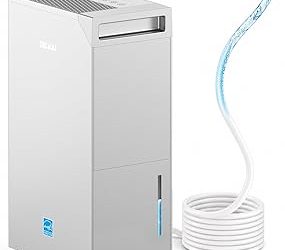
A well-executed freestanding steam unit with a 304 stainless heater and no filters to replace, which spares you both cartridge costs and the musty smell neglected wicks develop. The warm mist and clean, dust-free output make it a sensible choice for a nursery or a primary bedroom where you want vapor you can trust.
Y&O 10L Steam Humidifier (1200ml/h)
The higher-output configuration of the same platform, moving up to 1200ml per hour for rooms that lose moisture fast — think large primary suites, converted attics, or spaces with tall ceilings. If your hygrometer barely budges with a standard unit, this is the version to buy.
Lacidoll 16L Cool Mist Humidifier
At 16 liters, this ultrasonic model runs multiple nights between fills and covers around 1500 square feet, with an extension tube that lifts mist above furniture level and a night light that won’t wreck your dark adaptation. It is quiet, inexpensive to run, and best paired with distilled water and a weekly rinse to keep mineral dust in check.
Frequently Asked Questions
What humidity level is best for sleep?
Aim for 40–50% relative humidity. Below 30% airways dry out and snoring worsens; above 60% you risk dust mite proliferation, condensation, and mold — all of which undermine sleep in a different way.
Do steam humidifiers really eliminate white dust?
Largely, yes. Boiling leaves minerals behind in the reservoir rather than aerosolizing them, so you get clean vapor and a scale ring to descale periodically instead of a film on your furniture.
Is a warm mist humidifier safe in a bedroom?
Modern steam units are well insulated and shut off when tipped or emptied, but they do hold hot water. Place them on a stable surface away from bedding, cords, and the reach of small children.
How often should I clean it?
Rinse the tank weekly and descale monthly with a vinegar solution, more often with hard water. A neglected humidifier can aerosolize what’s growing inside it, which is worse for sleep and health than dry air.
Final Thoughts
If your home has ductwork, the AprilAire 800 remains the most complete answer — silent, automatic, and genuinely whole-house. Ductless homes should look to the AprilAire 865 for comparable coverage, while renters and single-room sleepers will get most of the benefit from the Y&O 10L steam unit at a fraction of the installation hassle.