Key takeaways
- Noise floor, not just “quiet”: Look for a published decibel figure. Anything at or under 30 dB sits below the threshold that reliably triggers cortical arousals, meaning the heater won’t pull you out of deep sleep when it cycles on. Models rated 34 dB are fine for offices and light sleepers who use white noise, but the 25 dB tower is the one I recommend for anyone who wakes easily.
- Thermostat precision over wattage: Every unit here draws the same 1500W ceiling, so raw power isn’t the differentiator. What matters is how tightly the thermostat holds your target. A heater that overshoots by four degrees will have you kicking off the duvet at 2 a.m.; a precise one paired with ECO mode maintains a flat curve all night.
- Oscillation matched to room size: A 70° sweep distributes heat well across a standard 150–250 sq ft bedroom. For open-plan spaces, great rooms, or long bedrooms where the bed sits far from an outlet, step up to 120° oscillation so you aren’t creating a hot zone at one end and a cold pocket at the other.
- Timer and remote from bed: A 12-hour programmable timer lets you pre-warm the room before bedtime and taper off in the early hours, mimicking the natural nocturnal temperature dip. A remote matters more than it sounds — getting up to adjust a dial means light exposure and full wakefulness you won’t easily recover from.
- Safety architecture for unattended hours: Overnight running is exactly when protections earn their keep. Prioritize ETL certification plus multi-layer systems covering tip-over, overheat, and internal thermal cutoff. Ceramic PTC elements are inherently self-limiting, which is why I favor them over coil designs in bedrooms.
What's inside
Sleep science keeps circling back to one unglamorous variable: temperature. Your core body temperature needs to fall roughly one to two degrees Fahrenheit for sleep to begin and stay consolidated, which is why a room that runs cold at 3 a.m. and stuffy by 6 a.m. produces the fragmented, unrefreshing nights so many people blame on stress. The trouble is that most portable heaters are built for raw output, not for the quiet, stable, low-drama environment a sleeping body actually needs. They cycle loudly, glow like a dashboard, and overshoot the set point by several degrees before shutting off.
Dreo has become the default recommendation in my consultations because its heaters are engineered around the two specifications that matter most overnight: a genuinely low noise floor and thermostatic control tight enough to avoid temperature swings. This guide looks at the current Dreo lineup through a sleep-wellness lens — decibel ratings, oscillation behavior, ECO cycling, timer logic, and safety architecture — and matches each model to a specific room and sleeper profile, whether you’re heating a drafty primary bedroom, a nursery, or a home office you’d like to stop shivering in.
As an Amazon Associate we earn from qualifying purchases.


How to Choose a Dreo Space Heater (2026)
- Noise floor, not just “quiet”: Look for a published decibel figure. Anything at or under 30 dB sits below the threshold that reliably triggers cortical arousals, meaning the heater won’t pull you out of deep sleep when it cycles on. Models rated 34 dB are fine for offices and light sleepers who use white noise, but the 25 dB tower is the one I recommend for anyone who wakes easily.
- Thermostat precision over wattage: Every unit here draws the same 1500W ceiling, so raw power isn’t the differentiator. What matters is how tightly the thermostat holds your target. A heater that overshoots by four degrees will have you kicking off the duvet at 2 a.m.; a precise one paired with ECO mode maintains a flat curve all night.
- Oscillation matched to room size: A 70° sweep distributes heat well across a standard 150–250 sq ft bedroom. For open-plan spaces, great rooms, or long bedrooms where the bed sits far from an outlet, step up to 120° oscillation so you aren’t creating a hot zone at one end and a cold pocket at the other.
- Timer and remote from bed: A 12-hour programmable timer lets you pre-warm the room before bedtime and taper off in the early hours, mimicking the natural nocturnal temperature dip. A remote matters more than it sounds — getting up to adjust a dial means light exposure and full wakefulness you won’t easily recover from.
- Safety architecture for unattended hours: Overnight running is exactly when protections earn their keep. Prioritize ETL certification plus multi-layer systems covering tip-over, overheat, and internal thermal cutoff. Ceramic PTC elements are inherently self-limiting, which is why I favor them over coil designs in bedrooms.
The Best Dreo Space Heaters (2026) Reviewed
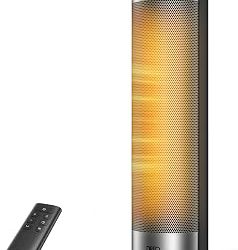
Dreo 30″ Tower Heater, 120° Oscillation
At a claimed 25 dB, this is the quietest unit Dreo makes and my first recommendation for sensitive sleepers and nurseries. The 30-inch column plus 120° sweep moves warm air across large or awkwardly shaped rooms without the concentrated blast that dries out sinuses, and five heat levels give you finer control than the usual high/low toggle.
Dreo Space Heater with 70° Oscillation and 5 Modes
The most balanced pick for a standard bedroom: precise thermostat, ECO cycling, 12-hour timer, and five modes that let you dial in a genuinely stable set point rather than approximating it. It’s the model I suggest when someone wants one heater to handle both a bedroom and a home office.
Dreo Space Heater for Large Rooms, ETL-Certified
Built for square footage — fast ramp-up, quiet steady-state operation, and 70° oscillation that keeps a wide space even rather than stratified. Ideal for a chilly primary bedroom or a converted attic where you need warmth to reach the bed from across the room.
Dreo 34 dB Portable Heater, Black
A compact, remote-controlled PTC ceramic unit with adjustable thermostat and 12-hour timer. At 34 dB it’s whisper-adjacent rather than truly silent, making it a strong value choice for offices, guest rooms, and anyone who already sleeps with a fan or sound machine.
Dreo 8-Protection Silver Tower Heater
The safety-first option, layering eight protection systems onto a quiet ceramic tower with thermostat, remote, and ECO mode. Worth the premium if the heater will run unattended overnight or share a room with pets or children.
Frequently Asked Questions
What temperature should I set for the best sleep?
Most adults sleep best between 65 and 68°F. Set the thermostat toward the lower end and let bedding provide insulation — a cool room with warm covers supports the core temperature drop far better than a uniformly warm room.
Is it safe to run a space heater all night?
With an ETL-certified ceramic unit featuring tip-over and overheat protection, yes — placed on a hard, level surface at least three feet from bedding, curtains, and furniture. Plug it directly into a wall outlet, never an extension cord or power strip.
Does ECO mode actually help overnight?
Considerably. ECO cycles the element to hold your set point instead of running at full output, which flattens temperature swings, reduces the audible on-off contrast that wakes light sleepers, and cuts electricity use.
Will a heater dry out the air and irritate my throat?
Any heater lowers relative humidity. Aim the unit away from your face, use the lowest heat setting that maintains your target, and pair it with a humidifier if you wake with a dry throat or congestion.
Final Thoughts
If sleep quality is your priority, the 30-inch Dreo tower with 120° oscillation and its 25 dB rating is the clearest choice — it disappears acoustically while heating a full room evenly. For most standard bedrooms, the 70° oscillating model with five modes and a 12-hour timer delivers the same thermostatic precision in a smaller footprint, and the 8-protection silver tower is the one I’d pick for a nursery or any room where a heater runs unattended until morning.