Key takeaways
- Reach versus room: Measure floor to blade, then subtract your own comfortable overhead grip — roughly 6.5 feet for most adults. A standard 9-foot bedroom needs very little pole; vaulted primary suites and stairwell fixtures are where 20 to 26 feet earns its keep.
- Blade-sleeve versus flat pad: A U-shaped sleeve that slides over the blade cleans top and bottom in a single pass and traps debris inside the fibres. Flat pads only reach one face and tend to push dust off the edge — bad news directly above a pillow.
- Pole rigidity: Long telescoping poles flex. Look for locking collars rather than friction twist-locks, and accept that the last two extended sections of any 24-foot pole will wobble. Aluminium beats plastic-jointed steel for weight-to-stiffness.
- Washable, not disposable: Microfiber heads should survive dozens of machine washes on cold with no fabric softener. Softener coats the fibres and destroys the electrostatic grab that makes microfiber work in the first place.
- Pivoting head: A head that locks at multiple angles lets you match blade pitch and reach cornices, sloped ceilings, and the top edge of a wardrobe without contorting your shoulders.
What's inside
Dust doesn’t stay on your ceiling fan. Every time those blades spin up, whatever has settled on the leading edge gets flung into the air you spend seven or eight hours breathing each night. As a sleep-wellness practitioner, I see the downstream effects constantly: the 3 a.m. congestion, the dry throat, the person who swears their allergies are “worse in bed” and assumes it’s the mattress. Often it’s the four grey felt strips circling above them at head height, undisturbed since the last time someone dragged a chair over and gave up halfway.
The obstacle is almost never willingness — it’s access. Ladders are unpleasant, unstable on carpet, and genuinely dangerous over a bed frame or stairwell landing. An extension-pole duster removes the balance problem entirely, which means the job actually gets done monthly instead of annually. This guide covers six poles I’ve evaluated for reach, blade-wrapping design, and how well they handle sloped and vaulted bedroom ceilings, plus the specifications worth checking before you buy.
As an Amazon Associate we earn from qualifying purchases.



How to Choose a/an Ceiling Fan Duster With Extension Pole (2026)
- Reach versus room: Measure floor to blade, then subtract your own comfortable overhead grip — roughly 6.5 feet for most adults. A standard 9-foot bedroom needs very little pole; vaulted primary suites and stairwell fixtures are where 20 to 26 feet earns its keep.
- Blade-sleeve versus flat pad: A U-shaped sleeve that slides over the blade cleans top and bottom in a single pass and traps debris inside the fibres. Flat pads only reach one face and tend to push dust off the edge — bad news directly above a pillow.
- Pole rigidity: Long telescoping poles flex. Look for locking collars rather than friction twist-locks, and accept that the last two extended sections of any 24-foot pole will wobble. Aluminium beats plastic-jointed steel for weight-to-stiffness.
- Washable, not disposable: Microfiber heads should survive dozens of machine washes on cold with no fabric softener. Softener coats the fibres and destroys the electrostatic grab that makes microfiber work in the first place.
- Pivoting head: A head that locks at multiple angles lets you match blade pitch and reach cornices, sloped ceilings, and the top edge of a wardrobe without contorting your shoulders.
The Best Ceiling Fan Duster With Extension Pole (2026)s Reviewed
Eunice 13–50 Inch Ceiling Fan Duster
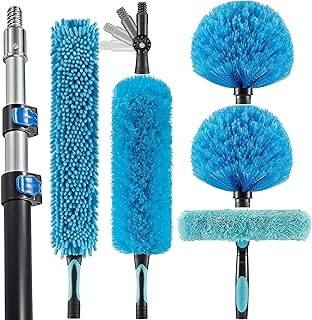
This is the one I recommend to most bedroom owners: a compact 13-to-50-inch pole with a sleeve-style microfiber head that grips both blade faces at once, so nothing showers down onto the bed. It lives in a nightstand drawer or closet corner, which matters more than any spec — a tool you can grab in ten seconds gets used.
20 Foot Cobweb Duster with 5–12ft Pole
A sensible middle option for two-storey entryways and lofted bedrooms, pairing a feather-style cobweb head with a squeegee for window work. The 5-to-12-foot range hits the sweet spot where the pole is still rigid enough to control precisely rather than whipping around above your head.
LAANPOLE 26FT High Reach Duster Cleaning Kit
The most versatile kit here, bundling a microfiber feather duster and window squeegee onto a 26-foot pole — genuinely useful if you have clerestory windows in a bedroom that need seasonal attention. Extend it fully and you’ll want two hands and slow movements, but for cobwebs in vaulted apexes nothing else in this list reaches.
LAANPOLE 26FT Ceiling Fan Cleaner Duster
Same reach as the kit above but purpose-built for blades, with a replaceable cleaning cloth over the microfiber head that you can strip off and wash separately. The 5-to-20-foot working range covers almost every residential ceiling, and the fan-specific head shape is noticeably better at hugging blade contours than a generic duster.
SISUPASSIE 30FT Reach High Ceiling Duster Kit
The longest reach on test, with a 5-to-24-foot pole, rotatable squeegee, feather duster, and cobweb head — built for double-height great rooms and stairwell fixtures. Overkill for a standard bedroom, but if you’ve been avoiding one specific unreachable fan for years, this is the tool that finally settles it.
Frequently Asked Questions
How often should I dust a bedroom ceiling fan?
Every two to four weeks during months the fan runs nightly, and once a season otherwise. Visible fuzz on the blade edge means you’re already past due and redistributing that material every time you switch on.
Does a dusty fan really affect sleep?
Indirectly, yes. Fan blades accumulate settled dust containing skin cells, textile fibres, and dust-mite allergen, and airflow lifts it into your breathing zone. For anyone with rhinitis or asthma, that translates to nasal congestion, mouth-breathing, and more fragmented sleep.
Should the fan be off while I clean it?
Always — switch it off at the wall and let the blades come to a complete stop. A pole caught by a moving blade can jerk hard enough to strain a shoulder or damage the motor housing.
How do I keep the microfiber working?
Shake the head out into a bin bag rather than the room, then machine wash cold with detergent only. Skip fabric softener and dryer sheets, and air-dry to preserve the fibre split that gives microfiber its dust-grabbing charge.
Final Thoughts
For most bedrooms, the Eunice 13–50 inch duster is the practical winner — short, stiff, sleeve-headed, and easy enough to store that monthly cleaning actually happens. If your fan sits above a vaulted or double-height space, the LAANPOLE 26FT Ceiling Fan Cleaner Duster offers the best blade-specific design at real height, while the SISUPASSIE 30FT kit is the one to choose when nothing shorter has ever reached.