Key takeaways
- Measured noise, not marketing noise: Look for a published decibel figure at low speed — anything at or under about 25 dB reads as ambient rather than intrusive. Vague claims of “whisper quiet” with no number attached usually mean an AC motor with a detectable hum.
- DC motor and low-speed range: DC motors draw less power, run cooler, and — critically — offer more usable speeds at the bottom of the scale. Six speeds is workable; ten or more means you can find true drift instead of choosing between stuffy and windy.
- Tunable white light, ideally 2700K to 6000K: A single fixed color temperature is a compromise you’ll feel at both ends of the day. Warm amber below 3000K in the evening protects melatonin onset; cooler light in the morning helps anchor your wake time.
- Reverse mode and ceiling height: Winter reversal pushes trapped warm air down and keeps heating bills honest. For ceilings under nine feet, choose a low-profile or flush-mount design and check the downrod length before you buy.
- Automation that’s genuinely hands-off: Timers, sunrise and sunset triggers, and app scheduling matter more than voice control. The goal is a fan that dials itself down at 4 a.m. without waking you to ask permission.
What's inside
Most people shop for a ceiling fan the way they shop for a lightbulb — by looking at the ceiling, not at the bed underneath it. That’s backwards. As a sleep-wellness consultant, I spend a lot of time in client bedrooms with a decibel meter and a thermometer, and the pattern is remarkably consistent: the room is a degree or two too warm, the air is still, and the fixture overhead either hums at a pitch that keeps the nervous system on alert or floods the space with 5000K light at 10 p.m. Any one of those will fragment sleep. Together, they quietly cost people an hour of good rest a night.
A well-chosen smart fan solves all three at once. Core body temperature needs to drop roughly one degree to initiate sleep, and gentle air movement accelerates that drop without forcing you to overcool the whole house. Add a schedule that steps the fan down before dawn and lighting that shifts warm after sunset, and you’ve built a bedroom that supports your circadian rhythm instead of fighting it. Below, I’ve assessed the 2026 field on the criteria that actually matter for rest — measured noise, motor type, color temperature range, and how gracefully the automation behaves when you’re half asleep.
As an Amazon Associate we earn from qualifying purchases.


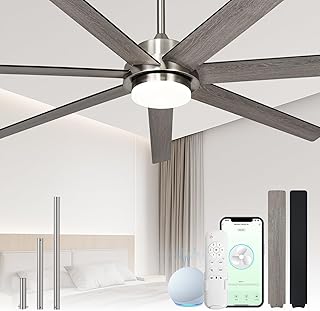
How to Choose a Smart Ceiling Fan With Light (2026)
- Measured noise, not marketing noise: Look for a published decibel figure at low speed — anything at or under about 25 dB reads as ambient rather than intrusive. Vague claims of “whisper quiet” with no number attached usually mean an AC motor with a detectable hum.
- DC motor and low-speed range: DC motors draw less power, run cooler, and — critically — offer more usable speeds at the bottom of the scale. Six speeds is workable; ten or more means you can find true drift instead of choosing between stuffy and windy.
- Tunable white light, ideally 2700K to 6000K: A single fixed color temperature is a compromise you’ll feel at both ends of the day. Warm amber below 3000K in the evening protects melatonin onset; cooler light in the morning helps anchor your wake time.
- Reverse mode and ceiling height: Winter reversal pushes trapped warm air down and keeps heating bills honest. For ceilings under nine feet, choose a low-profile or flush-mount design and check the downrod length before you buy.
- Automation that’s genuinely hands-off: Timers, sunrise and sunset triggers, and app scheduling matter more than voice control. The goal is a fan that dials itself down at 4 a.m. without waking you to ask permission.
The Best Smart Ceiling Fans With Lights, Reviewed
DREO 52″ Smart Ceiling Fan, Black
This is my default bedroom recommendation: twelve stepless speeds and a 22 dB DC motor give you the fine-grained low-end control that sleep actually requires, and the dimmable LED plus timer covers the wind-down routine without a separate smart bulb. The black finish reads as intentional in a modern room rather than as a compromise.
DREO 52″ Smart Ceiling Fan with RGBIC Light, White
Mechanically the same excellent platform, but the RGBIC light layer earns its place in a shared bedroom or a teenager’s room where a dim amber accent glow is more useful than a full ceiling light at midnight. Three fan modes — including a natural-breeze pattern — help if steady airflow feels artificial to you.
Sofucor 52″ Smart Ceiling Fan, Brown
The strongest value pick, pairing a reversible DC motor with six speeds and genuine 3CCT switching, so you can drop to warm white in the evening. The five ABS blades in a woodgrain-style brown suit farmhouse and transitional rooms where a glossy white fan would look out of place.
DREO Low-Profile 52″ Smart Fan with RGB Ambient Light
Built for the eight-foot ceilings most bedrooms and finished basements actually have — you get full 52-inch blade span without losing headroom. Color tuning plus a separate RGB ambient channel makes it a strong fit for a room that has to serve as both a sleep space and a hangout.
Minislak 65″ Large Smart Ceiling Fan
For open-plan great rooms, primary suites over roughly 400 square feet, or a covered patio, the 65-inch span moves air at low RPM instead of resorting to high speed — which is exactly why it stays quiet. Wi-Fi and Alexa control are built in, and it handles indoor and outdoor installation.
Frequently Asked Questions
Is sleeping with a fan on actually good for you?
For most people, yes — the airflow supports the overnight drop in core temperature that sleep depends on, and the steady sound masks disruptive noise from outside. If you wake with a dry throat or stiff neck, aim the airflow across the room rather than directly at the bed and drop a speed.
What color temperature should a bedroom fan light be?
Use 2700K to 3000K in the two to three hours before bed, and reserve 4000K or higher for morning and task lighting. That’s the main argument for a 3CCT or fully tunable fixture over a fixed-temperature one.
Do I need neutral wiring or a smart switch?
These fans control themselves over Wi-Fi, so no smart switch is needed — but the wall switch must stay powered on for the app and voice control to work. Standard fan-rated ceiling boxes are required; if yours is rated for light fixtures only, have it replaced.
How large should the fan be for my room?
As a rough guide: 44 to 52 inches for rooms up to about 225 square feet, 52 to 60 inches up to 400, and 60 inches or more beyond that. Oversizing slightly is better than undersizing, since a large fan on a low setting is quieter than a small one working hard.
Final Thoughts
If you want one fan that reliably improves how you sleep, the DREO 52″ in black is the pick — twelve stepless speeds and a verified 22 dB floor are the specifications that matter after lights out. Choose the DREO low-profile RGB model if your ceilings sit at eight feet or the room does double duty, and step up to the Minislak 65″ for great rooms and patios where a smaller fan would have to work too hard to be quiet. Budget-focused buyers give up very little with the Sofucor 52″, which still delivers a DC motor, reversal, and true color-temperature switching.