Key takeaways
- Motor type: DC motors draw roughly 60–70% less power than AC equivalents and, more importantly for sleepers, run without the low-frequency hum that AC windings produce. If the listing doesn’t say DC, assume it isn’t.
- Lowest usable speed: Six-speed fans matter less for their top end than their bottom. You want speed one to move air perceptibly across the bed without creating the dry-eye, dry-throat draft that wakes people at 4 a.m.
- Color temperature control: Look for 3CCT switching (roughly 3000K/4000K/5000K). The 3000K setting is your evening mode — warm enough not to suppress melatonin an hour before bed, while the cooler settings handle daytime tasks.
- Dimming depth: “Dimmable” is nearly meaningless without a floor. Fans that bottom out around 10% output double as a night light; those that stop at 40% will feel glaring in a dark room.
- Downrod and blade pitch: Aim for blades 8–9 feet off the floor and a pitch of 12–15 degrees. Flush-mounting a fan against a low ceiling kills airflow efficiency and forces you onto higher, louder speeds.
What's inside
Sleep quality lives or dies on the details most shoppers overlook, and airflow is one of the biggest. Core body temperature has to drop roughly a degree for you to fall asleep and stay there, which is why a gently moving room outperforms a still one almost every time. The trouble is that the average 48-inch fan sold today asks you to choose: either you get real air movement and a motor that hums all night, or you get silence and lighting so harsh it undoes your evening wind-down in about four seconds.
This guide looks at 48-inch ceiling fans with integrated lighting through a sleep-wellness lens — motor acoustics, low-end speed control, color temperature range, and how dim the light will actually go before bed. Forty-eight inches is the sweet spot for rooms in the 175 to 250 square foot range, which covers most primary bedrooms, nurseries, and mid-size living rooms. Below are the models worth your money in 2026, plus the specs that matter and the marketing noise you can safely ignore.
As an Amazon Associate we earn from qualifying purchases.


How to Choose a 48 Inch Ceiling Fan With Light (2026)
- Motor type: DC motors draw roughly 60–70% less power than AC equivalents and, more importantly for sleepers, run without the low-frequency hum that AC windings produce. If the listing doesn’t say DC, assume it isn’t.
- Lowest usable speed: Six-speed fans matter less for their top end than their bottom. You want speed one to move air perceptibly across the bed without creating the dry-eye, dry-throat draft that wakes people at 4 a.m.
- Color temperature control: Look for 3CCT switching (roughly 3000K/4000K/5000K). The 3000K setting is your evening mode — warm enough not to suppress melatonin an hour before bed, while the cooler settings handle daytime tasks.
- Dimming depth: “Dimmable” is nearly meaningless without a floor. Fans that bottom out around 10% output double as a night light; those that stop at 40% will feel glaring in a dark room.
- Downrod and blade pitch: Aim for blades 8–9 feet off the floor and a pitch of 12–15 degrees. Flush-mounting a fan against a low ceiling kills airflow efficiency and forces you onto higher, louder speeds.
The Best 48 Inch Ceiling Fan With Light (2026)s Reviewed
YUHAO 48″ Brushed Nickel DC Fan
This is the most sleep-friendly configuration on the list: a genuinely quiet DC motor, six speeds with a soft bottom end, 3CCT switching, and dimming that goes low enough to leave on during a bedtime routine. The damp-rated ETL listing also makes it a legitimate option for a covered porch or sleeping sunroom.
Honeywell Carmel Modern 48″
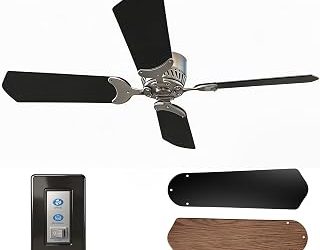
The Carmel is the pragmatic pick — a five-blade, reversible fan from a brand with a real service network, offered in gray oak or chestnut blade finishes that suit transitional bedrooms. It’s an AC motor, so expect a faint hum at higher speeds, but the low settings are quiet and the LED module is warm and even.
Fanbulous 48″ Black DC Fan
A near-twin to the YUHAO on paper — DC motor, six speeds, adjustable 3CCT LED — but in a matte black finish that disappears against dark ceilings and modern trim. Strong value for a secondary bedroom, kitchen, or home office where you want the same quiet performance without a second premium purchase.
48″ Retractable Fandelier (Brushed Nickel)
Retractable blades tuck away when the fan is off, so it reads as a light fixture by day and a fan at night — useful in bedrooms where a traditional fan looks utilitarian. The app control and timer are the real sleep features here, letting you taper speed and brightness on a schedule instead of waking up to reach for a remote.
Fanbulous 48″ Farmhouse Caged 2-Light
The caged, dual-finish design in black and walnut is the aesthetic outlier, and its two-light configuration throws more directional light than a flush LED panel — better for reading, slightly less ideal for pure ambient softness. The DC motor keeps it quiet despite the heavier styling.
Frequently Asked Questions
Is 48 inches big enough for a primary bedroom?
For rooms up to about 250 square feet, yes. Beyond that you’ll be running the fan harder than necessary, which adds noise — step up to 52 inches or add a second fan instead.
Does sleeping with a ceiling fan on cause problems?
It can dry out sinuses and eyes and stiffen muscles if the airflow blows directly on you. Use the lowest speed, aim for indirect circulation rather than a direct draft, and consider a bedside humidifier in winter.
Which direction should the blades turn at night?
Counterclockwise in warm months to push air down and create a cooling effect. Reverse to clockwise in winter to pull air up and redistribute warm air from the ceiling without a draft.
Can I use a smart dimmer with these fans?
Generally no. Integrated LED fans with remote or app control have their own onboard dimming circuitry, and adding a wall dimmer typically causes flicker or receiver failure. Use the supplied controls or a smart switch that only cuts power.
Final Thoughts
If your priority is uninterrupted sleep, the YUHAO 48″ Brushed Nickel is the one to buy — quiet DC motor, deep dimming, and 3CCT lighting that adapts from morning to bedtime. The Fanbulous 48″ Black delivers nearly the same experience for less in secondary rooms, while the Honeywell Carmel is the safest choice for anyone who values brand support and finish options over squeezing out the last decibel.