Key takeaways
- Match BTU to square footage, not ambition: Roughly 20 BTU per square foot is the working baseline. Oversizing feels clever until the unit blasts cold air, satisfies the thermostat in four minutes, shuts off, and leaves the room clammy — short-cycling removes temperature but not humidity, which is exactly backward for sleep.
- Treat noise as a specification, not an afterthought: Anything above the low 50s in decibels will register during light sleep stages. Look for multi-speed fans so you can run the unit at its quietest setting overnight, and favor designs that decouple the compressor from the interior half of the chassis.
- Prioritize thermostat behavior over feature lists: Electronic controls with a genuine setpoint hold temperature far more steadily than a mechanical dial, and that stability matters more to overnight comfort than any number of preset modes.
- Check the window opening before you check the price: Measure width, sash height, and sill depth. U-shaped units need a sash that closes down into the middle of the frame; conventional chassis need adequate exterior clearance and a sill that can bear the weight.
- Read the running cost, not just the purchase price: A modestly more expensive unit with a better efficiency rating and an eco or energy-saver mode typically repays the difference across a single cooling season, especially if it runs eight hours nightly.
What's inside
Sleep researchers have known for decades that core body temperature has to drop before deep sleep arrives, and a bedroom hovering in the high seventies quietly sabotages that process every single night. Yet most shoppers approach window air conditioners the way they approach a gallon of paint — grab the cheapest box that fits the opening and hope for the best. The result is a unit that runs loud, cycles hard, cools unevenly, and leaves you half-awake at 3 a.m. wondering why you feel worse than you did in June.
This guide reframes the search around value rather than raw sticker price: which window units deliver genuine cooling comfort, tolerable decibel levels, and honest energy draw for the money you actually spend. Below you’ll find a practical buying framework built around sleep quality and room size, followed by focused reviews of six units spanning 5,000 to 12,000 BTU — from compact bedroom coolers to a U-shaped design that keeps your window view intact.
As an Amazon Associate we earn from qualifying purchases.



How to Choose a Price For Window Air Conditioner (2026)
- Match BTU to square footage, not ambition: Roughly 20 BTU per square foot is the working baseline. Oversizing feels clever until the unit blasts cold air, satisfies the thermostat in four minutes, shuts off, and leaves the room clammy — short-cycling removes temperature but not humidity, which is exactly backward for sleep.
- Treat noise as a specification, not an afterthought: Anything above the low 50s in decibels will register during light sleep stages. Look for multi-speed fans so you can run the unit at its quietest setting overnight, and favor designs that decouple the compressor from the interior half of the chassis.
- Prioritize thermostat behavior over feature lists: Electronic controls with a genuine setpoint hold temperature far more steadily than a mechanical dial, and that stability matters more to overnight comfort than any number of preset modes.
- Check the window opening before you check the price: Measure width, sash height, and sill depth. U-shaped units need a sash that closes down into the middle of the frame; conventional chassis need adequate exterior clearance and a sill that can bear the weight.
- Read the running cost, not just the purchase price: A modestly more expensive unit with a better efficiency rating and an eco or energy-saver mode typically repays the difference across a single cooling season, especially if it runs eight hours nightly.
The Best Price For Window Air Conditioner (2026)s Reviewed
Frigidaire 5,000 BTU Window-Mounted Air Conditioner
For a small bedroom under 150 square feet, this is the sensible default: quiet at its lower fan speed, simple to set, and equipped with auto-restart so a brief power blip doesn’t leave you waking up overheated. The effortless temperature control holds a setpoint reliably, which is precisely what you want between midnight and dawn.
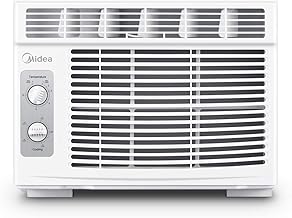
Midea 5,000 BTU EasyCool Window Air Conditioner
Mechanical controls are often dismissed, but they’re durable, intuitive in the dark, and immune to firmware quirks. Paired with a reusable filter that cuts long-term maintenance costs, this compact unit is a strong pick for a home office or guest room where simplicity beats sophistication.
Electactic 8,000 BTU Window AC Unit
The 350-square-foot rating and 6-in-1 mode set make this a flexible choice for a primary bedroom or open studio space. The 24-hour timer is the underrated feature here — programming a pre-sleep cool-down and a gentle overnight setback mirrors the natural temperature curve your body expects.
BLACK+DECKER 12,000 BTU Window Air Conditioner
At 550 square feet of coverage, this is the unit for large or sun-exposed rooms where smaller models simply cannot keep pace. Three cooling speeds plus a fan-only function give you meaningful control across shoulder seasons, and the remote spares you a trip across a dark room.
Tehanld 10,000 BTU U-Shaped Window Air Conditioner
The U-shaped chassis lets the window sash close between the compressor and the room, and the acoustic payoff is substantial — this is the quietest architecture available in a window unit. If light and view matter to you, the full-window visibility is a genuine quality-of-life upgrade over a conventional box.
Antarctic Star 8,000 BTU Window Air Conditioner
A capable mid-tier option covering 350 square feet with six operating modes and straightforward installation hardware. The energy-saving mode makes it a reasonable overnight companion for anyone cooling a single bedroom on a modest budget.
Frequently Asked Questions
What temperature is actually best for sleep?
Most sleep clinicians point to roughly 65–68°F for the bedroom, with individual variation. Rather than chasing a number, set your unit two degrees below where you currently sleep and adjust across a week.
Should I run the air conditioner all night?
Generally yes — a steady temperature prevents the 4 a.m. wake-ups caused by a room reheating. Use the lowest fan speed and an energy-saver or eco mode to keep consumption down.
Are U-shaped units worth the premium?
If noise sensitivity or window light is a priority, yes. They typically run noticeably quieter and preserve your view, though they require a window that closes properly onto the chassis.
How often should the filter be cleaned?
Every two to four weeks during heavy use. A clogged filter restricts airflow, raises energy draw, and degrades the air quality you’re breathing for eight hours a night.
Final Thoughts
For most bedrooms, the Tehanld U-shaped 10,000 BTU unit offers the best overall sleep experience thanks to its unusually quiet architecture and open-window design. Compact spaces are well served by the Frigidaire 5,000 BTU for its steady thermostat and auto-restart, while larger or west-facing rooms should step up to the BLACK+DECKER 12,000 BTU, which has the capacity to hold a comfortable setpoint through the hottest nights of the year.