Key takeaways
- Match sweep to square footage: Rooms over 400 sq ft need at least a 62-inch sweep; anything past 600 sq ft or with a ceiling above 10 feet calls for 72 to 84 inches. Undersizing is the single most common mistake, and no amount of speed compensates for it.
- Read CFM, not just blade count: Airflow volume tells you what a fan actually does. Look for 6,000+ CFM in large spaces, and treat eight-blade designs as an aesthetic and smoothness choice rather than an automatic airflow win.
- Insist on a DC motor: DC motors draw roughly 60–70% less power than AC equivalents, offer six or more genuinely distinct speeds, and — critically for bedrooms — run without the low-frequency hum that fragments light sleep.
- Check the color temperature options: Multi-CCT lighting matters more than people realize. A 5000K setting supports daytime alertness, while 2700K in the evening avoids suppressing melatonin. Dimmable warm-white capability is non-negotiable for any fan above a bed.
- Confirm the rating and downrod: Damp-rated housings are required for covered patios and sunrooms. On sloped or tall ceilings, plan for an extended downrod that lands the blades 8–9 feet above the floor for optimal circulation.
What's inside
Big rooms sabotage sleep and comfort in ways most people never diagnose. Vaulted great rooms, open-plan lofts, and oversized primary bedrooms stratify air: warm air pools near the ceiling while the floor stays clammy, and a standard 52-inch fan spins hard without ever moving that column of air. The result is the pattern I see constantly in sleep consultations — thermostats dropped to 66°F, energy bills climbing, and people still waking at 3 a.m. flushed and restless because the air above them is simply sitting still.
The fix is span, not speed. A properly sized 62- to 84-inch fan running on a low setting circulates far more air, far more quietly, than a small fan straining at maximum. This guide breaks down what actually matters when shopping for a large-room fan in 2026 — blade sweep versus CFM, DC motor acoustics, color temperature and its effect on melatonin timing — and reviews the models worth your money.
As an Amazon Associate we earn from qualifying purchases.


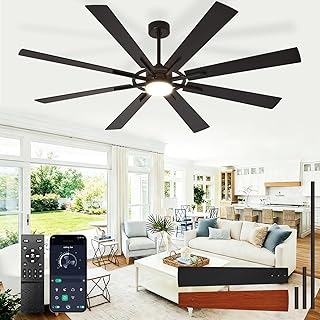
How to Choose a Ceiling Fan For Big Room (2026)
- Match sweep to square footage: Rooms over 400 sq ft need at least a 62-inch sweep; anything past 600 sq ft or with a ceiling above 10 feet calls for 72 to 84 inches. Undersizing is the single most common mistake, and no amount of speed compensates for it.
- Read CFM, not just blade count: Airflow volume tells you what a fan actually does. Look for 6,000+ CFM in large spaces, and treat eight-blade designs as an aesthetic and smoothness choice rather than an automatic airflow win.
- Insist on a DC motor: DC motors draw roughly 60–70% less power than AC equivalents, offer six or more genuinely distinct speeds, and — critically for bedrooms — run without the low-frequency hum that fragments light sleep.
- Check the color temperature options: Multi-CCT lighting matters more than people realize. A 5000K setting supports daytime alertness, while 2700K in the evening avoids suppressing melatonin. Dimmable warm-white capability is non-negotiable for any fan above a bed.
- Confirm the rating and downrod: Damp-rated housings are required for covered patios and sunrooms. On sloped or tall ceilings, plan for an extended downrod that lands the blades 8–9 feet above the floor for optimal circulation.
The Best Ceiling Fan For Big Room (2026)s Reviewed
ZMISHIBO 72″ Ceiling Fan with Lights
This is my default recommendation for open-plan living areas that connect to a covered porch, thanks to its damp rating and a dual-finish body that reads as intentional rather than utilitarian. The 24W 3-CCT LED and genuinely quiet DC motor make it equally viable over a seating area or a bed, and the airflow at mid-speed is enough to let you raise the thermostat several degrees.
62 Inch Large Ceiling Fan, Brushed Nickel
The most bedroom-appropriate fan on this list: brushed nickel finish, dual-color reversible blades, and a memory function that restores your last speed and color temperature without fumbling for the remote in the dark. At 62 inches it suits rooms in the 400–550 sq ft range where an 84-inch propeller would overwhelm the ceiling plane.
84 Inch Extra Large Fan, Deep Walnut
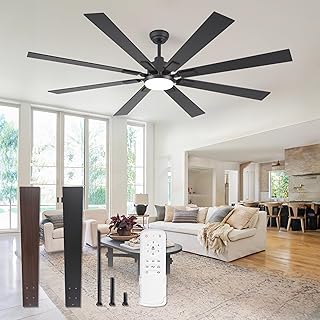
Three wood blades in deep walnut, no light kit, and a huge 84-inch sweep — this is the purist’s choice for a vaulted great room or a screened patio where lighting comes from elsewhere. Removing the LED assembly also removes a source of glare, which is a quiet advantage in any room you use to wind down.
ZMISHIBO 84 Inch, 8 Aluminum Blades
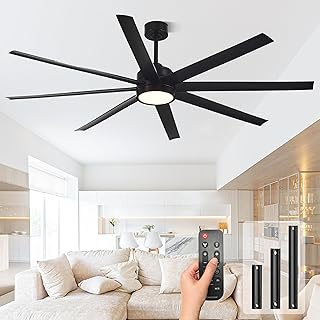
Industrial-grade construction with eight reversible aluminum blades makes this the workhorse pick for garages, shops, gazebos, and cathedral-ceiling rooms where you need to move serious volume. Six adjustable speeds mean it scales down gracefully; on setting one it is little more than a slow drift of air.
Modern 72 Inch Fan, 6CCT Dimmable
The standout here is the six-position color temperature control, which gives you finer evening dimming than the usual three-step systems — useful if you are deliberately managing light exposure before bed. Eight blades and a reversible DC motor make it a legitimate year-round fixture, pushing warm air down in winter.
Frequently Asked Questions
What size ceiling fan does a 20×20 room need?
A 400 sq ft room is right at the threshold where 62 inches becomes the minimum and 72 inches the better choice, particularly if the ceiling exceeds nine feet. Larger sweep at lower RPM is always the quieter, more comfortable solution.
Will a large ceiling fan keep me awake at night?
A quality DC-motor fan produces broadband air movement rather than mechanical noise, which most sleepers find masking and neutral. Problems almost always trace back to loose blade screws, an inadequate mounting box, or a wobble — not the fan’s size.
Can one fan cool an open-plan space?
Often yes, if the sweep is generous and the mount is centered over the primary living zone. Long galley-shaped rooms and L-shaped layouts are the exception; there, two coordinated fans outperform one oversized unit.
Should the fan run clockwise or counterclockwise?
Counterclockwise in summer, to push air down and create a cooling draft. Reverse to clockwise on low in winter to pull the warm ceiling layer down the walls without a perceptible breeze — a meaningful comfort gain in tall rooms.
Final Thoughts
For most large living rooms, the ZMISHIBO 72″ with its damp rating and 3-CCT lighting hits the best balance of airflow, acoustics, and versatility. Choose the 62 Inch Brushed Nickel if the fan is going over a bed and you want memory-function convenience with a more restrained footprint, and step up to the ZMISHIBO 84 Inch eight-blade model when you are conditioning a truly cavernous room, shop, or vaulted patio.