Key takeaways
- Span before speed: Match blade diameter to the room, not the ceiling. Rooms over 400 square feet generally need 72 inches or more; a wider sweep moves the same volume of air at a lower RPM, which is quieter and gentler on sleep.
- Insist on a DC motor: DC motors draw roughly 60–70% less power than comparable AC units, run measurably quieter, and offer six or more speeds. That granularity matters at bedtime, when the difference between “pleasant” and “too much” is one notch.
- Judge the low setting, not the high: Ask what speed one feels like. A well-engineered large fan should produce a barely audible drift of air you can leave on for eight hours without waking up cold or hearing it work.
- Treat the light as a circadian tool: Selectable color temperature (3 CCT or 6 CCT) with true dimming lets you run cool white for daytime tasks and warm amber after sunset, avoiding the melatonin suppression that comes with bright blue-heavy light in the evening.
- Confirm mounting and rating: Verify your downrod length for sloped or vaulted ceilings, check that the box is fan-rated, and choose a damp-rated model for covered porches, sunrooms, or humid climates.
What's inside
Large rooms break most ceiling fans. A 52-inch fan that feels luxurious in a 12×12 bedroom simply cannot move air across 400 square feet — it stirs a column of air beneath itself and leaves the perimeter stagnant. If you sleep in a vaulted primary suite, or you’ve turned a great room into a den that doubles as a guest space, you’ve probably noticed the symptom before the cause: you’re comfortable directly under the fan and clammy everywhere else, so you push the speed up, and now the motor hum and blade wobble are louder than your white noise machine. That trade-off — coverage versus quiet — is the real problem, and it’s a solvable one.
I evaluate fans the way I evaluate mattresses and blackout curtains: by whether they support uninterrupted sleep and stable thermal comfort through the night. That means I weigh perceived airflow at low speeds far more heavily than headline CFM at full tilt, and I treat motor noise, light-temperature control, and remote usability as sleep-hygiene features rather than luxuries. Below are six large-span fans (72 to 84 inches) that earn their footprint, plus a buying framework you can apply to any model you find later.
As an Amazon Associate we earn from qualifying purchases.


How to Choose a Ceiling Fan For Large Room (2026)
- Span before speed: Match blade diameter to the room, not the ceiling. Rooms over 400 square feet generally need 72 inches or more; a wider sweep moves the same volume of air at a lower RPM, which is quieter and gentler on sleep.
- Insist on a DC motor: DC motors draw roughly 60–70% less power than comparable AC units, run measurably quieter, and offer six or more speeds. That granularity matters at bedtime, when the difference between “pleasant” and “too much” is one notch.
- Judge the low setting, not the high: Ask what speed one feels like. A well-engineered large fan should produce a barely audible drift of air you can leave on for eight hours without waking up cold or hearing it work.
- Treat the light as a circadian tool: Selectable color temperature (3 CCT or 6 CCT) with true dimming lets you run cool white for daytime tasks and warm amber after sunset, avoiding the melatonin suppression that comes with bright blue-heavy light in the evening.
- Confirm mounting and rating: Verify your downrod length for sloped or vaulted ceilings, check that the box is fan-rated, and choose a damp-rated model for covered porches, sunrooms, or humid climates.
The Best Ceiling Fans For Large Rooms (2026), Reviewed
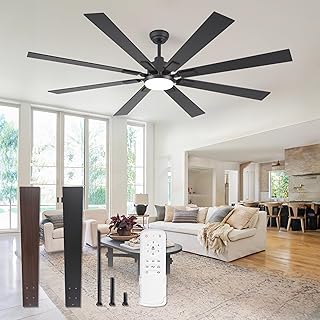
ZMISHIBO 72″ Ceiling Fan with Light, Dual-Finish Black
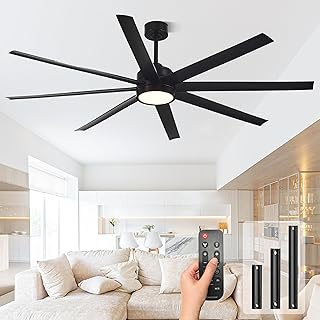
This is my default recommendation for a great room that shares walls with bedrooms: the DC motor stays unobtrusive through the mid speeds, and the 24W 3-CCT LED lets you drop to a warm tone in the evening without swapping bulbs. The dual-finish blades read as intentional design rather than hardware-store default, and damp rating widens where you can use it.
84″ Extra Large Ceiling Fan, No Light, Deep Walnut
If your lighting is already handled by lamps or recessed cans — the layered, low-glare setup I recommend for evening wind-down — a light-free fan is the cleaner choice. At 84 inches with three propeller-style wood blades, it delivers genuine edge-to-edge coverage in open-plan spaces, and the deep walnut finish warms up rooms that skew cool and modern.
ZMISHIBO 84″ Ceiling Fan, 8 Aluminum Reversible Blades
The most capable mover on this list, and the one I’d point toward for shops, garages, gazebos, or double-height living rooms where heat stratifies badly. Eight aluminum blades plus six speeds and reversible operation make it a legitimate year-round appliance, pushing warm ceiling air back down in winter.
72″ Modern Farmhouse Fan, 6 Solid Wood Blades
Solid wood blades and a dimmable fixture make this the most bedroom-appropriate option here, visually and acoustically. It’s the fan I’d hang over a bed in a vaulted primary suite: quiet at the speeds you’d actually sleep with, and handsome enough that you’re not designing around it.
72″ 8-Blade Fan with Remote and App Control
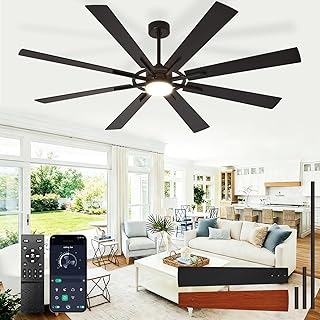
App control sounds like a gimmick until you’ve set a schedule that eases the fan down as the room cools overnight, which is exactly how I’d use it. Six DC speeds, reversible direction, and a dimmable black body make it a strong pick for anyone already running a connected bedroom.
Frequently Asked Questions
What size fan does a large room need?
For rooms above roughly 400 square feet, start at 72 inches; above 500 square feet or in open-plan spaces, 84 inches or two smaller fans will serve you better than one undersized unit pushed to maximum.
Is sleeping with a ceiling fan on bad for you?
For most people it’s beneficial — mild air movement supports the small drop in core temperature that helps you fall asleep. If you wake with a dry throat, congestion, or stiff shoulders, drop a speed or two rather than turning it off entirely.
How quiet is quiet enough?
Aim for a fan whose lowest two speeds produce steady, unvarying sound with no ticking, clicking, or rhythmic wobble. Constant broadband noise is easy for the brain to habituate to; intermittent noise is what fragments sleep.
Which way should the blades spin?
Counterclockwise in warm months to push air down and create a cooling breeze; clockwise on low in cold months to pull air up and redistribute trapped ceiling heat without a draft.
Final Thoughts
For most large living rooms and great rooms, the ZMISHIBO 72″ with its 3-CCT light is the best balance of coverage, quiet, and evening-friendly lighting. Choose the 72″ Modern Farmhouse with solid wood blades if the fan is going over a bed, and step up to the ZMISHIBO 84″ eight-blade model when you’re fighting a vaulted ceiling, a shop, or a genuinely oversized open plan.