Key takeaways
- Extraction rate vs. tent volume: A 2×2 or 4×4 tent with young plants may only shed a few ounces of water overnight, and a mini Peltier unit is plenty. A dense 4×4 in late flower under strong lights can release liters per day — that’s when you need something in the 10–12L/day class. Undersizing means the machine runs constantly and never wins; oversizing in a small tent risks over-drying and stressing leaf tissue.
- Noise output at night: Compressor units cycle loudest exactly when the lights are off and transpiration drops, which is often when you’re asleep nearby. Anything advertised under roughly 30dB sits below a whisper and won’t register as an arousal trigger; look for stated decibel figures rather than the word “quiet.”
- Humidistat and true auto-cycling: A manual on/off switch is a liability. You want a target RH you can set — ideally 45–55% for flower, higher for veg — with the unit cutting out on its own and restarting when it drifts. Sensor probes you can position at canopy height are far more accurate than a reading taken at the machine’s own intake.
- Drainage and tank access: Reaching into a zipped tent to empty a 35oz reservoir twice a day gets old fast. Either commit to continuous drainage through a gravity hose, or accept a small tank only if the unit shuts off safely and you’re checking it daily.
- Light discipline: Color-changing LED rings are charming in a bathroom and actively unhelpful in a tent, where stray light during dark hours can disrupt flowering — and, if the tent is in your bedroom, disrupt your own melatonin. Prioritize units whose lighting can be switched off entirely.
What's inside
Most people don’t think about a grow tent as a bedroom appliance, but if yours shares a wall with where you sleep — a spare room, a closet, a corner of the office-turned-nursery — it absolutely is one. As a sleep-wellness writer, I spend most of my time on the invisible variables: the 40dB hum that fragments your third sleep cycle, the swampy 65% humidity that makes a room feel airless at 3 a.m., the strip of LED light bleeding under a door. A grow tent quietly turns all three dials at once, and the dehumidifier you choose is the single component that pulls them back.
This guide is written for that overlap: growers who need genuine moisture control inside a sealed canopy, and who also need the room around it to stay habitable and restful. Below you’ll find the specifications that actually matter in an enclosed tent (as opposed to a basement), five units worth your attention in 2026 across small-cabinet and full-tent capacities, and answers to the questions that come up once the tent is running and the lights flip to their dark cycle.
As an Amazon Associate we earn from qualifying purchases.


How to Choose a Dehumidifier For Grow Tent (2026)
- Extraction rate vs. tent volume: A 2×2 or 4×4 tent with young plants may only shed a few ounces of water overnight, and a mini Peltier unit is plenty. A dense 4×4 in late flower under strong lights can release liters per day — that’s when you need something in the 10–12L/day class. Undersizing means the machine runs constantly and never wins; oversizing in a small tent risks over-drying and stressing leaf tissue.
- Noise output at night: Compressor units cycle loudest exactly when the lights are off and transpiration drops, which is often when you’re asleep nearby. Anything advertised under roughly 30dB sits below a whisper and won’t register as an arousal trigger; look for stated decibel figures rather than the word “quiet.”
- Humidistat and true auto-cycling: A manual on/off switch is a liability. You want a target RH you can set — ideally 45–55% for flower, higher for veg — with the unit cutting out on its own and restarting when it drifts. Sensor probes you can position at canopy height are far more accurate than a reading taken at the machine’s own intake.
- Drainage and tank access: Reaching into a zipped tent to empty a 35oz reservoir twice a day gets old fast. Either commit to continuous drainage through a gravity hose, or accept a small tank only if the unit shuts off safely and you’re checking it daily.
- Light discipline: Color-changing LED rings are charming in a bathroom and actively unhelpful in a tent, where stray light during dark hours can disrupt flowering — and, if the tent is in your bedroom, disrupt your own melatonin. Prioritize units whose lighting can be switched off entirely.
The Best Dehumidifier For Grow Tent (2026)s Reviewed
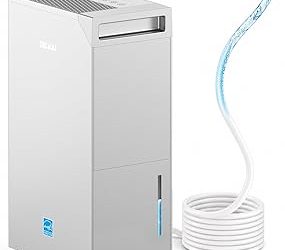
VIVOSUN AeroDrain D12 Smart Dehumidifier
This is the one to buy if your tent is a serious operation: 12L/day of extraction, an external sensor probe you can clip at canopy level, and app control that lets you check RH without unzipping anything or turning on a light. Auto-restart after a power blip is a genuinely underrated feature for anyone who’d rather not lie awake wondering whether the tent is still regulating itself.
Small Grow Tent Dehumidifier Kit for Confined Spaces
A neat semiconductor-based kit designed for genuinely sealed volumes — cabinets, safes, small tents — where a conventional dehumidifier would be absurd overkill. It’s slow by design, which is exactly right for maintaining a set point rather than fighting a flood, and it runs close to silent.
Grow Tent Dehumidifier with Smart Humidity Controller
The standout here is the external heating or cooling interface, which lets the controller coordinate more than one device from a single humidity reading. If you’re already running a heat mat or fan and want them responding to the same data, this is the tidiest way to consolidate.
Dehumidifier 1657ML for Rooms up to 230 Ft²
Better thought of as a room unit than a tent unit: the 1657ML tank, five timers and three modes make it a sensible choice for controlling the ambient air your tent draws from. Turn the ten-color light ring off before bed and it’s an unobtrusive overnight performer.
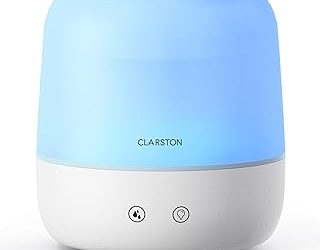
35 OZ Quiet Dehumidifier for Bedroom and RV
At a claimed 28dB, this is the quietest pick on the list and the one I’d put in a bedroom without hesitation. The 35oz tank is small, so treat it as maintenance for a compact tent or adjacent closet rather than a heavy-lifting solution.
Frequently Asked Questions
What humidity should I target inside a grow tent?
Broadly, 65–70% during early vegetative growth, tapering to 45–55% through flower, with the lower end helping to discourage bud rot in dense canopies. Set your humidistat to the stage you’re in rather than a single year-round number.
Will a dehumidifier in my bedroom affect my sleep?
Favorably, if it’s quiet and unlit. Sleep quality generally improves when relative humidity sits in the 40–60% band, since very damp air impairs evaporative cooling and your core temperature needs to fall to initiate sleep. The risk is mechanical noise and indicator lights, not the dehumidification itself.
Do mini Peltier dehumidifiers actually work?
Yes, within their limits. They extract modest amounts of water very quietly and use little power, which suits sealed cabinets and small tents. They struggle in cool rooms and in any space with meaningful air exchange, where a compressor unit is the honest answer.
Should I run it during the dark period?
Usually yes — transpiration drops but temperature does too, so relative humidity often spikes overnight and that’s precisely when mold takes hold. Let the humidistat decide, and choose hardware quiet enough that letting it run doesn’t cost you your own rest.
Final Thoughts
For most serious tents, the VIVOSUN AeroDrain D12 is the clear pick — the capacity, probe placement and app monitoring together mean you can leave it alone and sleep through the night. If your setup is a cabinet or compact tent, the small confined-space dehumidification kit does the job with almost no noise or power draw, and the 28dB 35oz unit is the one I’d choose for a tent sharing a room with your bed.