Key takeaways
- Blade span before anything else: Ceiling height multiplies the distance air must travel, so span does the heavy lifting. Budget 52–65 inches for rooms up to twelve feet, 72–84 inches for open-plan vaults, and 96 inches where the peak clears sixteen feet or the footprint exceeds 600 square feet.
- Downrod length, not just fan size: Aim to position blades eight to nine feet above the floor. A fan hugging a fifteen-foot peak stirs the attic air, not yours — most high-ceiling installs need a 24 to 60-inch downrod, sold separately more often than not.
- DC motor for nighttime acoustics: Direct-current motors run markedly quieter than AC equivalents and draw roughly 60–70% less power. For bedrooms, listen for a smooth low hum rather than a mechanical whir; broadband white noise helps sleep, while intermittent ticking or wobble fragments it.
- Reversibility and a real winter mode: Reverse rotation at low speed pushes trapped warm air down the walls without creating a draft. In a vaulted room this alone can even out a three-to-five degree vertical temperature split and cut heating runtime.
- Dimmable 3-CCT lighting: Fans doing double duty as the room’s main fixture should dim deeply and shift to 3000K in the evening. Cool 6000K light before bed suppresses melatonin; warm, low-lumen light late in the day protects sleep onset.
What's inside
Vaulted ceilings, lofted great rooms, and second-story landings all share the same flaw: the air up there rarely comes back down. Heat stratifies near the peak while the space you actually occupy — the sofa, the reading chair, the bed beneath the loft — sits in still, stagnant air. From a sleep-wellness standpoint that matters more than most buyers realize. Core body temperature has to fall roughly one to two degrees for sleep to initiate and consolidate, and a room with no meaningful air exchange makes that thermal drop slow and unreliable. The result is the familiar pattern of tossing for forty minutes, kicking off the duvet, then waking at 3 a.m. clammy and alert.
A standard 44-inch fan mounted eleven feet up simply cannot move enough air to solve this. What high ceilings demand is blade span, torque, and a downrod long enough to bring the airfoil into the occupied zone. This guide covers the large-span DC fans worth installing in 2026 — from 48-inch caged farmhouse models for moderate vaults up to 96-inch industrial spans for open shops and double-height living rooms — with an emphasis on airflow you can feel and motor noise quiet enough to sleep beneath.
As an Amazon Associate we earn from qualifying purchases.


How to Choose a Fan for High Ceilings (2026)
- Blade span before anything else: Ceiling height multiplies the distance air must travel, so span does the heavy lifting. Budget 52–65 inches for rooms up to twelve feet, 72–84 inches for open-plan vaults, and 96 inches where the peak clears sixteen feet or the footprint exceeds 600 square feet.
- Downrod length, not just fan size: Aim to position blades eight to nine feet above the floor. A fan hugging a fifteen-foot peak stirs the attic air, not yours — most high-ceiling installs need a 24 to 60-inch downrod, sold separately more often than not.
- DC motor for nighttime acoustics: Direct-current motors run markedly quieter than AC equivalents and draw roughly 60–70% less power. For bedrooms, listen for a smooth low hum rather than a mechanical whir; broadband white noise helps sleep, while intermittent ticking or wobble fragments it.
- Reversibility and a real winter mode: Reverse rotation at low speed pushes trapped warm air down the walls without creating a draft. In a vaulted room this alone can even out a three-to-five degree vertical temperature split and cut heating runtime.
- Dimmable 3-CCT lighting: Fans doing double duty as the room’s main fixture should dim deeply and shift to 3000K in the evening. Cool 6000K light before bed suppresses melatonin; warm, low-lumen light late in the day protects sleep onset.
The Best Fans for High Ceilings (2026), Reviewed
ZMISHIBO 72″ Ceiling Fan with Lights
This is the sweet spot for most vaulted living rooms and covered patios — enough span to genuinely circulate a large volume of air, paired with a quiet DC motor and 24W 3-CCT LED that dims low enough for evening use. The damp rating and dual-finish blades make it equally credible over a porch seating area as over a sectional.
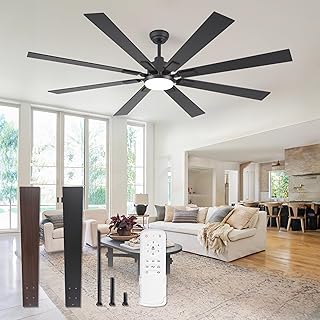
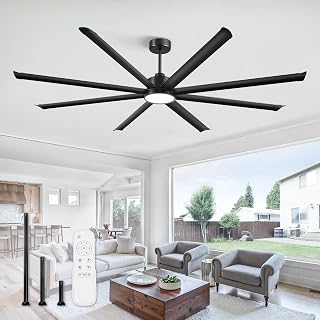
ZMISHIBO 96 Inch Ceiling Fan, 8 Aluminum Blades
An eight-foot span with reversible aluminum blades and industrial-grade torque, this is the answer for double-height great rooms, shops, gazebos, and garages where smaller fans just push air around uselessly. Six speeds mean you can run it barely-moving overnight and still have real force in reserve for August.
84 Inch Walnut/Black Ceiling Fan
A strong compromise between the 72 and 96-inch models, with the practical extras that matter for bedrooms: a sleep timer, memory function so it resumes your setting, and smooth 3-CCT dimming. The walnut-and-black finish reads warmer than typical large-span fans, which tend toward industrial.
Fanbulous 48″ Farmhouse Caged Ceiling Fan
For moderately raised or sloped ceilings where a 72-inch span would overwhelm the room, this caged two-light model delivers reversible DC airflow across six speeds without visual bulk. Pair it with a longer downrod and it performs well above what its compact span suggests.
ZMISHIBO 65″ Black 8-Blade Ceiling Fan
Eight blades on a 65-inch span produce a broad, soft column of air rather than a concentrated draft — ideal directly over a bed, where sharp airflow tends to dry the sinuses and wake light sleepers. The 3000–6000K dimmable light and reversible DC motor round out a genuinely versatile indoor-outdoor pick.
Frequently Asked Questions
How long should my downrod be?
Subtract nine feet from your ceiling height, then subtract the fan body’s own height (typically 10–12 inches). A twelve-foot ceiling usually calls for a 24-inch rod; sixteen feet or more often needs 48–60 inches.
Is sleeping with a ceiling fan on unhealthy?
For most people, no — it aids the thermal drop sleep depends on. If you wake with a dry throat or stiff neck, lower the speed or angle the airflow away from your head rather than switching it off entirely.
What about sloped or cathedral ceilings?
Confirm the canopy supports your pitch, as many are rated only to a certain angle. Steep vaults may require a sloped-ceiling adapter, and blades must clear the nearest wall by at least 18–24 inches.
Do I still need a fan if I have central air?
Yes. Air conditioning cools but does little to break up vertical stratification in tall rooms. Running a fan lets you raise the thermostat several degrees while feeling cooler, which lowers energy use.
Final Thoughts
For the majority of vaulted living rooms and covered patios, the ZMISHIBO 72″ is the most balanced choice — real airflow, quiet DC operation, and dimmable warm lighting that respects your evening wind-down. Scale up to the ZMISHIBO 96 Inch for double-height or commercial-size spaces, and choose the 65″ 8-blade model when the fan sits directly over a bed and you want broad, gentle circulation instead of a targeted draft.