Key takeaways
- Motor type: DC motors draw roughly 60–70% less power than AC equivalents and, more importantly for bedrooms, produce far less electromagnetic hum at low speeds. If you sleep in the room, treat a DC motor as non-negotiable rather than an upgrade.
- Speed granularity: Three speeds is rarely enough. Six-speed fans let you find the setting that produces air movement without perceptible noise — usually speed one or two — which is the setting you’ll actually leave on all night.
- Light temperature and dimming: Look for 3CCT switching (typically 3000K/4000K/5000K) plus genuine dimming. Warm, dim light in the two hours before bed supports melatonin onset; a fixed 5000K panel does the opposite.
- Blade span versus room size: A 42-inch fan suits rooms up to about 144 square feet; 52 inches covers most primary bedrooms and living rooms. Oversizing forces you to run higher speeds than necessary, which reintroduces noise.
- Mounting depth and clearance: Confirm total drop, not just “low profile.” Building code wants 7 feet from floor to blade, and true huggers typically hang 8–11 inches — verify before you buy if your ceiling is under 8 feet.
What's inside
Low ceilings create a specific kind of misery that most shoppers only discover after installation: a fan blade sweeping eight inches above your head, a light kit you duck around, and airflow that arrives as a stuttering wobble instead of a steady drift. Anyone who has slept beneath a downrod fan in a room with 7.5-foot ceilings knows the other half of the problem — the low hum and periodic ticking that your nervous system registers even when your conscious mind has stopped noticing. Sleep architecture is fragile in the second half of the night, and intermittent noise is one of the more reliable ways to fragment it.
Hugger fans — also sold as flush-mount or low-profile fans — solve the clearance issue by bolting the motor housing directly to the electrical box. The trade-off is aerodynamic: less space between blade and ceiling means the fan has to work harder to move the same volume of air. That’s why the current generation of DC-motor huggers matters so much. Below, I’ve assessed six flush-mount fans through the lens of what actually supports rest: sound floor at low speed, true dimming range on the light kit, color temperature control after dark, and whether the thing stays quiet after a year of duty cycles.
As an Amazon Associate we earn from qualifying purchases.




How to Choose a Hugger Ceiling Fan (2026)
- Motor type: DC motors draw roughly 60–70% less power than AC equivalents and, more importantly for bedrooms, produce far less electromagnetic hum at low speeds. If you sleep in the room, treat a DC motor as non-negotiable rather than an upgrade.
- Speed granularity: Three speeds is rarely enough. Six-speed fans let you find the setting that produces air movement without perceptible noise — usually speed one or two — which is the setting you’ll actually leave on all night.
- Light temperature and dimming: Look for 3CCT switching (typically 3000K/4000K/5000K) plus genuine dimming. Warm, dim light in the two hours before bed supports melatonin onset; a fixed 5000K panel does the opposite.
- Blade span versus room size: A 42-inch fan suits rooms up to about 144 square feet; 52 inches covers most primary bedrooms and living rooms. Oversizing forces you to run higher speeds than necessary, which reintroduces noise.
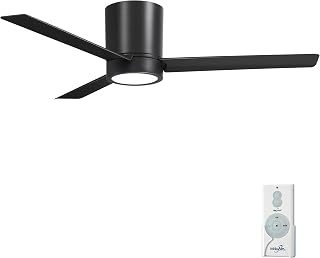
- Mounting depth and clearance: Confirm total drop, not just “low profile.” Building code wants 7 feet from floor to blade, and true huggers typically hang 8–11 inches — verify before you buy if your ceiling is under 8 feet.
The Best Hugger Ceiling Fans (2026) Reviewed
52″ Flush Mount Fan with 3CCT Dimmable LED and Reversible DC Motor
This is the most complete bedroom package here: six DC speeds with a genuinely quiet floor, three selectable color temperatures with dimming, and a reversible motor for winter recirculation. The wide 90–264V input also makes it usable in older homes and covered outdoor spaces where voltage can be inconsistent.
MINKA-AIRE Roto Flush 52″
The Roto Flush is the design-forward choice, with a genuinely engineered blade pitch rather than a stamped profile, and the Coal finish reads as architectural rather than builder-grade. Airflow at mid speed is noticeably stronger than budget huggers of the same diameter, though you’re paying for the engineering.
52″ Black Flush Mount Fan with App and Remote Control
App control sounds like a gimmick until you can schedule a step-down in fan speed for the early morning hours, when core body temperature begins rising and a full-blast fan becomes a wake-up trigger. The DC motor is quiet, the 3CCT light dims well, and the space-saving housing suits ceilings in the 7.5-foot range.
42″ Flush Mount Fan with 3CCT Dimmable LED
The right pick for smaller bedrooms, nurseries, and covered patios where a 52-inch span would overwhelm the space. It carries the same six-speed noiseless DC motor and ETL listing as its larger sibling, so you’re sacrificing coverage rather than quality.
LEDLUX 48″ Flush Mount Fan without Light
If your bedroom already has considered lighting — and for sleep purposes, dedicated warm lamps beat any ceiling panel — a fan without a light kit is the smarter buy. Four reversible blades, six DC speeds, and no LED driver means one fewer component to buzz or fail.
Design House Millbridge 52″ Satin Nickel
A straightforward traditional fan with a steel housing and satin nickel finish that suits transitional interiors. It uses a conventional motor rather than DC, so expect a slightly higher noise floor, but the value is hard to argue with.
Frequently Asked Questions
Is sleeping with a ceiling fan on actually healthy?
For most people, yes. Cooling the sleep environment supports the natural nocturnal drop in core temperature, and steady air movement provides broadband masking sound. The exceptions are people with dry eyes, significant allergies, or sinus sensitivity — a lower speed and a slightly humidified room usually resolves it.
How much clearance does a hugger fan need?
Blades should sit at least 7 feet above the floor and roughly 18 inches from any wall. Most huggers drop 8–11 inches from the ceiling, which keeps a 7.5-foot ceiling compliant.
Do hugger fans move less air than downrod fans?
Slightly, yes — proximity to the ceiling restricts intake. Modern DC motors and improved blade pitch have narrowed the gap considerably, but if you have the clearance for a downrod, take it.
Which direction should the fan turn?
Counterclockwise in summer, pushing air down for a wind-chill effect. Clockwise on low in winter, pulling air up to redistribute warm air trapped at the ceiling without creating a draft.
Final Thoughts
For a primary bedroom, the 52-inch flush mount with 3CCT dimmable LED and six-speed DC motor is the most complete sleep-friendly option here, and the app-controlled 52-inch black model earns its place if you want scheduled speed changes overnight. Choose the MINKA-AIRE Roto Flush when the fan needs to hold up visually in a living space — the airflow and build quality justify the step up.