Key takeaways
- Motor type: DC motors draw roughly 60–70% less power than older AC designs and, more importantly for sleepers, run at a lower and steadier noise floor. They also unlock six or more speeds, so you can find the setting that moves air without creating a draft you feel on your face all night.
- Light temperature control: Look for 3CCT or full-spectrum tuning. Warm light around 2700K in the evening supports natural melatonin release; cooler 5000K light is genuinely useful for morning dressing and cleaning. A single fixed color temperature forces you to pick one and live with the compromise.
- Dimming range: Check how low the LED actually goes, not just that it dims. Many fixtures bottom out at 20–30% brightness, which is still too bright for winding down. The best units drop to a low amber glow suitable for a 2 a.m. trip down the hall.
- Blade span versus room: A 52-inch fan suits bedrooms in the 225–400 square foot range. Under 150 square feet, drop to 34–44 inches to avoid over-circulating. Rooms above 400 square feet benefit from a 60-inch span so you get coverage at lower, quieter speeds.
- Mounting height and profile: Ceilings under eight feet call for a flush-mount or low-profile design. You want at least seven feet of clearance beneath the blades, and low-profile fans keep that margin without sacrificing airflow the way an undersized fan would.
What's inside
Sleep quality depends far more on your bedroom’s physical environment than most people realize, and airflow sits near the top of that list alongside darkness and quiet. The trouble is that most ceiling fans force an uncomfortable tradeoff: the ones that move enough air to keep your core temperature dropping through the night tend to hum, rattle, or wobble just enough to keep your nervous system on alert. Add a light kit that only offers one harsh color temperature, and you’ve built a fixture that actively works against your circadian rhythm at exactly the hour you need it working with you.
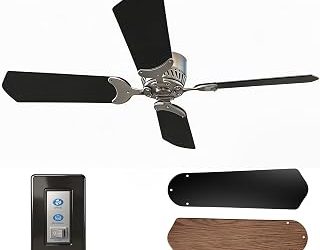
Wall control changes the equation. A hardwired wall unit means you’re not hunting for a remote in the dark or leaving your phone glowing on the nightstand — you set your speed and light level on the way into bed and you’re done. This guide looks at six fans that pair genuine wall control with dimmable, often tunable lighting and DC motors quiet enough to disappear into the background. I’ve evaluated each on noise floor, light quality across the evening, blade span versus room size, and how well the controls actually serve a bedtime routine rather than complicate it.
As an Amazon Associate we earn from qualifying purchases.

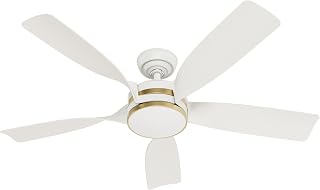


How to Choose a Ceiling Fan With Light And Wall Control (2026)
- Motor type: DC motors draw roughly 60–70% less power than older AC designs and, more importantly for sleepers, run at a lower and steadier noise floor. They also unlock six or more speeds, so you can find the setting that moves air without creating a draft you feel on your face all night.
- Light temperature control: Look for 3CCT or full-spectrum tuning. Warm light around 2700K in the evening supports natural melatonin release; cooler 5000K light is genuinely useful for morning dressing and cleaning. A single fixed color temperature forces you to pick one and live with the compromise.
- Dimming range: Check how low the LED actually goes, not just that it dims. Many fixtures bottom out at 20–30% brightness, which is still too bright for winding down. The best units drop to a low amber glow suitable for a 2 a.m. trip down the hall.
- Blade span versus room: A 52-inch fan suits bedrooms in the 225–400 square foot range. Under 150 square feet, drop to 34–44 inches to avoid over-circulating. Rooms above 400 square feet benefit from a 60-inch span so you get coverage at lower, quieter speeds.
- Mounting height and profile: Ceilings under eight feet call for a flush-mount or low-profile design. You want at least seven feet of clearance beneath the blades, and low-profile fans keep that margin without sacrificing airflow the way an undersized fan would.
The Best Ceiling Fan With Light And Wall Control (2026)s Reviewed
OJX 52″ Ceiling Fan with Light and App Control
The 3CCT lighting and app scheduling make this the most bedtime-friendly option here — you can program the light to shift warm as evening progresses without touching a switch. The reversible DC motor stays impressively quiet at low speeds, which is where you’ll leave it overnight.
Casablanca Julia 52″ Indoor/Outdoor Fan
Casablanca’s six-speed DC motor is the smoothest in this group, and the included wall control plus remote gives you redundancy that matters when a remote inevitably slides under the bed. Wet-rated construction and Energy Star certification make it equally at home in a sunroom or a humid bedroom.
52″ Solid Wood 3-Blade Walnut Fan
Real walnut blades give this fan a warmth that painted MDF can’t match, and the three-blade geometry cuts turbulence noise noticeably. Six speeds and full dimming cover the range from a barely-perceptible night breeze to serious summer circulation.
VONLUCE 60″ Farmhouse Fan
At 60 inches, this is the pick for large or vaulted primary bedrooms where a 52-inch fan would need to work too hard. The full-spectrum 3CCT light output is unusually pleasant, and dual remote plus wall control means every household member has a way to adjust it.
52″ Low Profile Flush Mount Wood Fan
Flush mounting makes this the answer for eight-foot ceilings where a downrod fan feels oppressive overhead. The DC motor runs quietly enough that the fan effectively vanishes, and the wall control switch keeps operation simple for guest rooms.
Frequently Asked Questions
Does sleeping with a ceiling fan on affect sleep quality?
Generally it helps. Your body needs a modest drop in core temperature to initiate and maintain sleep, and gentle air movement assists that. The caveat is direct airflow on your face, which can dry sinuses and cause morning congestion — angle the bed slightly off-center from the fan or use a lower speed.
Can I keep my existing wall switch?
Most of these fans include their own wall control unit that replaces the standard switch. Installation usually requires a single-gang box with a neutral wire present, which is standard in homes built after roughly 1985. Older wiring may need an electrician.
What light color temperature is best for a bedroom?
Choose 2700K–3000K for evening use. Blue-heavy light above 4000K within two hours of bedtime measurably suppresses melatonin, which is why 3CCT fixtures are worth the small premium — you get cooler light when you want it and warm light when it counts.
Should the fan reverse direction in winter?
Yes. Running clockwise at low speed pulls warm air down from the ceiling without creating a draft, which can make a cold bedroom feel usable at a lower thermostat setting. All the DC models here reverse from the control.
Final Thoughts
For most bedrooms, the Casablanca Julia is the safest investment — the motor is exceptionally quiet, the build quality justifies the price, and the dual wall-plus-remote control suits a real bedtime routine. If circadian-friendly lighting is your priority, the OJX 52″ with its 3CCT tuning and app scheduling does the most to support your sleep timing, while the VONLUCE 60″ is the clear choice for larger rooms that need coverage without noise.