Key takeaways
- Seat angle and adjustability: A forward tilt of roughly 20 to 30 degrees is the sweet spot — enough to open the hips without dumping weight onto your knees. Look for chairs that let you set both seat height and shin-pad height independently, since a fixed ratio rarely suits both short and long femurs.
- Shin support, not knee support: Pressure should land across the broad, padded surface of your shins, never on the kneecap itself. Wide, generously cushioned pads with moulded foam distribute load far better than thin slabs, and they’re the single biggest factor in whether you can sit for more than 40 minutes.
- Rocking versus static base: A rocking or curved base encourages micro-movement, which helps circulation and keeps you from freezing into one shape. If you write, sketch, or do fine detail work, a static base with brake casters gives you the stability to stay precise.
- Backrest or backless: Backless models train the postural muscles hardest and suit shorter, focused work blocks. If you’re building up tolerance gradually, easing back after an injury, or working long days, a model with a backrest gives you somewhere to unload without abandoning the open hip angle.
- Weight capacity and frame integrity: Kneeling chairs load their frames at unusual angles, so treat the stated capacity as meaningful rather than decorative. A 250-pound rating covers most users; heavier builds or anyone who shifts position frequently should look toward 300 pounds or more, and a multi-year warranty signals a manufacturer confident in its welds.
What's inside
Most posture problems don’t announce themselves at 3 p.m. — they announce themselves at 3 a.m. As someone who spends their days untangling why people can’t get comfortable in bed, I’ve learned that the eight hours before sleep quietly write the script for the eight hours after it. A desk chair that lets your pelvis roll backward and your ribs collapse forward for a full workday leaves the deep hip flexors shortened and the thoracic spine stiff, and those tissues don’t reset the moment you lie down. They keep tugging, which is why so many people describe “waking up more tired than when I went to bed.”
Kneeling chairs interest me for exactly that reason. By opening the hip angle and tipping the pelvis forward, they discourage the slumped posture that carries over into the night, and their subtle instability keeps the postural muscles lightly engaged instead of switched off. This guide covers what actually matters when you shop — seat angle, shin-pad geometry, rocking versus fixed bases, and weight capacity — followed by honest assessments of the standouts, including two conventional ergonomic chairs worth knowing about if a kneeling posture isn’t right for your body. My aim is simple: help you pick a chair that leaves your spine calmer by bedtime.
As an Amazon Associate we earn from qualifying purchases.


How to Choose an Ergonomic Kneeling Office Chair (2026)
- Seat angle and adjustability: A forward tilt of roughly 20 to 30 degrees is the sweet spot — enough to open the hips without dumping weight onto your knees. Look for chairs that let you set both seat height and shin-pad height independently, since a fixed ratio rarely suits both short and long femurs.
- Shin support, not knee support: Pressure should land across the broad, padded surface of your shins, never on the kneecap itself. Wide, generously cushioned pads with moulded foam distribute load far better than thin slabs, and they’re the single biggest factor in whether you can sit for more than 40 minutes.
- Rocking versus static base: A rocking or curved base encourages micro-movement, which helps circulation and keeps you from freezing into one shape. If you write, sketch, or do fine detail work, a static base with brake casters gives you the stability to stay precise.
- Backrest or backless: Backless models train the postural muscles hardest and suit shorter, focused work blocks. If you’re building up tolerance gradually, easing back after an injury, or working long days, a model with a backrest gives you somewhere to unload without abandoning the open hip angle.
- Weight capacity and frame integrity: Kneeling chairs load their frames at unusual angles, so treat the stated capacity as meaningful rather than decorative. A 250-pound rating covers most users; heavier builds or anyone who shifts position frequently should look toward 300 pounds or more, and a multi-year warranty signals a manufacturer confident in its welds.
The Best Ergonomic Kneeling Office Chairs (2026) Reviewed
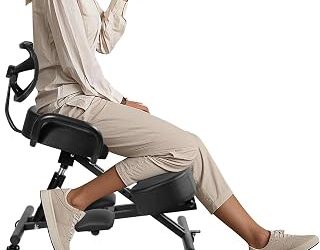
Ergonomic Kneeling Chair with Adjustable Seats
This is the most sensible starting point for anyone new to kneeling posture: independently adjustable seat and knee pads mean you can dial in the angle over weeks rather than committing to one geometry on day one. The 250-pound capacity and five-year warranty put it comfortably ahead of the disposable end of this category.
Varier Ergonomic Kneeling Chair
Varier essentially defined the rocking kneeling chair, and the backless design here does the most honest work for spinal endurance — you sit tall because the chair gives you no other option. Best suited to people who already have reasonable core awareness and want their sitting to be genuinely active.
Ergonomic Kneeling Chair with Angled Seat and Brake Casters
The thick moulded foam is the standout feature; it resists the flattening that makes cheaper cushions unbearable by month three, and brake casters let you roll to a filing cabinet then lock down for focused work. A strong pick if shin pressure has driven you away from kneeling chairs before.
Kneeling Chair with Backrest and Linen Upholstery
The addition of a backrest makes this the most forgiving option for full workdays or for anyone rebuilding tolerance after back pain. Linen breathes better than vinyl during long sessions, and the braked wheels keep it from drifting mid-task.
marrap Ergonomic Office Chair with Lumbar Support
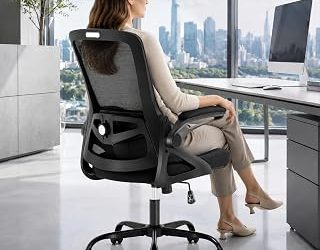
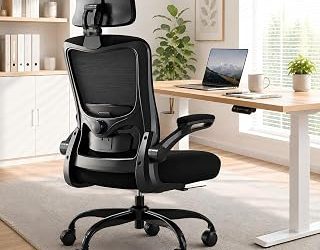
If your knees, hips, or existing joint issues rule out kneeling entirely, this is the conventional alternative I’d point you toward: adjustable lumbar support, a headrest, and a 90–120° recline that lets you decompress between tasks. Pair it with a sit-stand routine and you’ll get much of the same postural benefit.
Frequently Asked Questions
Can a kneeling chair really improve my sleep?
Indirectly, yes. Reducing daytime hip flexor tightness and thoracic stiffness means fewer positional aches at night, and people who report less low-back discomfort in bed generally cycle through deep sleep with fewer awakenings.
How long should I sit in one at first?
Start with 20 to 30 minutes, once or twice a day, and alternate with a standard chair. Your shins and postural muscles need two to three weeks to adapt, and pushing through discomfort early is the fastest way to abandon the chair.
Will it hurt my knees?
It shouldn’t. Weight belongs on the shins, with the knees merely resting — if you feel kneecap pressure, your seat is too low relative to the pads. Anyone with existing knee pathology should check with a clinician first.
Backless or with a backrest?
Backless builds strength faster but demands more of you. Choose a backrest if you work long uninterrupted stretches, are recovering from injury, or know you’ll otherwise stop using the chair by week two.
Final Thoughts
For most buyers, the Ergonomic Kneeling Chair with Adjustable Seats offers the best combination of fit flexibility and warranty backing, while the Varier remains the choice for anyone serious about active sitting and core engagement. If long days or a sensitive back are your reality, the linen kneeling chair with a backrest is the version you’ll actually keep using — and that consistency, not the chair’s specification sheet, is what your spine will thank you for at bedtime.