Key takeaways
- Match the technology to your climate: Compressor-based units (the BTU-rated ones) genuinely cool and dehumidify, and work anywhere. Evaporative coolers add moisture to the air and only cool effectively when humidity is low — brilliant in Denver, disappointing in Miami.
- Size to the room, not to the marketing: Roughly 20 BTU per square foot is a workable baseline, adding capacity for west-facing windows, top floors, or vaulted ceilings. Undersizing means the compressor runs continuously; oversizing means it short-cycles and leaves humidity behind.
- Check the decibel figure, then the sound character: Anything under about 52 dB on low is reasonable for a bedroom, but steady broadband hum is far less disruptive than a unit that cycles loudly on and off. A dedicated sleep or night mode that ramps the fan down after you drift off is worth paying for.
- Insist on a real sleep or timer function: Ideal sleeping temperature sits around 65–68°F, and the body doesn’t need that all night. Timers and gradual temperature ramps prevent the 4 a.m. shivering wake-up that ruins your last REM cycle.
- Plan the exhaust before you buy: Compressor units must vent hot air out a window. Measure the sash, confirm the kit fits casement or sliding frames, and consider insulating the hose — an uninsulated hose radiates heat straight back into the room you’re trying to cool.
What's inside
Anyone who has stared at the ceiling at 2 a.m. while the room hovers around 78°F understands something sleep researchers have documented for decades: the body cannot fall asleep until its core temperature drops. That thermal dip is the biological trigger for sleep onset. When a bedroom traps heat, the descent stalls, sleep fragments, and you wake unrefreshed no matter how many hours you logged. Central air is the obvious fix, but it’s expensive, immovable, and often absent in bedrooms, apartments, guest rooms, and finished attics — precisely the spaces where people sleep worst.
This guide looks at self-evaporative portable air conditioners, a category that solves a nagging practical problem: the drip bucket. Traditional portable units collect condensate that you have to empty, sometimes nightly during humid stretches. Self-evaporative designs recycle that moisture through the condenser and vent it out with the exhaust, so most of the time there is nothing to drain. We’ve also included evaporative (swamp) coolers, which work on a different principle entirely and suit dry climates. Below you’ll find selection criteria that matter for sleep specifically, then honest assessments of six units for 2026.
As an Amazon Associate we earn from qualifying purchases.


How to Choose a Self Evaporative Portable Air Conditioner (2026)
- Match the technology to your climate: Compressor-based units (the BTU-rated ones) genuinely cool and dehumidify, and work anywhere. Evaporative coolers add moisture to the air and only cool effectively when humidity is low — brilliant in Denver, disappointing in Miami.
- Size to the room, not to the marketing: Roughly 20 BTU per square foot is a workable baseline, adding capacity for west-facing windows, top floors, or vaulted ceilings. Undersizing means the compressor runs continuously; oversizing means it short-cycles and leaves humidity behind.
- Check the decibel figure, then the sound character: Anything under about 52 dB on low is reasonable for a bedroom, but steady broadband hum is far less disruptive than a unit that cycles loudly on and off. A dedicated sleep or night mode that ramps the fan down after you drift off is worth paying for.
- Insist on a real sleep or timer function: Ideal sleeping temperature sits around 65–68°F, and the body doesn’t need that all night. Timers and gradual temperature ramps prevent the 4 a.m. shivering wake-up that ruins your last REM cycle.
- Plan the exhaust before you buy: Compressor units must vent hot air out a window. Measure the sash, confirm the kit fits casement or sliding frames, and consider insulating the hose — an uninsulated hose radiates heat straight back into the room you’re trying to cool.
The Best Self Evaporative Portable Air Conditioner (2026)s Reviewed
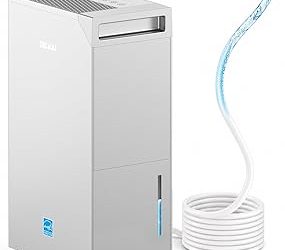
Newair 8,000 BTU Portable AC for Bedrooms
This is the one I’d point most bedroom buyers toward: 8,000 BTU is well matched to a typical 200–300 sq ft sleeping space, and the self-evaporative system means you’re unlikely to be emptying anything mid-week. The compact footprint and remote make it practical to operate without getting out of bed, which matters more than it sounds.
12,000 BTU Smart Portable AC with Silent Sleep Mode
The strongest choice for large or open bedrooms up to roughly 600 sq ft, and the only one here with genuine smart control — useful for pre-cooling the room 30 minutes before you head upstairs. The silent sleep mode dials the fan back progressively, which addresses the most common complaint about high-capacity portables.
10,000 BTU 3-in-1 Portable AC with Auto-Evaporation
A sensible middle capacity for medium rooms around 450 sq ft, with cooling, dehumidification, and fan-only modes covering shoulder-season nights when you want air movement without refrigeration. The dehumidifier function alone earns its keep in basement bedrooms, where clammy air disrupts sleep even at moderate temperatures.
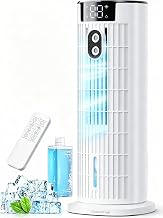
3000 CFM Swamp Cooler with 6.87 Gal Tank
No exhaust hose, no window kit, and a tank large enough to run overnight — genuinely appealing if you live somewhere arid and can’t modify a window. Set the 120° oscillation to sweep rather than blow directly at the bed, and skip this entirely if your summers are humid.
4-in-1 Evaporative Air Cooler with 1500ML Tank
Best understood as a personal cooling device rather than a room air conditioner: USB-C power and a small tank make it a strong bedside or travel companion for camping and hotel rooms. It won’t lower ambient temperature meaningfully, but directed airflow across the skin still lowers perceived warmth.
Frequently Asked Questions
Does self-evaporative mean I never empty water?
Almost never, but not literally never. During prolonged high humidity, condensate can outpace evaporation and the internal reservoir fills, at which point the unit pauses and prompts you to drain it. Budget for a handful of drains across a humid summer.
Is an evaporative cooler the same as a portable AC?
No, and this is the most common purchasing mistake. Evaporative coolers pass air over water-saturated media, cooling it while raising humidity; they need no exhaust vent. Compressor ACs actively remove heat and moisture and must vent outside.
What temperature should I set for sleep?
Most adults sleep best between 65 and 68°F. If that feels aggressive or expensive, prioritize cooling during the first two hours of sleep, when core temperature is falling fastest, and let the room drift warmer toward morning.
Will the noise keep me awake?
A consistent low hum often helps by masking street noise and household sounds. Problems arise from intermittent noise — compressors kicking on, rattling hoses, or vibration through a hard floor. A rubber mat under the unit and a snug window seal solve most of it.
Final Thoughts
For most bedrooms, the Newair 8,000 BTU delivers the right balance of capacity, quiet operation, and drain-free convenience. Larger or upstairs rooms should step up to the 12,000 BTU Smart model for its pre-cooling and graduated sleep mode, while readers in genuinely dry climates can skip venting altogether with the 3000 CFM swamp cooler. Choose based on your humidity and your square footage, and treat the temperature drop as part of your sleep routine rather than a luxury.