Key takeaways
- Read the DOE rating, not the headline number: Manufacturers often lead with ASHRAE BTUs, which are measured under generous conditions. The DOE figure accounts for hose heat loss and duty cycling, and it’s typically 35–40% lower. A unit advertised at 12,000 BTU ASHRAE performs like an 8,000 BTU unit in your actual bedroom, so size accordingly.
- Treat noise as a spec, not an afterthought: Compressors on portables sit inside the room with you, so anything above the mid-50s decibel range at low fan speed will fragment light sleep. Look for published low-setting figures and prioritize units with a variable-speed compressor that idles down rather than cycling hard on and off — the abrupt transitions wake people more reliably than steady volume does.
- Insist on a real sleep program: The best implementations ramp the setpoint upward over several hours, matching the natural rise in core temperature toward morning, while dropping fan speed and killing the display light. Weaker versions simply mute the beeper. Ask whether the mode adjusts temperature on a curve.
- Match capacity to your worst room, not your average one: Square footage on the box assumes eight-foot ceilings and modest sun exposure. Add roughly 10% for a west-facing bedroom, another 10% for an upper floor, and more if the space is open to a stairwell. Undersizing forces continuous run time and constant noise; oversizing cools fast but leaves the air clammy.
- Check dehumidification and hose sealing: Self-evaporation works well up to about 80% relative humidity, above which most units revert to an auxiliary drain — worth knowing if you’re in the Gulf South. Equally important, a sloppy window bracket lets hot air leak straight back in, so look for a rigid kit with foam gaskets rather than thin plastic slides.
What's inside
Anyone who has spent a July night flipping their pillow to the cool side knows that thermoregulation isn’t a comfort preference — it’s a precondition for sleep. Core body temperature has to drop roughly a degree for sleep onset to happen efficiently, and a bedroom stalled at 78°F actively fights that process. The trouble is that the people who most need cooling are often the ones who can’t install a window unit: renters, upstairs-bedroom sleepers, converted attics, and anyone whose landlord has opinions about sashes. Portable units fill that gap, but the older generation came with a punishing catch — a drip tray that filled overnight and shut the compressor off at 3 a.m.
Self-evaporating models solve that. Instead of collecting condensate in a reservoir, they route moisture back across the hot condenser coil and exhaust it as vapor through the same hose that vents heat, so under normal humidity you never touch a drain plug. This guide covers what actually matters when you’re buying one for a sleeping space — real cooling capacity versus marketing BTUs, measured noise at bedside distance, and the difference between a genuine sleep mode and a dimmed display — followed by reviews of the strongest options available in 2026.
As an Amazon Associate we earn from qualifying purchases.


How to Choose a/an Self-Evaporating Portable Air Conditioner (2026)
- Read the DOE rating, not the headline number: Manufacturers often lead with ASHRAE BTUs, which are measured under generous conditions. The DOE figure accounts for hose heat loss and duty cycling, and it’s typically 35–40% lower. A unit advertised at 12,000 BTU ASHRAE performs like an 8,000 BTU unit in your actual bedroom, so size accordingly.
- Treat noise as a spec, not an afterthought: Compressors on portables sit inside the room with you, so anything above the mid-50s decibel range at low fan speed will fragment light sleep. Look for published low-setting figures and prioritize units with a variable-speed compressor that idles down rather than cycling hard on and off — the abrupt transitions wake people more reliably than steady volume does.
- Insist on a real sleep program: The best implementations ramp the setpoint upward over several hours, matching the natural rise in core temperature toward morning, while dropping fan speed and killing the display light. Weaker versions simply mute the beeper. Ask whether the mode adjusts temperature on a curve.
- Match capacity to your worst room, not your average one: Square footage on the box assumes eight-foot ceilings and modest sun exposure. Add roughly 10% for a west-facing bedroom, another 10% for an upper floor, and more if the space is open to a stairwell. Undersizing forces continuous run time and constant noise; oversizing cools fast but leaves the air clammy.
- Check dehumidification and hose sealing: Self-evaporation works well up to about 80% relative humidity, above which most units revert to an auxiliary drain — worth knowing if you’re in the Gulf South. Equally important, a sloppy window bracket lets hot air leak straight back in, so look for a rigid kit with foam gaskets rather than thin plastic slides.
The Best Self-Evaporating Portable Air Conditioner (2026)s Reviewed
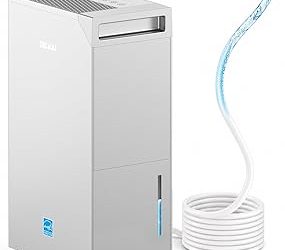
DREO 515S Portable Air Conditioner, 12,000 BTU ASHRAE
This is the unit I recommend most often for bedrooms, largely because DREO tuned the low-speed compressor and fan to hold a genuinely quiet floor rather than surging every few minutes. App and voice control mean you can raise the setpoint from bed without turning on a lamp, and the 8,000 BTU DOE rating comfortably handles a standard-to-large primary bedroom.
DREO 318S Portable Air Conditioner, 8,000 BTU ASHRAE
The smaller sibling suits nurseries, home offices, and bedrooms under about 250 square feet, where its 5,000 BTU DOE output won’t short-cycle. Drainage-free operation plus the same three-in-one cool, fan, and dehumidify structure makes it a low-maintenance choice for a room you don’t want to think about.
14,000 BTU 3-in-1 Portable Air Conditioner, up to 700 Sq. Ft.
The right pick when the sleeping space is genuinely large or opens into a hallway — smaller units simply cannot hold a setpoint across 700 square feet. Auto swing helps distribute cool air rather than pooling it at the foot of the bed, though expect more compressor presence than the DREO models at this capacity.
Antarctic Star 10,000 BTU 5-in-1 Portable Air Conditioner
A sensible middle-capacity option for a 450-square-foot bedroom or office, with sleep and timer modes plus a child lock that matters if the unit lives in a kid’s room. The dehumidifier function is capable enough to use on its own during shoulder-season nights when you want drier air, not colder air.
12,000 BTU Smart Portable Air Conditioner, up to 600 Sq. Ft.
Auto evaporation, a silent sleep mode, and smart control at a lower price point than the premium models make this a strong value for medium-to-large rooms. Take the 600-square-foot claim as a best case and size down a room if your space runs sunny.
Frequently Asked Questions
Do self-evaporating units ever need to be drained?
In typical conditions, no — the condensate is exhausted as vapor. In sustained high humidity above roughly 80%, the system can produce more moisture than it can vaporize, at which point the auxiliary drain port handles the excess. Most owners in dry or moderate climates never open it.
What bedroom temperature should I actually target?
Most adults sleep best between 65 and 68°F, cooler than daytime comfort because the body is shedding heat rather than generating it. If that feels too cold at bedtime, set 70°F for the first hour and let a sleep program step it down.
Will the exhaust hose make the unit less efficient?
Somewhat, which is why DOE ratings run lower than ASHRAE. Keep the hose as short and straight as the layout allows, avoid draping it across the floor where it radiates heat back into the room, and insulate it with a fabric sleeve for a measurable improvement.
Is a portable AC quiet enough for a light sleeper?
The best current models are, particularly those with variable-speed compressors that hold a steady low hum. If you’re highly noise-sensitive, position the unit on the far side of the room from your head and run it an hour before bed to pre-cool, then let sleep mode reduce output.
Final Thoughts
For most bedrooms, the DREO 515S is the best balance of real cooling capacity, quiet low-speed operation, and sleep-aware controls, with the DREO 318S serving smaller rooms and nurseries just as well at lower cost. If your sleeping space is large or opens onto other rooms, step up to the 14,000 BTU 3-in-1 unit and accept a little more compressor noise in exchange for the capacity you actually need.