Key takeaways
- Measure the negative space, not the desk: Leave at least 30 inches of clear pull-out room behind the chair and confirm the desk doesn’t block a door swing, radiator, or the path you’ll walk half-asleep at 3 a.m. A desk that technically fits but creates a pinch point will feel wrong every single day.
- Prioritise a “closable” surface in bedrooms: Folding desks and models with drawers let you end the workday with a physical gesture — fold, close, done. That ritual is one of the most reliable low-effort interventions I recommend for people who work where they sleep, because it gives the brain a clear boundary marker.
- Check height against your chair, then your monitor against your eyes: Most compact desks sit at 28–30 inches, which suits a standard dining or task chair. Your screen’s top edge should land at or just below eye level; a built-in monitor riser or a small shelf does more for neck comfort than any ergonomic gadget you’ll buy later.
- Favour visual lightness and warm finishes: Slim legs, open bases, oak tones, and matte white surfaces read as smaller than they are and reflect less harsh light back at you. Glossy black slabs absorb the room and, in a bedroom, tend to feel like an appliance rather than furniture.
- Plan cables and light sources before you buy: Look for a rear gap or a lower shelf you can route power through, and position the desk so no standby LED or monitor edge is visible from your pillow. Stray blue-white light at night is a genuine sleep disruptor, not a rounding error.
What's inside
When a desk has to live in the same room where you sleep, the stakes are higher than most furniture guides admit. As a sleep-wellness practitioner, I spend a lot of time helping people untangle work from rest — and in studio apartments, dorms, and box bedrooms, that untangling is often physical. A bulky desk parked at the foot of the bed becomes a glowing monument to unfinished tasks, and the brain notices. Your nervous system reads the room before your conscious mind does, and a workstation that dominates your line of sight from the pillow quietly teaches your body that this space means alertness, not recovery.
The good news: the right compact desk solves the spatial problem and the psychological one at once. This guide looks at small-footprint computer desks through a dual lens — how well they support focused work during the day, and how gracefully they disappear (visually or literally) at night. I’ve weighted footprint, visual lightness, foldability, cable discipline, and storage that lets you put work out of sight before bed. Below are my picks for 2026, followed by a buying framework you can apply to any desk you’re considering.
As an Amazon Associate we earn from qualifying purchases.




How to Choose a Computer Desk For Small Spaces (2026)
- Measure the negative space, not the desk: Leave at least 30 inches of clear pull-out room behind the chair and confirm the desk doesn’t block a door swing, radiator, or the path you’ll walk half-asleep at 3 a.m. A desk that technically fits but creates a pinch point will feel wrong every single day.
- Prioritise a “closable” surface in bedrooms: Folding desks and models with drawers let you end the workday with a physical gesture — fold, close, done. That ritual is one of the most reliable low-effort interventions I recommend for people who work where they sleep, because it gives the brain a clear boundary marker.
- Check height against your chair, then your monitor against your eyes: Most compact desks sit at 28–30 inches, which suits a standard dining or task chair. Your screen’s top edge should land at or just below eye level; a built-in monitor riser or a small shelf does more for neck comfort than any ergonomic gadget you’ll buy later.
- Favour visual lightness and warm finishes: Slim legs, open bases, oak tones, and matte white surfaces read as smaller than they are and reflect less harsh light back at you. Glossy black slabs absorb the room and, in a bedroom, tend to feel like an appliance rather than furniture.
- Plan cables and light sources before you buy: Look for a rear gap or a lower shelf you can route power through, and position the desk so no standby LED or monitor edge is visible from your pillow. Stray blue-white light at night is a genuine sleep disruptor, not a rounding error.
The Best Computer Desk For Small Spaces (2026)s Reviewed
Lufeiya 40″ Small White Desk with Drawers
This is my default recommendation for bedroom offices: 40 inches gives you real elbow room for a laptop and notebook, while the fabric drawer swallows the clutter that otherwise sits in your eyeline at bedtime. The reversible layout is genuinely useful in awkward rooms, letting you tuck the storage side against a wall and keep the open side facing the bed.
COTUBLR 27.5″ Small Desk with Monitor Stand
At 27.5 inches wide it’s one of the smallest credible workstations here, and the integrated monitor stand solves the neck-craning problem that plagues tiny desks. The rustic brown finish and side storage give it a bookshelf-adjacent look, which helps it blend into a bedroom rather than announcing itself.
WOHOMO 31.5″ Folding Desk
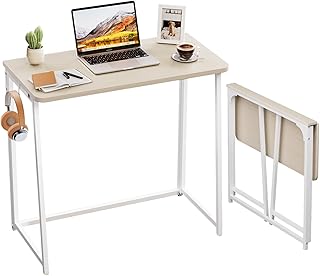
The oak finish and near-instant fold make this the strongest pick if you want your work surface gone by evening — it slides behind a door or under a bed in seconds. Sturdier than most folding tables at this size, though I’d keep it to a laptop and a lamp rather than a heavy dual-monitor setup.
GreenForest Folding Desk, No Assembly
No-assembly, two-tier, and just over 27 inches deep front to back, this is the dorm and micro-apartment specialist. The lower shelf is quietly the best feature: route a power strip along it and your cables, router, and chargers stay off the floor and out of sight.
39″ Fluted Desk with 2 Drawers
The fluted front gives this desk a considered, furniture-like presence that suits a bedroom far better than typical office fare, and two proper drawers mean laptops and paperwork can be genuinely put away. A good choice if you want the desk to look intentional even when you’re not working at it.
Frequently Asked Questions
Is it really a problem to have a desk in my bedroom?
It’s not a hard rule, but shared-use rooms do make sleep boundaries harder to maintain. The fix isn’t necessarily moving the desk — it’s making work visually and functionally “closed” at night through folding surfaces, drawers, and a lamp you switch off deliberately.
How narrow can a desk be before it becomes uncomfortable?
Around 27 inches wide is the practical floor for a laptop plus mouse. Below that you’ll be constantly rearranging, which erodes focus; a 31–40 inch desk is far more comfortable if the room allows it.
Are folding desks stable enough for daily work?
Modern folding models handle laptops, monitors, and typing without meaningful wobble, provided you set them on level flooring and lock the legs fully. For heavy multi-monitor rigs, a fixed-frame desk with drawers is the safer investment.
Where should I position the desk relative to the bed?
Ideally outside your direct sightline from the pillow — perpendicular to the bed or against the same wall as the headboard. If that’s impossible, angle the monitor away and drape or fold the surface at night so the last thing you see isn’t your to-do list.
Final Thoughts
For most small bedrooms, the Lufeiya 40″ Desk with Drawers hits the best balance of usable surface, hidden storage, and unobtrusive styling. If your room truly can’t spare permanent floor space, the WOHOMO 31.5″ Folding Desk lets you reclaim the room every evening, and the GreenForest No-Assembly Folding Desk is the smartest pick for dorms and rentals where cable management and portability matter most. Whichever you choose, decide now how you’ll close the desk at night — that habit will do more for your sleep than the furniture itself.