Key takeaways
- Measure the depth, not just the width: Anything under about 20 inches deep forces your monitor too close, which pushes you into a forward head posture and puts a bright screen right in your face. Aim for 22 inches or more, and use a monitor shelf to buy back the distance you lose.
- Prioritise designs that disappear: Folding and wall-facing desks let you physically close the workday. If your desk shares a room with your bed, the ability to collapse it in ten seconds is worth more than an extra shelf.
- Check the storage is enclosed or shielded: Open-shelf clutter stays visually “active” — your eye keeps returning to it. Drawers, fabric bins, or a raised lip on the shelving reduce that low-grade cognitive pull before bed.
- Test for wobble tolerance: Compact desks trade mass for footprint, so look for cross-bracing, adjustable feet, or a steel frame. A desk that shakes when you type will also shake when you lean on it at 1am, which is a small but real nudge toward frustration rather than focus.
- Plan for lamp placement: You want a warm, low, angled task light for evening work rather than the ceiling fixture. Confirm there’s a clear corner or shelf edge where a lamp can sit without stealing your working area.
What's inside
Most people shopping for a compact desk aren’t furnishing an office — they’re carving a workstation out of a bedroom, a studio corner, or the three feet of wall beside a dorm bed. That creates a problem the product listings rarely address: the room you work in is also the room you sleep in, and the brain is unhelpfully literal about that overlap. Sleep researchers talk about stimulus control, the idea that a bedroom should signal one thing — rest. A glowing monitor and a pile of unfinished work sitting in your line of sight at 11pm quietly teaches the opposite lesson, and it shows up as longer sleep onset and lighter, more fragmented nights.
The good news is that furniture choices can do a surprising amount of that boundary work for you. A desk that folds flat, tucks its cables out of sight, or keeps clutter behind a lip instead of spread across the surface makes it far easier to end the workday cleanly. This guide looks at six of the strongest small-space desks available in 2026 and evaluates them on the usual practicalities — footprint, stability, assembly — plus one criterion most roundups skip: how well each one gets out of your head at bedtime.
As an Amazon Associate we earn from qualifying purchases.




How to Choose a Small Space Computer Desk (2026)
- Measure the depth, not just the width: Anything under about 20 inches deep forces your monitor too close, which pushes you into a forward head posture and puts a bright screen right in your face. Aim for 22 inches or more, and use a monitor shelf to buy back the distance you lose.
- Prioritise designs that disappear: Folding and wall-facing desks let you physically close the workday. If your desk shares a room with your bed, the ability to collapse it in ten seconds is worth more than an extra shelf.
- Check the storage is enclosed or shielded: Open-shelf clutter stays visually “active” — your eye keeps returning to it. Drawers, fabric bins, or a raised lip on the shelving reduce that low-grade cognitive pull before bed.
- Test for wobble tolerance: Compact desks trade mass for footprint, so look for cross-bracing, adjustable feet, or a steel frame. A desk that shakes when you type will also shake when you lean on it at 1am, which is a small but real nudge toward frustration rather than focus.
- Plan for lamp placement: You want a warm, low, angled task light for evening work rather than the ceiling fixture. Confirm there’s a clear corner or shelf edge where a lamp can sit without stealing your working area.
The Best Small Space Computer Desks of 2026, Reviewed
Dripex 27.5″ 3-Tier Compact Desk
The three-tier layout is the smartest use of vertical space here: the monitor shelf lifts your screen to a sensible eye line while the lower shelves absorb the books and chargers that would otherwise colonise the desktop. At 27.5 inches wide it suits an alcove or the narrow wall beside a bed, though the open shelving means you’ll want a basket or two to keep the visual noise down.
GreenForest Folding Desk (No Assembly)
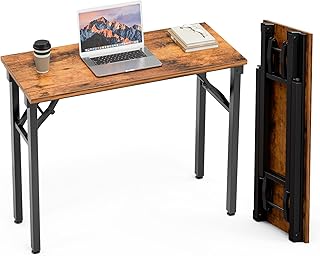
My pick for anyone sleeping in the same room they work in — it arrives assembled, unfolds in seconds, and folds back down to slide behind a door or under a bed. That single action is a remarkably effective end-of-day cue, and the small shelf gives you somewhere to park a laptop without cluttering the main surface.
TEMI 35.8″ Folding Desk
A wider folding option for people who genuinely need two devices side by side, with the same no-assembly, no-tools convenience. The extra eight inches of width makes a real difference for split-screen work, and it still stows flat when you’re done — just check your storage gap can take the longer frame.
ODK 27.5″ Desk with Storage & Monitor Stand
The built-in monitor stand and side storage make this one of the better-proportioned small desks for long sessions, with a warm deep-brown finish that reads more like bedroom furniture than office equipment. Assembly is straightforward, and the frame feels notably steadier than its size suggests.
Lufeiya 40″ White Desk with Drawers
The widest surface in this group and the only one with proper enclosed drawers, which is exactly what you want if visual tidiness matters to your wind-down routine. The reversible fabric drawer configuration is genuinely useful in awkward corners, and the clean white finish keeps a small room feeling open rather than crowded.
Frequently Asked Questions
Is it a bad idea to put a desk in my bedroom?
It isn’t ideal, but for most people it’s unavoidable and entirely manageable. The key is separation by cue rather than by wall: position the desk so it isn’t visible from your pillow, use a dedicated task lamp instead of overhead light, and physically close or clear it when you finish.
How narrow can a desk be before it becomes uncomfortable?
Width is flexible — 27 inches is workable for a laptop or single monitor. Depth is where compromise hurts, since anything shallower than about 20 inches forces your screen too close and encourages a hunched posture over long sessions.
Are folding desks stable enough for a monitor?
Modern folding designs handle a single monitor and laptop comfortably, but they’re not the right base for a heavy dual-arm setup. If you’re mounting anything on a clamp, choose a fixed-frame desk with a thicker top instead.
Does working late at a bedroom desk affect sleep even with a night-light setting?
Reducing blue light helps, but it isn’t the whole picture — mental activation matters as much as light exposure. Stopping cognitively demanding work 60 to 90 minutes before bed does more for sleep onset than any screen filter.
Final Thoughts
If your desk lives in your bedroom, the GreenForest Folding Desk is the one I’d recommend first — being able to fold the workday away is the closest thing to a hardware fix for blurred work-sleep boundaries. For a permanent setup, the Dripex 3-Tier gets the ergonomics right in a genuinely tiny footprint, while the Lufeiya 40″ White Desk is the better choice if you want a wider surface and drawers that keep clutter properly out of sight.