Key takeaways
- Dimming range, not peak lumens: A 1,500-lumen light with three or more usable brightness steps beats a 3,000-lumen light stuck on maximum. Low modes are what protect your eyes during close inspection work and evening projects.
- Beam diffusion: Look for frosted or wide-panel COB emitters rather than a bare, exposed die. Diffused light spreads evenly across an engine bay instead of creating hard hot spots your pupils have to constantly readjust to.
- Hands-free mounting: Strong magnets, a rotating body, and a hook are non-negotiable. Every minute the light sits on a fender instead of clenched in your teeth is a minute your neck and eyes aren’t fighting you.
- Honest battery feedback: A digital percentage readout is far better than a three-dot indicator. Knowing you have 40% left lets you finish calmly rather than scrambling under a fading beam — which is when eye strain and mistakes compound.
- Build and heat: Aluminum housings shed heat better and keep output stable. A light that dims and warms as it runs will subtly wreck the visual consistency you need for precise work.
What's inside
Most people shop for a work light the same way they shop for a wrench: they look at the number on the box and buy the biggest one. As someone who spends a great deal of time talking to people about light and how the body responds to it, I’d gently suggest a different starting point. A garage light isn’t just a tool for seeing a stubborn bolt — it’s a light source you’re often holding six inches from your face, frequently late in the evening, in an otherwise dim space. That combination matters more than most buyers realize. Harsh, flickering, blue-heavy output at 10 p.m. is a reliable recipe for eye strain, a dull headache, and a brain that stays stubbornly alert long after you’ve washed the grease off your hands.
This guide approaches mechanic work lights with that in mind. We’ll look at brightness you can actually control, beam quality that doesn’t glare back at you off a valve cover, mounting options that let you keep the light off your face and on the work, and battery behavior you can trust at the far end of a long session. Below are six rechargeable and cordless options worth considering in 2026, followed by the criteria I’d use to separate a genuinely comfortable light from a merely bright one.
As an Amazon Associate we earn from qualifying purchases.



How to Choose a Mechanic Work Light (2026)
- Dimming range, not peak lumens: A 1,500-lumen light with three or more usable brightness steps beats a 3,000-lumen light stuck on maximum. Low modes are what protect your eyes during close inspection work and evening projects.
- Beam diffusion: Look for frosted or wide-panel COB emitters rather than a bare, exposed die. Diffused light spreads evenly across an engine bay instead of creating hard hot spots your pupils have to constantly readjust to.
- Hands-free mounting: Strong magnets, a rotating body, and a hook are non-negotiable. Every minute the light sits on a fender instead of clenched in your teeth is a minute your neck and eyes aren’t fighting you.
- Honest battery feedback: A digital percentage readout is far better than a three-dot indicator. Knowing you have 40% left lets you finish calmly rather than scrambling under a fading beam — which is when eye strain and mistakes compound.
- Build and heat: Aluminum housings shed heat better and keep output stable. A light that dims and warms as it runs will subtly wreck the visual consistency you need for precise work.
The Best Mechanic Work Lights (2026) Reviewed
2-Pack Magnetic Rechargeable Aluminum Work Light (1500 Lumens)
This is my overall recommendation: the all-aluminum body runs cool and steady, and the digital display plus seven modes give you genuine control over how much light hits your eyes. Having two units means one can flood the workspace from a fender while the second handles close inspection at a low, comfortable setting.
Rechargeable 1200-Lumen Magnetic Flashlight with 360° Foldable Design
The folding, fully rotating head is the standout feature here — it lets you aim light into a wheel well or under a dash without ever pointing the emitter back toward your face. At 1,200 lumens with a 5,000mAh cell, it’s a sensible balance of output and runtime for most home garage work.
3000LM Magnetic Work Light Bar (5200mAh, Green)
The bar format is the most eye-friendly design in this roundup, spreading its output across a wide panel rather than concentrating it into a single glaring point. It’s the one I’d choose for extended under-hood sessions where you need consistent, shadow-free coverage rather than a tight beam.
DEWALT 20V MAX Handheld Spotlight (DCL043)
A different tool for a different job: this pivoting-head spotlight throws 1,500 lumens out to roughly 500 yards, making it the pick for roadside work, outbuildings, and locating things in the dark. Note that the battery is sold separately, so it makes most sense if you already own DEWALT 20V packs.
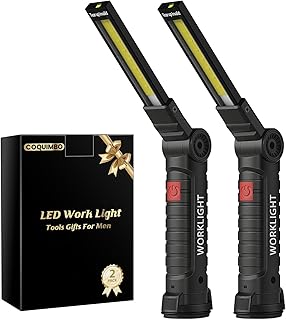
Coquimbo 2-Pack Rechargeable Work Light
The best value option, and surprisingly versatile thanks to a magnetic base and integrated hook that work as well over a grill as under a hood. Output is modest compared to the aluminum models, which is precisely why it’s a comfortable choice for detail work and late-evening tinkering.
Frequently Asked Questions
Does using a bright work light at night affect my sleep?
It can. Intense, blue-rich light in the two hours before bed suppresses melatonin and delays sleep onset. If you’re working late, use the lowest practical brightness setting, aim the light at the work rather than your eyes, and keep some ambient room light on so your pupils aren’t fully dilated.
How many lumens do I actually need?
For most under-hood and workbench tasks, 800 to 1,500 lumens is plenty. Higher figures are useful for large spaces or outdoor work, but in a confined engine bay excessive output mostly produces glare and reflections that make details harder to see.
Are magnetic bases strong enough to trust?
On the quality models here, yes — they hold reliably on vertical and inverted steel surfaces. Test placement before you let go, avoid aluminum panels entirely, and use the hook as a backup on painted surfaces to prevent scratching.
How should I store rechargeable work lights?
Keep lithium cells at roughly half charge if a light will sit unused for months, and store them somewhere temperature-stable rather than a freezing or baking garage. Topping up every few months preserves capacity far better than storing them fully drained.
Final Thoughts
If you want one light that handles nearly everything comfortably, the 1500-lumen aluminum two-pack offers the best combination of control, cooling, and honest battery feedback. For broad, glare-free under-hood coverage choose the 3000LM magnetic light bar, and if your work regularly takes you outdoors or roadside, the DEWALT DCL043 spotlight is the specialist worth adding alongside them.