Key takeaways
- Measure the opening first, twice: Casement units are taller than wide — typically around 23 to 24 inches high and under 16 inches across. Record your clear opening height, width, and depth before you shop, since a one-inch shortfall is an unfixable one.
- Match BTUs to the room, not the catalog: Roughly 20 BTU per square foot is a sane starting point, so 8,000 BTU for a 350 sq ft bedroom and 10,000 for 450. Oversizing is the classic sleep mistake: the unit blasts, satisfies the thermostat in minutes, shuts off, and the resulting cold-warm-cold cycling wakes light sleepers repeatedly.
- Treat noise as a sleep spec: Steady broadband sound around 50 dB can genuinely mask street noise, but abrupt compressor kick-ons are what pull you out of stage-two sleep. Inverter compressors, which modulate rather than slam on and off, are the single biggest upgrade for sensitive sleepers.
- Look for a real sleep mode and a 24-hour timer: A well-designed sleep setting ramps the setpoint up gradually across the night, tracking your natural temperature rebound toward morning. It cools when you need it most, in the first half of the night, and stops overcooling at 5 a.m.
- Check the light and the remote: Bright LED displays are melatonin-unfriendly at 2 a.m. Prioritize models with a display-off function, and treat a “follow me” remote — which reads the temperature at your bedside rather than at the window — as a meaningful comfort feature, not a gimmick.
What's inside
Casement and sliding windows are wonderful for airflow and terrible for air conditioners. The opening is tall and narrow instead of short and wide, the crank mechanism swings outward, and the standard box unit sitting on a big-box shelf simply will not fit. So people improvise: a too-heavy unit propped on a sill it was never sized for, a tangle of foam board and duct tape, or a bedroom that stays at 78°F all July. From a sleep perspective, that last outcome is the costly one. Core body temperature has to drop roughly one to two degrees for sleep to consolidate, and a room that won’t cool below the mid-70s keeps nudging you out of deep sleep all night — the fragmented, sweat-damp kind of night you feel in your shoulders the next morning.
This guide looks at cooling for narrow window openings through that lens: not just BTUs per square foot, but how quietly a unit runs, how gracefully it handles overnight temperature drift, and whether it can be installed in a tall-and-thin frame without a carpentry project. Below you’ll find true casement-specific units, plus two alternatives worth knowing about — a low-profile U-shaped model and a portable that vents through a slim crank opening — for rooms where a vertical unit genuinely won’t work. Note that some links here are affiliate links.
As an Amazon Associate we earn from qualifying purchases.



How to Choose a Casement Window Air Conditioner (2026)
- Measure the opening first, twice: Casement units are taller than wide — typically around 23 to 24 inches high and under 16 inches across. Record your clear opening height, width, and depth before you shop, since a one-inch shortfall is an unfixable one.
- Match BTUs to the room, not the catalog: Roughly 20 BTU per square foot is a sane starting point, so 8,000 BTU for a 350 sq ft bedroom and 10,000 for 450. Oversizing is the classic sleep mistake: the unit blasts, satisfies the thermostat in minutes, shuts off, and the resulting cold-warm-cold cycling wakes light sleepers repeatedly.
- Treat noise as a sleep spec: Steady broadband sound around 50 dB can genuinely mask street noise, but abrupt compressor kick-ons are what pull you out of stage-two sleep. Inverter compressors, which modulate rather than slam on and off, are the single biggest upgrade for sensitive sleepers.
- Look for a real sleep mode and a 24-hour timer: A well-designed sleep setting ramps the setpoint up gradually across the night, tracking your natural temperature rebound toward morning. It cools when you need it most, in the first half of the night, and stops overcooling at 5 a.m.
- Check the light and the remote: Bright LED displays are melatonin-unfriendly at 2 a.m. Prioritize models with a display-off function, and treat a “follow me” remote — which reads the temperature at your bedside rather than at the window — as a meaningful comfort feature, not a gimmick.
The Best Casement Window Air Conditioners of 2026, Reviewed
Perfect Aire 10,000 BTU Casement Window Air Conditioner
This is the most straightforwardly correct answer for a crank-out or sliding window: a purpose-built vertical chassis at 23.5 by 14.75 inches, with a Follow Me remote that lets the unit regulate to the temperature at your nightstand instead of the draft near the glass. The digital timer and dimmable LED round out a genuinely bedroom-appropriate package for rooms up to about 450 sq ft.
Element 10,000 BTU Window Casement Air Conditioner (ESC10BE)
A no-frills vertical unit that does the fundamental job — fitting a narrow opening and cooling a mid-sized bedroom — without asking you to pay for app control you’ll never open. Choose it if you want mechanical simplicity and a lower entry price, and don’t mind a slightly less refined fan curve than the Perfect Aire.
Midea 10,000 BTU U-Shaped Smart Inverter Window Air Conditioner
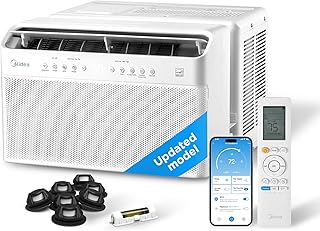
Not a casement unit, but the quietest option here by a wide margin, and worth a look if you have any conventional window in the room: the U-shape lets the sash close through the middle of the chassis, putting the compressor outside the glass barrier and landing it near 42 dB on low. For anyone whose sleep is disturbed by compressor cycling, the inverter alone justifies the price.
BLACK+DECKER 12,000 BTU Window Air Conditioner (BWAC12WTB)
A dependable horizontal unit for larger bedrooms up to 550 sq ft, with three cooling speeds and a fan-only mode that’s useful on shoulder-season nights when you want air movement without refrigeration. Confirm your opening is wide enough — this one won’t fit a casement frame.
Air Choice 10,000 BTU Portable Air Conditioner
The fallback when nothing can be mounted in the window at all: it sits on the floor, vents through a hose that a narrow crank-out opening can usually accommodate, and includes a 24-hour timer, sleep mode, and dehumidifier. Expect more in-room noise than any window unit, since the compressor is beside your bed rather than outside it — position it as far from the headboard as the hose allows.
Frequently Asked Questions
Will a regular window air conditioner fit a casement window?
Almost never. Standard units are wider than they are tall and need a sash that slides down onto the top of the chassis, which crank-out casements don’t provide. Forcing the issue with shims and foam risks an unsecured unit and constant air leakage.
What temperature should I set for sleep?
Most adults sleep best somewhere between 65 and 68°F, though the useful principle is directional rather than numeric: you want the room cool enough that your body can shed heat easily in the first few hours after lights-out.
Is a portable unit or a casement unit better for a bedroom?
A casement unit, if it fits. Window-mounted models keep the compressor and its noise outside, and they don’t create the negative room pressure that single-hose portables do, which pulls warm air in from the rest of the house.
How do I stop the AC from waking me up at night?
Use sleep mode so the setpoint drifts up gradually, avoid oversizing the unit, dim or disable the display, and set the fan to run continuously on low rather than cycling with the compressor. Steady sound is far less disruptive than intermittent sound.
Final Thoughts
For a genuine casement or sliding window, the Perfect Aire 10,000 BTU is the pick that requires the fewest compromises, with the Element ESC10BE as the value alternative when you want the same fit for less. If you have a conventional window available in the same room and sleep lightly, the Midea U-Shaped inverter is the quietest way to cool a bedroom at this price — and quiet, steady cooling is ultimately what your sleep is buying.