Key takeaways
- Color temperature strategy: 5000K daylight gives you the most honest reflection for grooming and makeup, but it’s stimulating late at night. 4000K is the diplomatic middle ground; 2700K is the sleep-friendly choice if your bathroom doubles as a bedtime space. Pick based on when you use the room most, not what looks brightest in the store aisle.
- CRI above 85: Color Rendering Index measures how faithfully a bulb reproduces color. Below 80, skin tones go flat and foundation shades read wrong. CRI85+ is the practical floor for any mirror you make decisions in front of.
- Frosted or opal diffusion: A clear bulb at eye level creates hot spots and squint-inducing glare that lingers as afterimages. Frosted globes spread output across the whole surface, which softens shadows under the eyes and chin — the two places vanity lighting usually fails.
- Dimmability, if you can get it: The single best upgrade for evening light hygiene is the ability to drop output to 20 percent. Most budget vanity globes are non-dimmable, so if your fixture is on a dimmer switch, verify compatibility or you’ll get flicker and buzz.
- Lumens per fixture, not per bulb: A three-socket vanity bar with 500-lumen bulbs delivers 1,500 lumens total, which is plenty for a standard bathroom. Multiply before you buy; over-lighting is as common a mistake as under-lighting.
What's inside
Bathroom vanity lighting has a job most buyers never consider: it has to serve two completely different versions of you. The 7 a.m. version needs crisp, accurate light for shaving, contouring, or spotting a stray hair. The 10 p.m. version needs light that doesn’t tell your brain the sun just came back. From a sleep-wellness perspective, that second scenario matters more than most people realize — bright, blue-heavy light in the 90 minutes before bed suppresses melatonin release and pushes your natural sleep onset later. And because the vanity is often the last fixture you switch off at night, it has outsized influence on how quickly you fall asleep.
Most shoppers grab whatever globe bulb fits the socket, end up with something either dingy and yellow or clinically harsh, and never connect the dots. This guide breaks down the six vanity bulbs worth your money in 2026, evaluated on color temperature, color rendering accuracy, glare control, and — critically — how they behave during your evening wind-down. I’ll cover the specs that actually change your experience, review the standouts, and answer the questions that come up most often.
As an Amazon Associate we earn from qualifying purchases.



How to Choose a Light Bulbs For Bathroom Vanity (2026)
- Color temperature strategy: 5000K daylight gives you the most honest reflection for grooming and makeup, but it’s stimulating late at night. 4000K is the diplomatic middle ground; 2700K is the sleep-friendly choice if your bathroom doubles as a bedtime space. Pick based on when you use the room most, not what looks brightest in the store aisle.
- CRI above 85: Color Rendering Index measures how faithfully a bulb reproduces color. Below 80, skin tones go flat and foundation shades read wrong. CRI85+ is the practical floor for any mirror you make decisions in front of.
- Frosted or opal diffusion: A clear bulb at eye level creates hot spots and squint-inducing glare that lingers as afterimages. Frosted globes spread output across the whole surface, which softens shadows under the eyes and chin — the two places vanity lighting usually fails.
- Dimmability, if you can get it: The single best upgrade for evening light hygiene is the ability to drop output to 20 percent. Most budget vanity globes are non-dimmable, so if your fixture is on a dimmer switch, verify compatibility or you’ll get flicker and buzz.
- Lumens per fixture, not per bulb: A three-socket vanity bar with 500-lumen bulbs delivers 1,500 lumens total, which is plenty for a standard bathroom. Multiply before you buy; over-lighting is as common a mistake as under-lighting.
The Best Light Bulbs For Bathroom Vanity (2026)s Reviewed
G25 LED Globe Bulbs, 60W Equivalent, 5000K Daylight, 4-Pack
This is the reference-grade pick for anyone who does detailed work at the mirror — the 60W-equivalent output paired with 5000K and CRI85+ renders skin and cosmetic tones with genuine accuracy. Just be aware that this much daylight-spectrum output is best paired with a separate, dimmer light source for late-night trips.
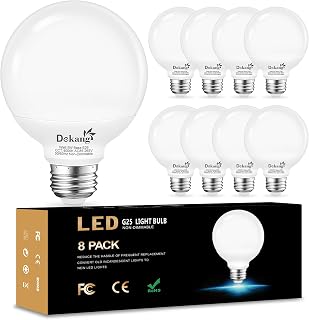
8-Pack LED Vanity Bulbs, 4000K Natural Daylight
My most-recommended all-rounder, largely because 4000K threads the needle: neutral enough to be trustworthy in the morning, warm enough that it isn’t jarring at night. At 5W drawing 500 lumens with CRI85+, the efficiency is excellent, and the eight-pack covers a double vanity with spares on the shelf.
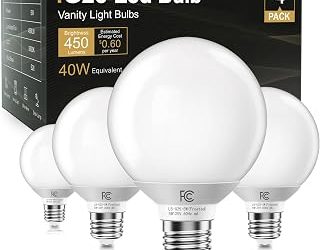
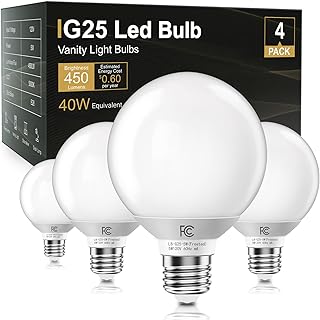
TJOY G25 Vanity Bulb, 40W Equivalent, 5000K
A restrained 450 lumens makes this the smart choice for compact powder rooms or fixtures with four-plus sockets, where full-brightness bulbs quickly become overwhelming. The UL listing and CRI85+ rendering give it credibility that many similarly priced globes lack.
Brtstiun G25 Vanity Bulbs, 40W Equivalent, 600LM
Notable for punching above its 40W-equivalent label — 600 lumens from 6W is genuinely bright for the category, making these a good fit for windowless bathrooms that always feel a little cave-like. The 5000K temperature keeps the mirror honest.
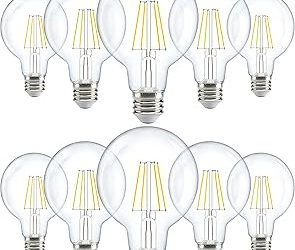
Vanity Globe Bulbs, 2700K Warm White, 40W Equivalent
This is the bulb I point sleep clients toward. At 2700K, the spectrum sits well away from the blue wavelengths that interfere with melatonin, so your evening routine won’t quietly reset your body clock — and CRI85+ means the warmth doesn’t come at the cost of muddy color.
Frequently Asked Questions
What color temperature is genuinely best for a bathroom vanity?
If you use the mirror primarily in the morning, 4000K to 5000K. If it’s your last stop before bed, 2700K to 3000K. The ideal setup uses warmer bulbs on a dimmer, or two separate circuits — task light for grooming, warm ambient light for evening.
Does bathroom light really affect how well I sleep?
Yes, measurably. Bright short-wavelength light in the final hour before bed delays melatonin onset and can shift your sleep timing later. The bathroom is often the brightest room you enter at night, which makes it a disproportionately large lever on sleep quality.
Why do globe bulbs cost more than standard A19 bulbs?
The larger diffusing envelope and the frosted lens treatment add manufacturing cost, and the wider surface area demands more careful thermal management. That diffusion is precisely what you’re paying for — it’s the difference between flattering light and glare.
Can I use these in an enclosed or steamy fixture?
Check for a damp-rated designation. The Sunco 12-Pack is explicitly damp rated, which makes it the safest bet for enclosed globes or shower-adjacent placements where humidity is persistent.
Final Thoughts
For most bathrooms, the 8-Pack 4000K Natural Daylight bulbs are the best-balanced choice — accurate enough for morning detail work without flooding your evening with sleep-disrupting blue light. If precision at the mirror is your priority, step up to the 60W-Equivalent 5000K G25 Globes; if your vanity is where your day ends, the 2700K Warm White Vanity Globes will do more for your sleep than any supplement on the shelf.