Key takeaways
- Measure your true clearance: Building codes generally want blades at least seven feet off the floor. Measure floor to ceiling, subtract seven feet, and shop only for fixtures whose total drop fits inside what remains — flush-mount units typically hang 8 to 12 inches.
- Prioritize a DC motor: Direct-current motors run cooler, draw roughly 60–70% less power, and — critically for bedrooms — produce a lower-pitched, steadier sound signature than older AC units. They also enable six or more usable speeds instead of three.
- Match diameter to room size: A 19–20 inch bladeless fandelier suits nurseries, offices, and rooms under about 120 square feet. Bedrooms and living areas from 150 to 250 square feet need 42 inches or more to avoid running the motor at maximum all night.
- Check the light’s color temperature range: Look for 3CCT or stepless tuning that reaches 3000K or warmer. Cool white light after dark suppresses melatonin; a fixture that can drop to a dim amber makes the fan part of your evening routine rather than working against it.
- Confirm reversible airflow and a timer: Reverse mode pushes warm air down from the ceiling in winter, extending your fixture’s usefulness to twelve months. A sleep timer lets the fan cool the room during sleep onset and shut off before the small hours, when body temperature naturally rises.
What's inside
Anyone who has slept in a room with an eight-foot ceiling knows the compromise: you either accept still, stagnant air or you install a fan that hangs low enough to graze a tall guest’s head. Low-profile and flush-mount fans exist to solve that geometry problem, but from a sleep-wellness standpoint they have a second job that most shoppers overlook — moving enough air to keep skin temperature dropping through the night without generating the mechanical hum or flicker that fragments light sleep. A fan that clears your head but rattles at speed three is not a solution; it’s a new problem in a smaller package.
This guide evaluates 2026’s strongest hugger and bladeless fandelier options through that dual lens: vertical clearance and sleep quality. I’ve weighted quiet DC motors, genuinely dimmable warm light for evening wind-down, reversible airflow for winter use, and control methods you can operate without sitting up in bed. Below you’ll find the shortlist, followed by the specifications that actually matter and answers to the questions that come up most often during installation.
As an Amazon Associate we earn from qualifying purchases.




How to Choose a/an Fan For Low Ceiling (2026)
- Measure your true clearance: Building codes generally want blades at least seven feet off the floor. Measure floor to ceiling, subtract seven feet, and shop only for fixtures whose total drop fits inside what remains — flush-mount units typically hang 8 to 12 inches.
- Prioritize a DC motor: Direct-current motors run cooler, draw roughly 60–70% less power, and — critically for bedrooms — produce a lower-pitched, steadier sound signature than older AC units. They also enable six or more usable speeds instead of three.
- Match diameter to room size: A 19–20 inch bladeless fandelier suits nurseries, offices, and rooms under about 120 square feet. Bedrooms and living areas from 150 to 250 square feet need 42 inches or more to avoid running the motor at maximum all night.
- Check the light’s color temperature range: Look for 3CCT or stepless tuning that reaches 3000K or warmer. Cool white light after dark suppresses melatonin; a fixture that can drop to a dim amber makes the fan part of your evening routine rather than working against it.
- Confirm reversible airflow and a timer: Reverse mode pushes warm air down from the ceiling in winter, extending your fixture’s usefulness to twelve months. A sleep timer lets the fan cool the room during sleep onset and shut off before the small hours, when body temperature naturally rises.
The Best Fan For Low Ceiling (2026)s Reviewed
CHAREADA 20″ Low Profile Foldable Ceiling Fan with Light
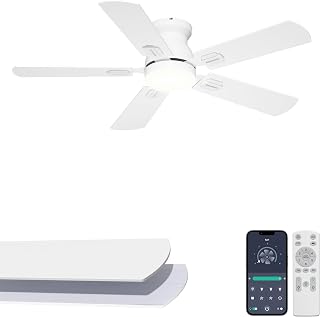
The folding blade design is the standout here — the blades retract when the fan is off, which visually reclaims headroom and makes the fixture read as a flush light rather than a fan. Six speeds and full dimming give you fine control over both airflow and evening light levels, making it a sensible pick for kids’ rooms where you want one fixture doing two jobs.
Bevenus Low Profile Flower Shape Ceiling Fan
Bevenus leans decorative, with a petal-form housing that suits a bedroom you don’t want reading as utilitarian. App and remote control plus a six-speed timer cover the practical bases, and the dimmable output is smooth enough at the low end to serve as a nightlight substitute.
Depuley 19″ Bladeless Flush Mount Fandelier
Fully enclosed and bladeless, this is the safest choice for nurseries, lofts with sleeping mezzanines, or any room where a curious hand might reach up. The enclosure also tames airflow noise noticeably, and at 19 inches it’s proportioned correctly for apartments rather than overwhelming a small ceiling.
42″ White Flush Mount Nursery Ceiling Fan
This is the one to buy if your room is genuinely large — 42 inches of blade span moves real volume at low RPM, which is the quietest way to cool a space. The quiet DC motor and 3CCT dimming make it a strong all-round bedroom fixture, not just a nursery product despite the listing’s framing.
ZMISHIBO 19.7″ Black Fandelier
The black finish is a welcome alternative in a category dominated by white plastic, and the 3000–6000K range plus reversible airflow make it a legitimate year-round fixture. Six wind speeds and an onboard timer cover sleep-cycle needs without requiring an app.
Frequently Asked Questions
Will a low-profile fan cool a room as effectively as a downrod fan?
It moves slightly less air at a given speed because the blades sit closer to the ceiling, reducing the pressure differential above them. In practice the gap is small in rooms under 250 square feet, and choosing a larger diameter more than compensates.
Are bladeless fandeliers quiet enough to sleep beside?
Generally yes — the enclosure diffuses turbulence that open blades create, and DC motors add little mechanical noise. Expect a soft, broadband whoosh at mid speeds, which many sleepers find beneficial as masking sound.
Can I install one of these myself?
If you’re replacing an existing light fixture on a fan-rated electrical box, most homeowners can manage it. Standard light boxes are not rated for a fan’s dynamic load, so if yours isn’t braced, bring in an electrician.
Should the fan run clockwise or counterclockwise?
Counterclockwise in warm months to push air downward and create a cooling breeze; clockwise on low in winter to circulate trapped warm air without a draft.
Final Thoughts
For most bedrooms with standard eight-foot ceilings, the CHAREADA foldable fan offers the best balance of clearance, quiet operation, and dual-purpose lighting. Choose the Depuley bladeless fandelier if a child sleeps in the room or the space is small enough that safety and silence outweigh raw airflow, and step up to the 42″ flush-mount model if you’re cooling a larger primary bedroom or living area where a compact fixture would simply be working too hard.