Key takeaways
- Sloped-ceiling capability: Confirm the canopy accommodates your pitch — most large fans handle up to 15–30 degrees, but steeper vaults need an angled mounting kit. Check your roof slope before you check anything else.
- Downrod length, not blade size alone: Aim to land the blades 8–9 feet above the floor. Measure from the mounting point at the peak, not from the lowest part of the ceiling, and expect to buy a longer rod separately for anything above ten feet.
- Airflow at low speed: Peak CFM sells fans; low-speed performance is what you actually live with overnight. A large-diameter fan moving air slowly delivers the same cooling as a small fan spinning fast, with a fraction of the noise and turbulence.
- DC motor and true reversibility: DC motors run quieter, draw far less power, and offer six or more genuinely distinct speeds. Reverse mode matters doubly in vaulted rooms, where it pushes trapped warm air back down in winter.
- Light temperature control: Look for 3CCT or 6CCT switching with dimming. Warm 2700K light in the evening supports melatonin onset; cooler 5000K is for daytime tasks. A fixed cool-white LED overhead is a poor choice in any bedroom.
What's inside
Cathedral ceilings do beautiful things for a room and terrible things for air movement. When the peak sits twelve, fourteen, sometimes eighteen feet overhead, warm air stratifies up in the vault where nobody benefits from it, while the sleeping and sitting zones below turn stale and clammy. From a sleep-wellness standpoint this matters more than most buyers realize: the body needs to shed roughly a degree of core temperature to fall asleep and stay there, and it does that through gentle, continuous convection across the skin. A vaulted room without proper air circulation actively works against that process, which is why so many people in gorgeous, airy bedrooms report waking at 3 a.m. feeling overheated and unrested.
The fix is rarely a bigger version of a standard fan. Sloped mounting, downrod length, blade span, and motor type all interact differently at height, and a fan that performs superbly on an eight-foot flat ceiling can feel like a decorative propeller from fourteen feet up. This guide breaks down what actually drives measurable airflow in a vaulted space, then reviews the large-span, remote-controlled DC fans that handle these rooms best in 2026 — including 72-inch and 84-inch options for great rooms, and a compact 65-inch pick for smaller vaulted bedrooms.
As an Amazon Associate we earn from qualifying purchases.


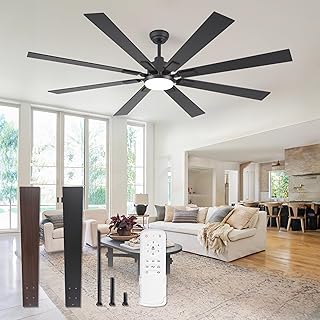

How to Choose a Ceiling Fan For Cathedral Ceiling (2026)
- Sloped-ceiling capability: Confirm the canopy accommodates your pitch — most large fans handle up to 15–30 degrees, but steeper vaults need an angled mounting kit. Check your roof slope before you check anything else.
- Downrod length, not blade size alone: Aim to land the blades 8–9 feet above the floor. Measure from the mounting point at the peak, not from the lowest part of the ceiling, and expect to buy a longer rod separately for anything above ten feet.
- Airflow at low speed: Peak CFM sells fans; low-speed performance is what you actually live with overnight. A large-diameter fan moving air slowly delivers the same cooling as a small fan spinning fast, with a fraction of the noise and turbulence.
- DC motor and true reversibility: DC motors run quieter, draw far less power, and offer six or more genuinely distinct speeds. Reverse mode matters doubly in vaulted rooms, where it pushes trapped warm air back down in winter.
- Light temperature control: Look for 3CCT or 6CCT switching with dimming. Warm 2700K light in the evening supports melatonin onset; cooler 5000K is for daytime tasks. A fixed cool-white LED overhead is a poor choice in any bedroom.
The Best Ceiling Fan For Cathedral Ceiling (2026)s Reviewed
ZMISHIBO 84″ Ceiling Fan with 8 Aluminum Blades
Eight aluminum blades on an industrial-grade DC motor make this the most capable mover of air on the list, and at 84 inches it fills the horizontal spread of a genuine great room rather than just stirring the center of it. The damp rating and six-speed range make it equally credible over a covered patio, and speed one is quiet enough for a sleeping space directly below.
72″ Modern Farmhouse Fan with 6 Solid Wood Blades
The pick for anyone who wants a vaulted room to feel warm rather than mechanical — solid wood blades read as architectural rather than appliance-like from fourteen feet away. Airflow is strong and the dimmable LED handles evening light well, though the blade profile favors smooth, broad circulation over aggressive downdraft.
84″ Extra Large Propeller Fan, Deep Walnut (No Light)
A three-blade propeller design with a high-CFM DC motor, best suited to vaults where you already have adequate lighting and want circulation only. The deep walnut finish and long blade arc give it real presence in a tall space, and removing the light module keeps the housing slim on a long downrod.
ZMISHIBO 72″ Dual-Finish Fan with 3CCT LED
The most versatile mid-size option here: strong airflow, a genuinely quiet DC motor, and 3CCT color switching that lets you drop to warm light at night. The dual-finish blades give it enough visual interest to anchor a vaulted living room without competing with the architecture.
72″ Modern Fan with 6CCT Dimmable Light, Black
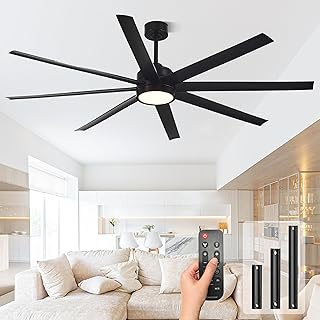
Six color temperatures and full dimming make this the strongest choice for a vaulted bedroom, where lighting flexibility matters as much as air movement. Eight blades across six speeds produce smooth, low-turbulence flow, and the matte black finish disappears against darker ceilings.
Frequently Asked Questions
How long should my downrod be for a cathedral ceiling?
Subtract nine feet from your mounting height at the peak, then subtract the fan’s own housing depth. A fourteen-foot peak typically calls for a 36–48 inch rod. Hanging blades too high is the single most common reason vaulted-room fans underperform.
Do I need a special mounting kit?
Often, yes. Standard canopies handle mild slopes; pitches beyond roughly 25–30 degrees require the manufacturer’s sloped-ceiling adapter. Verify the maximum rated angle for your specific model before ordering a downrod.
Is one large fan better than two smaller ones?
In an open vaulted great room longer than about 20 feet, two fans usually beat one. Distinct seating and sleeping zones each need their own column of moving air, and two 65-inch fans will feel more even than a single 84-inch unit.
Should the fan run all night for better sleep?
Low-speed continuous operation generally helps — it prevents the heat and humidity buildup that fragments sleep in the second half of the night. Avoid direct high-speed airflow on the face, which dries sinuses and can trigger morning congestion.
Final Thoughts
For a full-height great room, the ZMISHIBO 84-inch aluminum-blade fan delivers the most usable airflow per decibel at height, while the 72-inch modern farmhouse fan with solid wood blades is the better answer where the fan needs to look intentional as well as perform. In vaulted bedrooms, the 72-inch 6CCT dimmable model earns the nod on lighting control alone — being able to dial down to warm, low-level light overhead is a genuine sleep advantage, not a marketing feature.