Key takeaways
- Motor type: DC motors run quieter than AC, draw far less power, and offer six or more speeds instead of three. That low-end speed matters most — it lets you keep air circulating overnight without a draft on your face.
- Measured noise, not marketing: Look for a published decibel figure in the low-to-mid 20s. Anything under about 30 dB disappears into the background of a quiet bedroom; above that, you’re trading one sleep disruptor for another.
- Blade span and ceiling height: Match span to room size — roughly 44–52 inches for a standard bedroom, 56–60 inches for open living areas. Keep blades at least seven feet off the floor, and choose a flush or low-profile mount for ceilings under eight feet.
- Reversibility: A winter mode that pushes air upward recirculates warm air trapped at the ceiling without creating a chill. It’s the feature people forget they paid for and then use for half the year.
- Controls: Remote or app control means you’re not walking to a wall switch and flipping on a hall light at bedtime. Pull chains are dependable and cheap but require getting out of bed — fine for a living room, less ideal beside one.
What's inside
Ask most people what wakes them at 3 a.m. and they’ll blame noise or a racing mind. In sleep clinics, though, thermal discomfort is one of the quieter culprits — core body temperature has to drop roughly one to two degrees for deep sleep to consolidate, and a stuffy bedroom stalls that process. Moving air helps, which is why a ceiling fan is one of the cheapest sleep interventions available. The catch is that most fans arrive with a light kit bolted underneath, and overhead light in a bedroom is precisely what you don’t want at the end of the day: bright, downward, blue-heavy, and impossible to dim into something restful.
A light-free ceiling fan solves that. You get airflow and gentle sound masking with a ceiling that stays visually calm, freeing you to light the room at eye level with warm lamps. This guide looks at the best no-light ceiling fans for 2026 — plus a couple of low-profile models with dimmable, tunable LEDs for readers who genuinely need one fixture to do both jobs — and explains what actually matters when you’re buying for a bedroom rather than a kitchen.
As an Amazon Associate we earn from qualifying purchases.




How to Choose a Ceiling Fan No Light (2026)
- Motor type: DC motors run quieter than AC, draw far less power, and offer six or more speeds instead of three. That low-end speed matters most — it lets you keep air circulating overnight without a draft on your face.
- Measured noise, not marketing: Look for a published decibel figure in the low-to-mid 20s. Anything under about 30 dB disappears into the background of a quiet bedroom; above that, you’re trading one sleep disruptor for another.
- Blade span and ceiling height: Match span to room size — roughly 44–52 inches for a standard bedroom, 56–60 inches for open living areas. Keep blades at least seven feet off the floor, and choose a flush or low-profile mount for ceilings under eight feet.
- Reversibility: A winter mode that pushes air upward recirculates warm air trapped at the ceiling without creating a chill. It’s the feature people forget they paid for and then use for half the year.
- Controls: Remote or app control means you’re not walking to a wall switch and flipping on a hall light at bedtime. Pull chains are dependable and cheap but require getting out of bed — fine for a living room, less ideal beside one.
The Best Ceiling Fan No Light (2026)s Reviewed
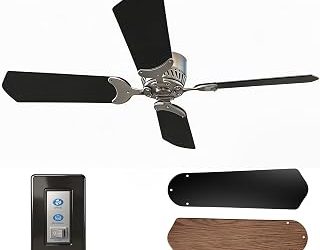
Sofucor 52″ Wood Ceiling Fan (No Light)
The strongest all-round pick for a bedroom: a quiet reversible DC motor, six speeds, remote control, and three wood-finish blades that read as furniture rather than hardware. Rated for covered outdoor use, so it also suits a screened porch or sunroom.
60″ Wood Ceiling Fan Without Light (Walnut)
Built for volume — a 60-inch span moves air across open-plan living rooms and large primary bedrooms where a 52-inch fan has to work harder and louder to do the same job. The downrod handles sloped ceilings, which is where a lot of vaulted-bedroom installs come unstuck.
Hunter Builder Elite 52″ (Snow White)
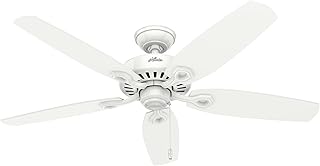
The dependable, no-fuss option from a brand that has been making these for a century. Pull-chain operation and a five-blade AC motor mean fewer features, but the build quality and wobble-free balance justify it — a sound choice for guest rooms and rentals.
DREO 42″ Low Profile with Light
For low ceilings and smaller bedrooms where you can’t give up the fixture. The 22 dB DC motor is genuinely quiet, and the dimmable five-CCT light drops to a warm setting that won’t derail melatonin the way a fixed cool-white panel does.
TCL 52″ Low Profile with Light & Remote
A flush-mount fan with a six-speed reversible DC motor and dimmable LED, aimed at rooms with eight-foot ceilings. Sensible value if you want one fixture and full remote control, though pure no-light buyers should stay with the Sofucor.
Frequently Asked Questions
Is sleeping with a ceiling fan on bad for you?
For most people, no. Continuous airflow can dry out sinuses and stiffen necks if it blows directly on you, so aim for indirect circulation at a low speed rather than a strong breeze at your pillow.
Can I install a no-light fan where a light fixture used to be?
Only if the ceiling box is fan-rated and braced to a joist — standard light boxes aren’t built for the weight or vibration. If in doubt, have an electrician swap in a rated box.
What direction should the blades turn?
Counterclockwise in warm months for a cooling downdraft; clockwise on the lowest speed in cold months to push warm ceiling air down the walls.
Will a fan replace air conditioning?
It won’t lower the room temperature, but the wind-chill effect makes a room feel three to four degrees cooler, which often means you can raise the thermostat and still sleep comfortably.
Final Thoughts
For a genuinely light-free bedroom, the Sofucor 52″ is the pick — quiet DC motor, six speeds, and a finish that flatters the ceiling. Scale up to the 60″ walnut model for open living spaces, choose the Hunter Builder Elite if you want simple, long-lived hardware, and consider the DREO 42″ low profile when one fixture has to handle both air and light.