Key takeaways
- Measure depth, not just width: A 10-inch-deep spine shelf can slip into a gap a 13-inch unit will block. In a bedroom, walkway clearance around the bed matters more than total shelf count — aim to keep at least 24 inches of unobstructed path to the door.
- Prioritise anchoring on tall units: Anything above roughly 40 inches with a narrow base needs the included wall strap fitted, especially near a bed or a child’s room. Tip-over risk is the single most common safety failure in this category, and it is entirely preventable in ten minutes.
- Watch the lighting: Integrated LED shelving is genuinely useful in a living room and genuinely counterproductive at 10pm. If you want a lit unit in a bedroom, insist on warm colour temperature and a switch you can reach without getting up.
- Think about visual noise: Open backs and slim frames read as lighter and make a small room feel bigger; closed cabinets hide the mess that keeps your eye moving. Both help sleep, for opposite reasons — pick the one matching your habits.
- Match height to sightline: Short bookcases under 30 inches double as bedside surfaces and keep the room’s upper half open and airy. Tall tree shelves draw the eye up, which suits high-ceilinged spaces but can feel looming beside a low bed.
What's inside
As a sleep-wellness practitioner, I spend a surprising amount of my time talking about furniture. The reason is simple: the room you sleep in is the room your nervous system reads for cues, and clutter is a cue. When paperbacks migrate to the nightstand, then the windowsill, then the floor beside the bed, the brain registers unfinished business — and unfinished business is the enemy of a clean wind-down. Small apartments and compact bedrooms make this worse, because there is rarely a spare wall to hand over to a full-width bookcase. Buyers end up choosing between a shelf that fits and a shelf that actually holds anything.
This guide approaches narrow bookcases the way I’d approach any bedroom fixture: as part of a sleep environment first, storage second. Below you’ll find compact freestanding units — vertical spine shelves, corner tree designs, short industrial frames, and mid-century cube styles — assessed for footprint, stability, visual weight, and whether they’ll disrupt or support a calm evening routine. I’ve flagged which models earn a place beside a bed, which belong in a hallway or office nook, and what to check before you commit floor space you can’t spare.
As an Amazon Associate we earn from qualifying purchases.




How to Choose a Bookcase For Small Spaces (2026)
- Measure depth, not just width: A 10-inch-deep spine shelf can slip into a gap a 13-inch unit will block. In a bedroom, walkway clearance around the bed matters more than total shelf count — aim to keep at least 24 inches of unobstructed path to the door.
- Prioritise anchoring on tall units: Anything above roughly 40 inches with a narrow base needs the included wall strap fitted, especially near a bed or a child’s room. Tip-over risk is the single most common safety failure in this category, and it is entirely preventable in ten minutes.
- Watch the lighting: Integrated LED shelving is genuinely useful in a living room and genuinely counterproductive at 10pm. If you want a lit unit in a bedroom, insist on warm colour temperature and a switch you can reach without getting up.
- Think about visual noise: Open backs and slim frames read as lighter and make a small room feel bigger; closed cabinets hide the mess that keeps your eye moving. Both help sleep, for opposite reasons — pick the one matching your habits.
- Match height to sightline: Short bookcases under 30 inches double as bedside surfaces and keep the room’s upper half open and airy. Tall tree shelves draw the eye up, which suits high-ceilinged spaces but can feel looming beside a low bed.
The Best Bookcase For Small Spaces (2026)s Reviewed
TUTOTAK 8-Tier Narrow Spine Bookshelf
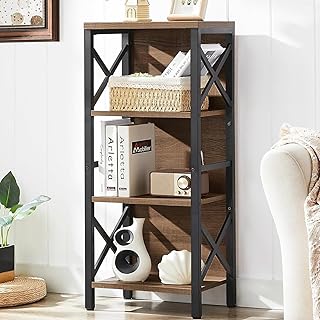
At roughly 10 x 13 inches of floor space and 47.5 inches tall, this is the most floor-efficient option here — it swallows a genuine library’s worth of paperbacks in the footprint of a side table. The narrow base makes wall-strapping non-negotiable, but as an entryway or bedside-corner tower it’s hard to beat.
SUNMORY 6-Tier Tree Bookshelf with Cabinet
The staggered tree layout tucks neatly into a corner while the lower cabinet swallows chargers, cables, and the small chaos that otherwise ends up on a nightstand. I recommend it most often for bedrooms, because concealed storage removes visual triggers without sacrificing display space.
MNEETRUNG 3-Tier Industrial Bookshelf
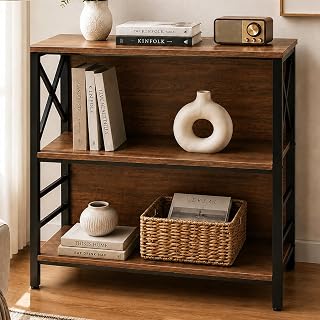
At 29.5 inches, this short steel-framed unit sits at nightstand height, which makes it unusually versatile — books below, lamp and water glass on top. The backboard adds real rigidity, so the shelf doesn’t sway when you pull a hardback from the bottom row.
LEYAOYAO Mid-Century Cube Bookshelf
Raised legs and open sides give this three-tier cube a light, floating look that keeps small bedrooms from feeling boxed in. It holds less than the tall towers, but as a low-profile piece beneath a window it’s the most restful design in this lineup.
Casaottima 6-Tier Tree Bookshelf with LED Lights
A steel-and-wood corner unit with built-in lighting and a closed cabinet, best suited to living rooms, studies, and home offices. If you do put it in a bedroom, treat the LEDs as accent lighting only and switch them off well before bed.
Frequently Asked Questions
Can a bookcase belong in a bedroom without harming sleep?
Absolutely — provided it stays organised and doesn’t become an overflow zone. A contained, tidy shelf reduces visual clutter; an overflowing one adds to it.
Are LED shelves a problem at night?
Bright or cool-toned light in the hour before bed suppresses melatonin. Warm-white LEDs used briefly are fine; leaving them on as ambient lighting is not.
How tall is too tall next to a bed?
There’s no hard rule, but many people sleep better without a tall unit looming directly over the headboard. Place taller shelves along a side wall or in a corner instead.
Do narrow bookcases really need wall anchoring?
Yes. Slim bases and top-heavy loading make tipping far more likely than the shelf’s modest size suggests, particularly on carpet or with children or pets in the home.
Final Thoughts
For maximum capacity in minimum floor space, the TUTOTAK 8-tier spine shelf remains the standout — strap it to the wall and it disappears into a corner. If your priority is a calmer bedroom, the SUNMORY tree bookshelf’s closed cabinet does the quiet work of hiding clutter, while the MNEETRUNG 3-tier offers the most restful, low-profile solution for anyone who wants storage that doubles as a bedside surface.