Key takeaways
- Posture at the point of use: Measure your seated elbow height and your standing elbow height, then buy a desk whose range covers at least one of them properly. A surface that forces your shoulders up toward your ears all day leaves residual muscle tension that makes it harder to settle at bedtime.
- Ability to disappear: If the desk lives in a bedroom or studio, prioritise casters or a folding frame. Being able to physically remove work from view before you sleep is one of the most reliable behavioural cues for separating “awake mode” from “rest mode.”
- Lighting temperature and control: Integrated LED or RGB strips are genuinely useful, but only if you can dim them and shift them warm in the evening. Cool, bright light close to the eyes after dusk suppresses melatonin more than most people expect.
- Cable and charging management: Built-in outlets and USB ports let you charge devices at the desk instead of on the nightstand. Getting phones off the bedside table is a small change with a disproportionate payoff for sleep continuity.
- Stability under real load: Check the stated weight capacity against your monitor, laptop, and the inevitable stack of books. Wobble is not just annoying — it makes you brace, and bracing all day is fatigue you carry into the night.
What's inside
Most people don’t realize how much their desk setup shapes their sleep. As someone who spends their days helping clients untangle sleep problems, I keep circling back to the same culprit: a workspace that bleeds into the bedroom. A laptop balanced on a duvet, a glowing screen inches from the pillow, hours of hunched shoulders that leave the nervous system too wired to wind down. The desk itself is rarely blamed, but it is often where the trouble starts.
This guide looks at laptop computer desks through that lens. I’ve weighed the usual furniture criteria — stability, footprint, build quality, assembly headaches — alongside the ones that matter for rest: whether the desk lets you sit or stand with a neutral spine, whether it can be rolled or folded out of your line of sight at night, and whether its lighting works with your circadian rhythm rather than against it. Below you’ll find the models worth your money in 2026, plus the buying criteria I’d apply before adding anything to your cart.
As an Amazon Associate we earn from qualifying purchases.


How to Choose a/an Laptop Computer Desk (2026)
- Posture at the point of use: Measure your seated elbow height and your standing elbow height, then buy a desk whose range covers at least one of them properly. A surface that forces your shoulders up toward your ears all day leaves residual muscle tension that makes it harder to settle at bedtime.
- Ability to disappear: If the desk lives in a bedroom or studio, prioritise casters or a folding frame. Being able to physically remove work from view before you sleep is one of the most reliable behavioural cues for separating “awake mode” from “rest mode.”
- Lighting temperature and control: Integrated LED or RGB strips are genuinely useful, but only if you can dim them and shift them warm in the evening. Cool, bright light close to the eyes after dusk suppresses melatonin more than most people expect.
- Cable and charging management: Built-in outlets and USB ports let you charge devices at the desk instead of on the nightstand. Getting phones off the bedside table is a small change with a disproportionate payoff for sleep continuity.
- Stability under real load: Check the stated weight capacity against your monitor, laptop, and the inevitable stack of books. Wobble is not just annoying — it makes you brace, and bracing all day is fatigue you carry into the night.
The Best Laptop Computer Desk (2026)s Reviewed
Adjustable Lap Desk for Bed with USB Port
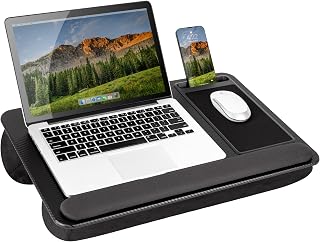
If you’re going to work in bed occasionally, do it on a stable, height-adjustable surface rather than a pillow — this one keeps a 17″ laptop level, raises the screen closer to eye height, and folds flat to slide under the bed afterward. The non-slip surface and integrated USB port are practical touches, though I’d still treat this as a tool for short sessions rather than a full workday.
Mount-It! Rolling Laptop Desk
The 29.6″–44.2″ range genuinely covers both seated and standing work for most adults, and the casters mean you can wheel the whole workstation out of the bedroom at day’s end. It’s the pick I recommend most often to clients in small apartments who need a hard boundary between office and sleep space.
Tangkula Computer Desk with Bookshelf
A fixed-height desk, but a thoughtfully designed one: the integrated shelves and CPU stand keep clutter off the work surface, and the natural wood finish reads as furniture rather than office equipment. Pair it with an adjustable chair to dial in elbow height, since the desktop itself won’t move.
BONTEC Mobile Standing Desk with Keyboard Tray
The separate keyboard tray is what sets this apart — it lets you raise the screen without pushing your wrists into extension, which is the usual failure mode of cheap standing carts. At 33 lbs capacity it suits a laptop and light peripherals rather than a heavy dual-monitor rig.
Lufeiya White Computer Desk with LED Lights
A tidy 40″ desk with a monitor riser, built-in outlets, and LED lighting, which together let you consolidate charging and task light in one place. Set the LEDs to their warmest, lowest setting after sunset and the desk becomes genuinely sleep-friendly rather than a second light source competing with your evening wind-down.
Frequently Asked Questions
Is working on a laptop in bed really that harmful?
Occasionally, no. Habitually, yes — your brain builds associations between locations and activities, and repeatedly using the bed for alert, effortful work weakens its association with sleep. If you must work there, use a lap desk, keep sessions short, and finish well before bedtime.
Do RGB desk lights affect sleep?
They can, depending on colour and brightness. Blue and cool-white light in the two to three hours before bed has the strongest effect on melatonin timing; warm amber tones at low brightness are far gentler. Choose a strip with genuine dimming and full-colour control.
Sit-stand or fixed height?
Sit-stand, if the budget allows. Alternating postures reduces the accumulated stiffness that keeps people fidgeting at night, and standing in the mid-afternoon can blunt the post-lunch slump without a caffeine hit that lingers into the evening.
How small a desk can I get away with?
Roughly 23″ of width is workable for a laptop-only setup; a 40″ surface is more comfortable once a monitor and notebook are involved. Prioritise depth of at least 20″ so the screen sits far enough from your eyes.
Final Thoughts
For most buyers, the Mount-It! Rolling Laptop Desk is the strongest all-round choice — the height range is honest, and being able to wheel work out of the bedroom is worth more to your sleep than any gadget. If you need built-in charging and considered lighting, the Lufeiya White Computer Desk delivers both in a compact footprint, and for occasional in-bed use the adjustable Lap Desk with USB Port is the sanest way to do it without wrecking your posture or your rest.