Key takeaways
- Power availability: If your boat sits unpowered between trips, a rechargeable desiccant or hanging absorber is the only honest answer. Reserve electric units for slips with dependable shore power, and never run one unattended on a marginal circuit.
- Cubic feet, not square feet: Marine spaces are low-ceilinged and compartmentalized. A unit rated for 400 cubic feet handles a quarter berth or lazarette; open cabins need higher throughput or multiple placements, since air rarely circulates between bulkheads.
- Drainage plan: Tanks that fill and shut off leave you with days of unchecked humidity. A continuous drain hose routed to a sink or sump is the difference between a device that works for a week and one that works for a season.
- Sleep-grade noise: Peltier and desiccant designs typically run in the low-to-mid 30 dB range, comparable to a quiet fan. Compressor units cycle audibly and vibrate through a hull, which is precisely the kind of intermittent noise that fragments sleep architecture.
- Low-temperature behavior: Thermoelectric units lose efficiency below roughly 59°F, while desiccants keep pulling moisture in cold air. For shoulder-season and winter layup, choose chemistry over refrigeration.
What's inside
Anyone who has spent a night in a V-berth knows the particular discomfort of sleeping in a damp cabin: bedding that feels faintly cool and heavy, a locker that smells like an old sponge, condensation beading on the hull liner inches from your face. As a sleep-wellness writer, I pay attention to this because humidity is one of the least discussed sleep disruptors. The comfortable range for restful sleep sits somewhere around 40–55% relative humidity; a closed-up boat cabin routinely climbs past 70%, and at that point your body struggles to shed heat through evaporation, sheets stop wicking, and mildew begins colonizing the very foam mattress you’re lying on.
The fix isn’t a household unit wedged into a companionway. Boats present a distinct set of constraints: unattended weeks on the mooring, shore power that may or may not be reliable, tight lockers, and cabins measured in cubic feet rather than square feet. This guide covers what actually matters when choosing marine moisture control — power strategy, capacity, drainage, and noise — and then works through the units worth your money in 2026, from renewable desiccant cylinders for off-grid layups to quiet compressor-free models you can run overnight beside the berth.
As an Amazon Associate we earn from qualifying purchases.


How to Choose a Dehumidifier For Boats (2026)
- Power availability: If your boat sits unpowered between trips, a rechargeable desiccant or hanging absorber is the only honest answer. Reserve electric units for slips with dependable shore power, and never run one unattended on a marginal circuit.
- Cubic feet, not square feet: Marine spaces are low-ceilinged and compartmentalized. A unit rated for 400 cubic feet handles a quarter berth or lazarette; open cabins need higher throughput or multiple placements, since air rarely circulates between bulkheads.
- Drainage plan: Tanks that fill and shut off leave you with days of unchecked humidity. A continuous drain hose routed to a sink or sump is the difference between a device that works for a week and one that works for a season.
- Sleep-grade noise: Peltier and desiccant designs typically run in the low-to-mid 30 dB range, comparable to a quiet fan. Compressor units cycle audibly and vibrate through a hull, which is precisely the kind of intermittent noise that fragments sleep architecture.
- Low-temperature behavior: Thermoelectric units lose efficiency below roughly 59°F, while desiccants keep pulling moisture in cold air. For shoulder-season and winter layup, choose chemistry over refrigeration.
The Best Dehumidifier For Boats (2026)s Reviewed
Eva-Dry EDV-365 Rechargeable System
The smartest solution for boats left unattended: two desiccant cylinders alternate on a blower base, so one draws moisture while the other renews in about two hours. It protects up to 400 cubic feet with no cords, no tank, and nothing to leak — ideal for berth lockers and anchor wells during layup.
Caframo Stor-Dry Air Dryer
A marine-purpose classic that pairs gentle warmth with a circulating blower, raising surface temperature just enough to keep condensation from forming on cushions and cabinetry. It doesn’t collect water, so there’s nothing to empty; it simply prevents the dew point from being reached in the first place.
Eva-Dry EDV-2400 with Humidistat
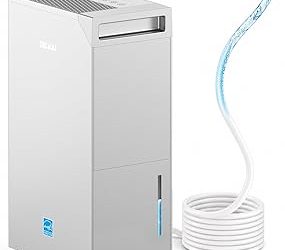
The adjustable humidistat is the standout feature here — set a target near 50% and the unit maintains it automatically rather than dehumidifying blindly. With the included drain hose plumbed overboard or to a sink, it will hold a mid-sized cabin at sleep-appropriate humidity indefinitely.
Hanging Moisture Absorber Bags (4 Pack)
Unscented calcium chloride paired with activated charcoal makes these the right choice for hanging lockers and under-berth voids where no unit will fit. They’re consumable rather than curative, but at four to a pack they’re the cheapest insurance against musty bedding you’ll find.
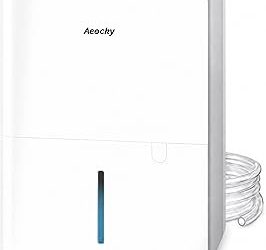
68oz Mini Dehumidifier with Drain Hose
Ultra-quiet operation and a 2000ml reservoir make this a reasonable overnight companion in a cabin up to roughly 650 square feet of equivalent volume. The included hose lets you bypass the tank entirely, which is how it should be used for anything longer than a weekend.
Frequently Asked Questions
What humidity level should I target in a boat cabin?
Aim for 45–55%. Below 40% you’ll find the air uncomfortably dry and wood joinery may shrink; above 60% you enter mold territory and your body’s evaporative cooling becomes noticeably less effective during sleep.
Can I leave a dehumidifier running while the boat is unattended?
Only with continuous drainage, a properly rated shore power connection, and ideally an auto shut-off. Otherwise, choose a rechargeable desiccant or absorber bags, which pose no electrical or overflow risk.
Will a dehumidifier eliminate that musty boat smell?
It removes the conditions causing it, but not existing colonies. Clean affected surfaces, air out cushions, then keep humidity controlled — the odor won’t return if the moisture doesn’t.
Do I still need ventilation if I run a dehumidifier?
Yes. Passive vents and cracked hatches move air between compartments, which is what allows any single unit to affect the whole cabin rather than one corner of it.
Final Thoughts
For most owners, the Eva-Dry EDV-365 handles unpowered layup while the Eva-Dry EDV-2400 with its humidistat keeps a lived-in cabin at genuinely restful humidity; add the Caframo Stor-Dry if condensation on cold surfaces is your particular battle. Get the moisture right and you’ll notice the difference the first night aboard.