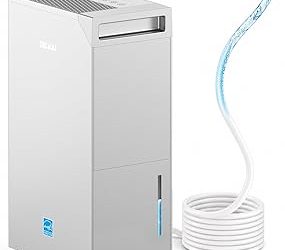
Key takeaways
- Power draw before BTU: A 5,000 BTU unit pulling 400W will run for hours off a mid-size power station; a 10,000 BTU unit pulling 1,100W will not. Match the wattage to your battery bank first, then look at cooling capacity.
- Input flexibility: Units accepting 48V DC, 12–24V vehicle power, and 100–240V wall current give you cooling at a campsite, at a rest stop, and at a full-hookup park. Single-input models strand you the moment your setup changes.
- Sleep-range decibels: Anything above roughly 50 dB near your head will cause micro-arousals you won’t remember but will feel. Look for a dedicated night or eco mode, and position the unit low and off to the side rather than at the head of the bed.
- Exhaust and condensate handling: Every compressor-based unit produces hot air and water. Confirm the hose length reaches a window or vent from where you’ll actually place the unit, and check whether drainage is self-evaporating or requires a tray you’ll be emptying at midnight.
- Heat capability: Shoulder-season camping cuts both ways. Models offering reverse-cycle heating extend your usable calendar considerably for little added weight or cost.
What's inside
Anyone who has tried to sleep in an RV on a July night knows the particular misery of it: the shell holds heat like a thermos, the roof unit either roars you awake or trips the breakout of a 30-amp hookup, and by 2 a.m. you’re lying on top of the sheets doing math on how many hours until sunrise. As someone who spends a lot of time helping people troubleshoot broken sleep, I can tell you the culprit is rarely the mattress. It’s thermal. Core body temperature needs to drop roughly one to two degrees for sleep to initiate and hold, and a cabin sitting at 82°F simply won’t let that happen.
This guide looks at portable air conditioners built for the realities of RV, van, and tent life — modest power draw, genuinely portable weight, and noise levels that won’t fragment your sleep architecture all night. I’ve focused on units that run off multiple power sources (battery, vehicle, or shore power), because the best cooling system is the one you can actually switch on where you’re parked. Below you’ll find the current standouts, followed by the specs that matter and the ones that are mostly marketing.
As an Amazon Associate we earn from qualifying purchases.


How to Choose a Portable Air Conditioner Rv (2026)
- Power draw before BTU: A 5,000 BTU unit pulling 400W will run for hours off a mid-size power station; a 10,000 BTU unit pulling 1,100W will not. Match the wattage to your battery bank first, then look at cooling capacity.
- Input flexibility: Units accepting 48V DC, 12–24V vehicle power, and 100–240V wall current give you cooling at a campsite, at a rest stop, and at a full-hookup park. Single-input models strand you the moment your setup changes.
- Sleep-range decibels: Anything above roughly 50 dB near your head will cause micro-arousals you won’t remember but will feel. Look for a dedicated night or eco mode, and position the unit low and off to the side rather than at the head of the bed.
- Exhaust and condensate handling: Every compressor-based unit produces hot air and water. Confirm the hose length reaches a window or vent from where you’ll actually place the unit, and check whether drainage is self-evaporating or requires a tray you’ll be emptying at midnight.
- Heat capability: Shoulder-season camping cuts both ways. Models offering reverse-cycle heating extend your usable calendar considerably for little added weight or cost.
The Best Portable Air Conditioner Rv (2026)s Reviewed
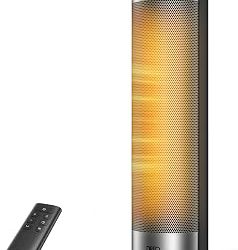
Cybertake S2 Pro Camping AC
The three-way power input and 5,100 BTU cooling paired with 6,100 BTU heating make this the most adaptable unit here, and the claimed eight hours per kilowatt-hour is realistic enough that a 1kWh battery gets you through a full sleep cycle. If you camp off-grid in variable weather, this is where I’d start.
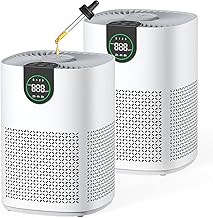
BAYKUL 5-in-1 Portable Tent AC
At 6,800 to 7,500 BTU, this is the strongest cooler on the list and the right choice for larger van builds or Class C cabins where smaller units struggle. The compact footprint and dual indoor/outdoor use give it real versatility, though budget accordingly for the higher current draw.
6000 BTU Portable AC with Carry Bag
A sensible middle ground on capacity, and the included carry bag is more than a throw-in — it protects the coil fins during transport, which is the most common failure point on portable units. Good pick for people who move the unit between an RV, a cabin, and a home office.
5100 BTU Low Power 410W Camping AC
The 410W draw is the headline: this runs comfortably off modest portable power stations without an inverter surge issue. Cooling is adequate for a sleeping area rather than a whole coach, which is exactly the right target for overnight comfort.
5200 BTU Quiet Compact Camping AC
Tuned for quiet operation at 400W, this is the one I’d recommend to light sleepers and anyone sharing a small space. It won’t drop a hot cabin quickly, so run it thirty to forty minutes before bed rather than expecting instant relief.
Frequently Asked Questions
How many BTUs do I need for an RV?
For a single sleeping area or a small van, 5,000 to 6,000 BTU is generally sufficient. Larger travel trailers and Class C motorhomes benefit from 7,000 BTU or more, especially if you’re cooling during daylight hours rather than just overnight.
Can these run off a portable power station?
Yes, provided the wattage matches. A 400W unit paired with a 1kWh station typically delivers six to eight hours. Confirm your station’s continuous output rating exceeds the AC’s running watts with headroom for compressor startup.
Will a portable unit replace my rooftop AC?
In most cases it supplements rather than replaces. Portable units excel at zone cooling — keeping the bed area comfortable — while rooftop systems handle whole-cabin loads. Many owners run the portable overnight specifically to avoid the rooftop unit’s noise.
What temperature should I target for sleep?
The research consistently points to 65–68°F as the sweet spot for most adults. You don’t need to freeze the cabin; you need a steady, slightly cool environment that lets your core temperature fall and stay down through the night.
Final Thoughts
If you want one unit that handles cold nights, hot afternoons, and inconsistent power access, the Cybertake S2 Pro is the most complete package on this list. Those cooling a larger coach should step up to the BAYKUL 5-in-1 for its extra capacity, while light sleepers and small-space campers will get the best rest from the 5200 BTU quiet model running at 400W. Whichever you choose, set it up before you’re overheated — cooling a cabin down takes far longer than keeping one cool.