Key takeaways
- Colour temperature: For bedrooms, hallways, and anywhere you’ll pass through after dark, stay at 3000K or lower. Warm white light carries less short-wavelength content, which means less circadian disruption during your final waking hour. Save 4000K and above for bathrooms and workspaces you use in daylight hours.
- Dimming range, not just “dimmable”: Plenty of fixtures dim to 20% and stop. Look for ones that reach genuinely low output, and check whether they need a compatible wall dimmer or bring their own remote. A sconce that can’t get dim is a sconce you’ll stop using at night.
- Beam direction: Up-and-down designs graze the wall and leave your eyeline clear, which is why they suit hallways and headboard walls so well. Fabric or frosted-glass shades diffuse more broadly — better for reading, slightly more spill.
- Mounting height and glare geometry: Aim for roughly 60–66 inches from the floor in hallways, and 48–52 inches beside a bed so the light source sits below your sightline when you’re lying down. If the bulb is visible from your pillow, you’ve mounted it too high.
- Hardwired versus battery: Hardwiring gives you cleaner lines and no maintenance, but requires a junction box or an electrician. Rechargeable sconces mount anywhere with adhesive or screws, which makes them the pragmatic choice for renters and awkward walls.
What's inside
Overhead lighting is the quiet saboteur of good sleep. A ceiling fixture blasting 4000K light down onto your pillow at 10pm tells your brain it’s still midday — melatonin stalls, your core temperature stays elevated, and the 20-minute wind-down you budgeted stretches into an hour of scrolling. As someone who spends most of my working life helping people rebuild their evenings, I’ve found that changing the *height and direction* of light in a bedroom or hallway does more for sleep onset than almost any gadget you can buy.
That’s where wall sconces earn their keep. Mounted at or below eye level, they push light sideways and upward instead of straight into your retinas, and they let you drop your bedroom to a low, amber-leaning glow without fumbling for a phone flashlight. This guide covers the sconces worth installing in 2026 — hardwired and battery-powered, warm and tunable — plus what to look for in colour temperature, dimming behaviour, and mounting height so your lighting works with your circadian rhythm rather than against it.
As an Amazon Associate we earn from qualifying purchases.




![[Hardwired] Wall Sconces Set of Two, Brushed Gold Bathroom Sconces with Clear Glass, Modern Wall Light Fixtures for Bathroom Mirror Vanity, Living Room, Bedroom, Hallway, Stairway, Cabinet, Foyer](https://m.media-amazon.com/images/I/617V7vuedbL._AC_UL320_.jpg)
How to Choose a Wall Sconce (2026)
- Colour temperature: For bedrooms, hallways, and anywhere you’ll pass through after dark, stay at 3000K or lower. Warm white light carries less short-wavelength content, which means less circadian disruption during your final waking hour. Save 4000K and above for bathrooms and workspaces you use in daylight hours.
- Dimming range, not just “dimmable”: Plenty of fixtures dim to 20% and stop. Look for ones that reach genuinely low output, and check whether they need a compatible wall dimmer or bring their own remote. A sconce that can’t get dim is a sconce you’ll stop using at night.
- Beam direction: Up-and-down designs graze the wall and leave your eyeline clear, which is why they suit hallways and headboard walls so well. Fabric or frosted-glass shades diffuse more broadly — better for reading, slightly more spill.
- Mounting height and glare geometry: Aim for roughly 60–66 inches from the floor in hallways, and 48–52 inches beside a bed so the light source sits below your sightline when you’re lying down. If the bulb is visible from your pillow, you’ve mounted it too high.
- Hardwired versus battery: Hardwiring gives you cleaner lines and no maintenance, but requires a junction box or an electrician. Rechargeable sconces mount anywhere with adhesive or screws, which makes them the pragmatic choice for renters and awkward walls.
The Best Wall Sconce (2026)s Reviewed
Joosenhouse Modern LED Up and Down Sconces (Set of 2)
A fixed 3000K output and a slim black profile make this pair my default recommendation for bedroom headboard walls — the split beam washes upward and downward without ever putting a hot spot at eye level. Buying as a set also means matched output on both sides of a bed, which matters more than people expect for visual comfort.
Aipsun Black LED Up and Down Wall Sconce
Essentially the single-unit answer to the same problem, and the G9 bulb format means you can swap in a different warm bulb later if you want to fine-tune the tone. Ideal for stairwells and corridors where you need one fixture, not two, and where a low-level guide light beats a bright overhead.
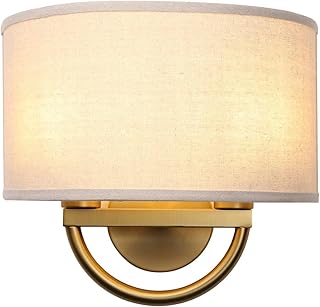
Industrial 2-Light Sconce with Linen Shade
The linen shades do real work here, softening output into a broad, forgiving pool that’s genuinely pleasant to read under. It’s the most reading-friendly pick on this list, though you’ll want to pair it with warm bulbs and a dimmer to keep evening brightness in check.
ASD 10-Inch Bronze LED Sconce (Adjustable CCT)
Selectable 3000K, 4000K, and 5000K is the standout feature — set it warm for a bedroom or hallway, cooler for a bathroom or landing where you need alertness in the morning. ETL-listed and dimmable, it’s the most flexible fixture here for anyone who isn’t sure yet how a room will be used.
Battery Operated Rechargeable Sconces (Set of 2, Gold)
No wiring, a large 10400mAh capacity, remote dimming, and colour options make this the obvious choice for rentals or any wall without a junction box. I’d ignore the novelty colours and use the warmest setting at low brightness — as a bedside or nursery night light, it’s excellent.
Frequently Asked Questions
What colour temperature is best for a bedroom sconce?
2700K–3000K. Anything cooler pushes more blue-wavelength light, which suppresses melatonin and delays sleep onset. If your fixture offers selectable temperatures, choose the warmest setting for evening rooms.
How high should a wall sconce be mounted?
Roughly 60–66 inches from the floor for general hallway and living room use, and 48–52 inches beside a bed. Bathroom vanity sconces sit around 65–70 inches, flanking the mirror rather than above it, to reduce shadows on the face.
Do I need an electrician to install a hardwired sconce?
If a junction box already exists at the right height, many people manage it themselves with the power off. If you’re adding a new box, running cable, or working in a bathroom, hire a licensed electrician and check local code.
Are battery-powered sconces bright enough to be useful?
For ambient and night-time use, yes — and the dimmability is often better than budget hardwired units. They’re less suitable as a primary reading light in a large room, where a hardwired fixture will hold brightness more consistently.
Final Thoughts
For most bedrooms, the Joosenhouse up-and-down set is the straightforward, sleep-friendly choice: fixed warm output, low glare, and a matched pair for either side of the bed. If you want one fixture that can adapt as a room’s purpose changes, the ASD adjustable-CCT sconce is the smarter buy, and renters or anyone facing an unwired wall should go straight to the rechargeable gold set and run it warm and low after dark.