Key takeaways
- Minimum seat height: This is the single specification that matters most. Measure from your floor to the crease behind your knee while barefoot, then look for a chair whose lowest setting falls at or just below that number. Feet planted flat means the pelvis stays neutral and your hip flexors stop quietly shortening all day.
- Seat depth, not just width: A seat pan deeper than your thigh length presses into the back of your knees, throttling circulation and nudging you into a slouch. Aim for roughly two to three fingers of clearance between the seat edge and your calves; compact and “small frame” models are built for exactly this.
- Where the lumbar curve sits: Fixed lumbar support designed for a taller torso lands somewhere around the mid-back on a shorter one, which is worse than no support at all. Prioritise adjustable or height-shifting lumbar pads, or a backrest with a low, pronounced curve.
- Armrests that drop and move: Arms set too high shrug your shoulders upward for hours, feeding the trapezius tightness that so often disrupts sleep onset. Adjustable or flip-up armrests let you support your forearms at true desk height, or tuck them away entirely.
- Breathability and cushion quality: Thermal comfort matters more than most buyers realise — overheating during the day disrupts hydration and afternoon alertness, which in turn muddles your sleep timing. Mesh backs excel here; if you prefer PU leather, look for double-layer cushioning that resists flattening.
What's inside
As a sleep-wellness practitioner, I spend most of my day asking people about their nights — and a surprising amount of that conversation ends up being about their chairs. When someone under 5’4″ perches for eight hours with their feet dangling, hips tipped backward, and shoulders hitched up toward their ears, the body doesn’t simply forget at bedtime. It carries that compressed posture into the mattress, where it shows up as restless hips, a stiff lower back at 3 a.m., and that peculiar tension headache that greets you before your alarm does. Daytime seating is a nighttime recovery issue.
The trouble is that the vast majority of office chairs are engineered around a 5’9″ frame. Seat pans run too deep, backrests place lumbar curves above where a shorter spine actually needs them, and even the lowest gas-lift setting leaves shorter legs stranded. This guide looks at chairs that genuinely accommodate petite proportions — shallower seats, lower minimum heights, adjustable arms and back support — so your spine can decompress overnight instead of spending the small hours undoing the workday.
As an Amazon Associate we earn from qualifying purchases.



How to Choose a/an Ergonomic Office Chair For Short People (2026)
- Minimum seat height: This is the single specification that matters most. Measure from your floor to the crease behind your knee while barefoot, then look for a chair whose lowest setting falls at or just below that number. Feet planted flat means the pelvis stays neutral and your hip flexors stop quietly shortening all day.
- Seat depth, not just width: A seat pan deeper than your thigh length presses into the back of your knees, throttling circulation and nudging you into a slouch. Aim for roughly two to three fingers of clearance between the seat edge and your calves; compact and “small frame” models are built for exactly this.
- Where the lumbar curve sits: Fixed lumbar support designed for a taller torso lands somewhere around the mid-back on a shorter one, which is worse than no support at all. Prioritise adjustable or height-shifting lumbar pads, or a backrest with a low, pronounced curve.
- Armrests that drop and move: Arms set too high shrug your shoulders upward for hours, feeding the trapezius tightness that so often disrupts sleep onset. Adjustable or flip-up armrests let you support your forearms at true desk height, or tuck them away entirely.
- Breathability and cushion quality: Thermal comfort matters more than most buyers realise — overheating during the day disrupts hydration and afternoon alertness, which in turn muddles your sleep timing. Mesh backs excel here; if you prefer PU leather, look for double-layer cushioning that resists flattening.
The Best Ergonomic Office Chair For Short People (2026)s Reviewed
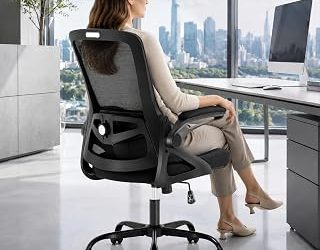
BestOffice Mid-Back Swivel Desk Chair
A genuinely low-profile mid-back option whose height range and modest seat depth suit petite frames far better than a full executive chair, with lumbar shaping that lands where a shorter lumbar spine actually curves. The sponge seat and breathable backrest make it a sensible everyday pick for anyone doing focused desk work rather than marathon 10-hour shifts.
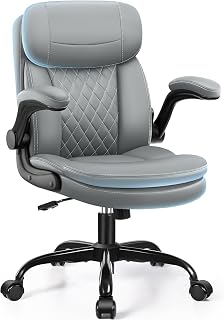
Upgraded PU Chair with Double-Layer Cushion and Neckrest, Grey
The double-layer seat cushion is the standout feature here — it resists the gradual collapse that turns cheap foam into a pelvis-tilting hazard within months. Explicitly proportioned for shorter users, and the neckrest gives you somewhere to unload your cervical spine during reading or calls.
PU Home Computer Desk Chair with Ergonomic Back Support
A compact, no-nonsense chair with a contoured back and adjustable armrests, well suited to smaller home offices where a bulky chair would dominate the room. Best for light-to-moderate daily use; the smaller footprint is a real advantage in tight corners.
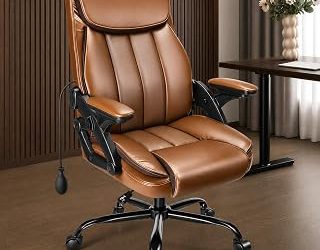
Leather Swivel Lumbar Support Chair, Brown
If you want executive-style presence without executive-scale dimensions, this is the pick — padded arms and a defined lumbar curve in a smaller-scaled shell. The warmer brown PU also reads less “corporate” in a bedroom-adjacent workspace, which matters if you’re trying to keep sleep spaces psychologically distinct from work ones.
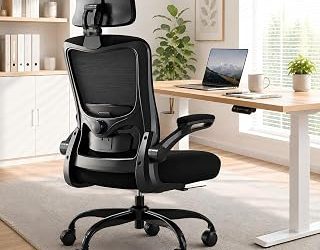
High-Back Mesh Chair with Flip-Up Armrests, 330 lb Capacity
The most thermally comfortable option here, pairing a breathable mesh back with adjustable lumbar support you can position to your own torso length rather than an average one. Flip-up armrests let shorter users tuck the chair fully under a desk and drop their shoulders — a small change with outsized effects on evening neck tension.
Frequently Asked Questions
What seat height should I look for if I’m 5’0″?
Most people around five feet need a seat height near 15–16 inches. Measure your own lower-leg length barefoot rather than trusting a size chart, and remember that a footrest is a perfectly legitimate fix if the chair’s minimum height is an inch or two too tall.
Can a bad chair really affect how I sleep?
Indirectly but meaningfully. Prolonged poor seating shortens hip flexors and stiffens the thoracic spine, which makes side and back sleeping less comfortable and increases nighttime position changes. It also reduces natural movement during the day, and movement is one of the strongest drivers of deep, consolidated sleep.
Is mesh or PU leather better for a small frame?
Mesh wins on airflow and tends to flex around a smaller torso rather than forcing it into a fixed shape. PU leather is easier to wipe clean and often feels more supportive underneath — provided the cushion is multi-layer rather than a single thin slab of foam.
How often should I get out of the chair?
Aim for a genuine change of position every 30 to 45 minutes, even if it’s only 60 seconds of standing. Regular circulation breaks reduce the accumulated stiffness that otherwise follows you to bed.
Final Thoughts
For most shorter users, the High-Back Mesh Chair with Flip-Up Armrests offers the best combination of adjustable lumbar positioning and all-day breathability, while the Upgraded PU Chair with Double-Layer Cushion is the stronger choice if you prefer padded comfort that won’t flatten out. On a tighter budget, the BestOffice Mid-Back Swivel remains a sound, low-profile entry point — and your lower back will notice the difference long before morning.