Key takeaways
- Height range over headline specs: Check the lowest and highest positions against your own body, not the marketing copy. Taller users routinely outgrow budget frames at the top end, and if standing is uncomfortable you simply won’t do it — which defeats the entire daytime-movement benefit.
- Storage you can reach seated: A drawer under the work surface gets used; a cabinet across the room does not. Prioritise integrated drawers and open shelving that let you clear the desktop in one sweep at the end of the day.
- Built-in power and cable routing: Onboard outlets and USB ports keep charging cables off the floor and out of the walkway. This matters doubly if the desk shares a bedroom — a tidy, dark desk at night means fewer glowing LEDs and less visual stimulation before bed.
- Motor noise and preset memory: Quiet single-motor systems are fine for most homes, but if you share walls or work near a sleeping partner or child, check reviews for noise. Memory presets remove friction, and friction is why most people stop alternating positions after week two.
- Footprint and room role: L-shaped models give you a generous surface and a natural filing zone, but they dominate a space. In a bedroom or studio, a compact 55-inch desk that reads as furniture rather than equipment supports better sleep hygiene.
What's inside
Most people shopping for a standing desk are thinking about their lower back, not their sleep. But as someone who spends their days working with clients on circadian health and insomnia, I can tell you the two are quietly linked. Daytime movement is one of the strongest natural drivers of deep, consolidated sleep at night — sedentary days produce shallow, fragmented ones. And when a home office bleeds into a bedroom or living space, a desk buried in cables, chargers, and unfinished paperwork keeps the nervous system in low-grade work mode long after the laptop closes. Storage isn’t a luxury feature here. It’s how you tell your brain the workday is over.
This guide looks at standing desks that combine genuine sit-stand functionality with real, usable storage — drawers, shelving, and integrated power that let you clear a surface in seconds rather than shuffling clutter from one pile to another. I’ve assessed each pick on adjustment range and motor quality, storage that’s actually within arm’s reach while seated, cable and outlet management, and how well the piece disappears into a shared room at night. Below you’ll find the current standouts, followed by a buying framework and answers to the questions I hear most often.
As an Amazon Associate we earn from qualifying purchases.




How to Choose a Standing Desk With Storage (2026)
- Height range over headline specs: Check the lowest and highest positions against your own body, not the marketing copy. Taller users routinely outgrow budget frames at the top end, and if standing is uncomfortable you simply won’t do it — which defeats the entire daytime-movement benefit.
- Storage you can reach seated: A drawer under the work surface gets used; a cabinet across the room does not. Prioritise integrated drawers and open shelving that let you clear the desktop in one sweep at the end of the day.
- Built-in power and cable routing: Onboard outlets and USB ports keep charging cables off the floor and out of the walkway. This matters doubly if the desk shares a bedroom — a tidy, dark desk at night means fewer glowing LEDs and less visual stimulation before bed.
- Motor noise and preset memory: Quiet single-motor systems are fine for most homes, but if you share walls or work near a sleeping partner or child, check reviews for noise. Memory presets remove friction, and friction is why most people stop alternating positions after week two.
- Footprint and room role: L-shaped models give you a generous surface and a natural filing zone, but they dominate a space. In a bedroom or studio, a compact 55-inch desk that reads as furniture rather than equipment supports better sleep hygiene.
The Best Standing Desks With Storage (2026) Reviewed
SEDETA Farmhouse 63″ x 67″ L-Shaped Standing Desk
The most generous storage-to-surface ratio here, with a full corner layout, integrated power outlets, and enough shelving to keep the entire desktop clear overnight. Best suited to a dedicated office or a spare room — it’s too commanding a presence for a bedroom.
FLEXISPOT Comhar 55″ Electric Standing Desk
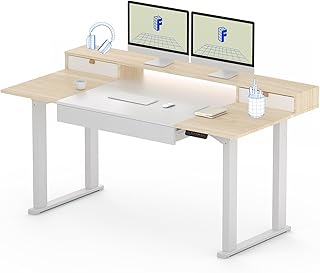
My default recommendation for shared or multi-purpose rooms: quiet electric adjustment, a slim built-in drawer, USB charging on the control panel, and a child lock that’s genuinely useful in a family home. The walnut finish reads as furniture, which helps the space feel restful when you’re not working.
70″ Executive Standing Desk with Privacy Panel
The privacy panel and one-piece natural oak top make this the strongest pick for video-heavy work, and AC plus USB outlets keep the whole setup tethered to a single cable. Measure carefully — 70 inches needs a wall it can call its own.
FLEXISPOT 4-Leg 63″ x 32″ Standing Desk
The four-leg frame delivers noticeably less wobble at standing height than typical two-leg designs, and three drawers plus shelving handle a real paper workflow. A sensible choice if you stand for long stretches and want stability you can lean on.
Mid Century Modern 55″ x 22″ Standing Desk
At just 22 inches deep, this is the one I point bedroom-office clients toward: it holds a laptop and a lamp, adjusts electrically, and looks like a writing desk rather than a workstation. Storage is modest, but that constraint keeps clutter — and evening mental arousal — in check.
Frequently Asked Questions
Does using a standing desk really improve sleep?
Indirectly, yes. Breaking up prolonged sitting increases overall daily energy expenditure and light physical activity, both of which are associated with faster sleep onset and more slow-wave sleep. A standing desk isn’t a treatment for insomnia, but it removes one common obstacle.
How long should I stand each day?
Aim for alternating roughly every 30 to 45 minutes rather than chasing a daily total. Standing until you ache is counterproductive — discomfort late in the day can itself interfere with settling at night.
Is it a bad idea to put a desk in the bedroom?
It’s not ideal, but it’s often unavoidable. Choose the smallest desk that meets your needs, use its storage to fully clear the surface each evening, and orient it away from your line of sight from the bed so the room reads as rest, not work.
Do I need a standing mat as well?
If you stand more than an hour or two a day, yes. A cushioned mat reduces foot and calf fatigue significantly, which makes you far more likely to keep standing — and keeps end-of-day soreness from following you to bed.
Final Thoughts
For most homes, the FLEXISPOT Comhar 55″ strikes the best balance of quiet adjustment, useful drawer storage, and furniture-like looks in a shared room. If you have a dedicated office and real paperwork to file, the SEDETA Farmhouse L-shaped desk offers unmatched storage, while the compact Mid Century Modern 55″ is the smart pick for anyone working — and sleeping — in the same four walls.