Key takeaways
- Height range that matches your desk, not the average desk: For perching, your hips should sit slightly above your knees at standing-desk height. Measure your desk surface, subtract roughly 10–12 inches, and confirm that number falls in the middle of the stool’s range — not at its absolute limit, where stability suffers.
- Movement type: Wobble bases invite constant subtle correction and are ideal for circulation and spinal decompression. Rocking or tilting bases feel calmer and suit longer sessions. Fixed swivel stools offer the least stimulation but the most predictability if you’re recovering from an injury.
- Seat tilt and shape: A slightly forward-sloping saddle or contoured seat opens the hip angle and reduces the pelvic tuck that flattens your lumbar curve — the same posture that leaves your back complaining at midnight. Flat, hard rounds are fine for 20-minute stints, less so for two hours.
- Base grip and footprint: Look for a genuinely non-slip base if you’re on hardwood or tile. Wheels are useful for multi-station work but reduce the resistance that makes active sitting effective; choose one or the other deliberately.
- Weight capacity and build: Steel-frame construction with a rated capacity comfortably above your weight will hold its adjustment and stay quiet. Flex and creaking are early signals of a stool that will drift out of position within months.
What's inside
Most people shopping for a standing desk stool are trying to solve a problem they’ve misdiagnosed. They think the issue is the 3 p.m. crash, the aching lower back, or the restlessness that makes an eight-hour workday feel like twelve. As someone who spends most days helping people troubleshoot poor sleep, I’d point somewhere else: how your body spent the preceding fourteen hours. Long stretches of static sitting suppress the low-grade physical output that builds healthy sleep pressure, and a stiff, compressed lower back at bedtime is one of the most common reasons people report tossing before they settle. A stool that keeps you semi-upright and gently moving isn’t office furniture so much as a small daily deposit into a better night.
This guide looks at standing desk stools through that lens — perch height, movement quality, seat support, and whether the thing actually encourages micro-motion instead of a slouched compromise between sitting and standing. Below you’ll find current picks, followed by the criteria I’d weigh before buying and answers to the questions I get asked most.
As an Amazon Associate we earn from qualifying purchases.


How to Choose a Standing Desk Stool (2026)
- Height range that matches your desk, not the average desk: For perching, your hips should sit slightly above your knees at standing-desk height. Measure your desk surface, subtract roughly 10–12 inches, and confirm that number falls in the middle of the stool’s range — not at its absolute limit, where stability suffers.
- Movement type: Wobble bases invite constant subtle correction and are ideal for circulation and spinal decompression. Rocking or tilting bases feel calmer and suit longer sessions. Fixed swivel stools offer the least stimulation but the most predictability if you’re recovering from an injury.
- Seat tilt and shape: A slightly forward-sloping saddle or contoured seat opens the hip angle and reduces the pelvic tuck that flattens your lumbar curve — the same posture that leaves your back complaining at midnight. Flat, hard rounds are fine for 20-minute stints, less so for two hours.
- Base grip and footprint: Look for a genuinely non-slip base if you’re on hardwood or tile. Wheels are useful for multi-station work but reduce the resistance that makes active sitting effective; choose one or the other deliberately.
- Weight capacity and build: Steel-frame construction with a rated capacity comfortably above your weight will hold its adjustment and stay quiet. Flex and creaking are early signals of a stool that will drift out of position within months.
The Best Standing Desk Stools of 2026, Reviewed
IWMH Adjustable Sit-Stand Stool with Footrest
The integrated footrest is the standout feature here — it gives you somewhere to unload one leg at a time, which meaningfully extends how long you can perch before fidgeting turns into slumping. A sensible first stool for anyone transitioning from a conventional chair rather than jumping straight into active sitting.
Height-Adjustable Swivel Stool with Rocking Motion (21–31″)
The rocking action is gentler than a full wobble, making this a good fit for focused work where you want movement in the background rather than the foreground. Its lower starting height also suits shorter users and standard-height desks better than most stools in this category.
IWMH Ergonomic Wobble Stool with Round Swivel Seat
A pared-back, backrest-free design that works well in shared or multi-purpose rooms — kitchen counters and bedroom desks included. Expect to build tolerance gradually; the round seat rewards an engaged core but doesn’t do the work for you.
Rolling Stool Chair with Back Support and PU Cushion
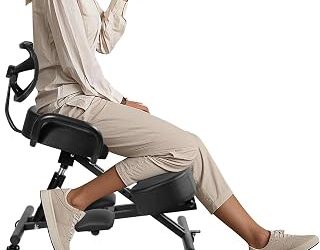
The compromise pick, and a genuinely useful one: wheels plus a low back make it viable for people who cannot perch unsupported for long, whether due to injury, pregnancy, or hip mobility limits. Best for tasks that involve moving between stations rather than sustained deep work.
SONGMICS ACTIVO Wobble Stool (23.6–33.3″)
The tallest range of the group and the most confident non-slip base, which makes it my pick for tall users and for anyone pairing a stool with a fully raised standing desk. Adjustment is smooth and holds position reliably over time.
Frequently Asked Questions
Can a standing desk stool really affect my sleep?
Indirectly, yes. More daytime movement and less spinal compression tend to reduce the evening stiffness and physical restlessness that delay sleep onset. It’s a supporting factor, not a treatment for insomnia.
How long should I sit on one at a stretch?
Start with 20–30 minutes and build up. Active sitting engages stabilising muscles that fatigue faster than you expect, and pushing through soreness usually just teaches you a worse posture.
Do I still need to stand and walk?
Absolutely. A stool changes the quality of your sitting; it doesn’t replace standing intervals or short walks, which do more for circulation and afternoon alertness than any seat can.
Are wobble stools suitable if I have back pain?
Often helpful for general stiffness, but check with a clinician if you have a diagnosed disc or joint condition. In those cases a supported rolling stool is the safer entry point.
Final Thoughts
For most home offices, the SONGMICS ACTIVO offers the best combination of height range and base stability, while the IWMH stool with footrest is the easiest transition for anyone new to perching. If you need genuine back support or mobility around the room, the rolling stool with PU cushion is the pragmatic choice — and any of the three will do more for how you feel at bedtime than the chair you’re likely sitting in now.