Key takeaways
- Low-end dimming: Three-way touch dimming is now standard, but what matters is how dim the lowest setting actually gets. You want a bottom step soft enough to read a page by without flooding the room — roughly candlelight territory. A lamp whose “low” is still bright enough to light the whole bedroom defeats the purpose.
- Color temperature: For the hour before bed, aim for 2700K or warmer. Cooler 5000K “daylight” bulbs are excellent for morning reading, homework, or a nursery changing station, but they suppress melatonin more aggressively at night. Lamps offering selectable color temperatures let you use one fixture for both jobs.
- Height and shade opacity: The bottom edge of the shade should sit at or just above seated eye level in bed — generally 20 to 26 inches of total lamp height on a standard nightstand. A fabric or ceramic shade that diffuses light sideways beats a clear or open-top design that shines directly into your face.
- Charging and outlets: A built-in USB-C port and pass-through AC outlet eliminate the tangle of adapters most bedsides accumulate. Confirm the USB-C port delivers enough wattage for a phone, and check whether the outlet is switched or always live — you want it always live so a charging phone isn’t cut off when you turn the lamp off.
- Control placement: Touch-sensitive bases are the most sleep-friendly option because they require no aim or precision. Rotary knobs and cord-inline switches force you to fully wake and locate them. If you share a bed, quieter touch controls also spare your partner the audible click.
What's inside
Most people shop for a nightstand lamp the same way they shop for a throw pillow — by looking at it. But the lamp beside your bed does something no other fixture in your home does: it’s the last light your eyes process before sleep and the first they meet on waking. That makes brightness, color temperature, and how finely you can dial both of them down far more consequential than the shape of the shade. A lamp that only knows “on” and “off” at 3000 lumens of cool white is, functionally, a small alarm clock for your circadian system.
This guide approaches nightstand lamps from a sleep-wellness perspective first and a décor perspective second. Below you’ll find picks that get the fundamentals right — genuine low-end dimming, warm evening light, and controls you can operate half-asleep without hunting for a switch — plus practical notes on built-in USB-C charging, height relative to your mattress, and which specs actually matter in a bedroom versus a home office. Every recommendation is evaluated on how well it supports winding down, not just how it photographs.
As an Amazon Associate we earn from qualifying purchases.


How to Choose a Nightstand Lamp
- Low-end dimming: Three-way touch dimming is now standard, but what matters is how dim the lowest setting actually gets. You want a bottom step soft enough to read a page by without flooding the room — roughly candlelight territory. A lamp whose “low” is still bright enough to light the whole bedroom defeats the purpose.
- Color temperature: For the hour before bed, aim for 2700K or warmer. Cooler 5000K “daylight” bulbs are excellent for morning reading, homework, or a nursery changing station, but they suppress melatonin more aggressively at night. Lamps offering selectable color temperatures let you use one fixture for both jobs.
- Height and shade opacity: The bottom edge of the shade should sit at or just above seated eye level in bed — generally 20 to 26 inches of total lamp height on a standard nightstand. A fabric or ceramic shade that diffuses light sideways beats a clear or open-top design that shines directly into your face.
- Charging and outlets: A built-in USB-C port and pass-through AC outlet eliminate the tangle of adapters most bedsides accumulate. Confirm the USB-C port delivers enough wattage for a phone, and check whether the outlet is switched or always live — you want it always live so a charging phone isn’t cut off when you turn the lamp off.
- Control placement: Touch-sensitive bases are the most sleep-friendly option because they require no aim or precision. Rotary knobs and cord-inline switches force you to fully wake and locate them. If you share a bed, quieter touch controls also spare your partner the audible click.
The Best Nightstand Lamps of 2026, Reviewed
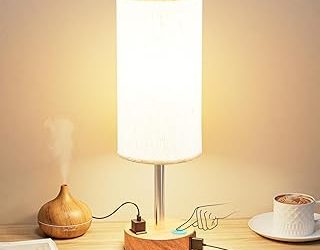
Dimmable Touch Lamp with USB A+C and AC Outlet, 14″
A compact, well-proportioned pick for smaller nightstands where a full-size lamp would crowd out a book and a water glass. The wood-grain metal base and fabric shade diffuse light evenly, and the three-way touch dimming plus pass-through outlet cover the essentials without unnecessary complexity.
Touch Control Table Lamps, Set of 2 with USB and AC Outlet
The value play for couples who want matched lamps on both sides of the bed, or for outfitting two rooms at once. Note that the included 5000K daylight bulbs are far too cool for pre-sleep use — swap them for 2700K bulbs in a bedroom and save the originals for a nursery or study.
19.6″ Touch Lamp with Charging Station
Our overall favorite for standard-height nightstands: at nearly 20 inches, the shade lands right around seated eye level, so light falls onto your book rather than into your eyes. The integrated charging station keeps cables contained, and assembly is genuinely tool-free.
Gold Bedside Lamps, Set of 2, 16.4″
The most design-forward option here, with brushed gold hardware that reads as intentional rather than trendy. At 16.4 inches it suits lower platform beds and dorm furniture particularly well, and the touch dimming performs on par with taller models in the lineup.
PoKat 20.75″ Ceramic Table Lamps, Set of 2
Choose these if aesthetics lead your decision — the white ceramic bodies and generous 20.75-inch height give a bedroom a considered, finished look. There’s no built-in USB here, so pair them with a separate bedside charger and a dimmable warm-white bulb.
Frequently Asked Questions
What color temperature is best for a bedside lamp?
2700K or warmer for evening use. Warm light contains less short-wavelength blue, which is the portion of the spectrum most implicated in delaying melatonin release. Reserve 4000K–5000K bulbs for daytime tasks.
How bright should a nightstand lamp be?
For reading in bed, 400 to 800 lumens at the top setting is ample. The more important number is the bottom of the dimming range — you want the option of something under 50 lumens for late-night navigation.
Do touch lamps work with smart bulbs?
Generally not well. Three-way touch bases cut power to cycle brightness, which can confuse smart bulbs or reset them. Use the lamp’s own dimming with a standard non-smart LED, or choose a plain-switch lamp for smart bulbs.
Will the USB ports charge my phone quickly?
Expect modest speeds — these ports are sized for overnight top-ups, not fast charging. That’s arguably ideal for bedside use, since slower charging generates less heat. For fast charging, use the pass-through AC outlet with your phone’s own adapter.
Final Thoughts
If you want one lamp that gets the sleep science right, the 19.6″ touch lamp with charging station is the strongest all-around choice thanks to its eye-level shade and integrated ports. Couples furnishing both sides of the bed will get more value from the touch control set of 2 — just plan on swapping the daylight bulbs for something warmer. And if the lamp needs to earn its place visually as well as functionally, the PoKat ceramic set is the one worth paying a little extra for.