Key takeaways
- Color temperature: 2700K–3000K is the sweet spot for living areas and bedrooms; it reads warm and does far less to your melatonin than 5000K daylight. Save cool white for garages, laundry rooms, and task-only zones you don’t occupy late.
- Dimming capability: Non-negotiable if the room is used in the evening. A dimmable kit paired with a compatible wall dimmer lets you drop output to 10–20% after dark, which is the single most effective sleep-friendly upgrade you can make.
- Head aim and glare control: Look for heads with a wide rotation range and a recessed or shrouded lamp so the diode isn’t staring at you. Aiming light at walls and ceilings instead of at seated eye level cuts perceived brightness dramatically without losing usable illumination.
- Integrated LED versus GU10 bulbs: Integrated heads are slimmer and better sealed; GU10 sockets let you swap in whatever wattage, beam angle, or Kelvin you want later. If you’re unsure of the final color temperature, choose replaceable bulbs.
- Track length and head count: Plan roughly one head per 2–3 feet of counter or artwork, and measure your ceiling run before ordering. More heads at lower output beats fewer heads cranked bright — even coverage is what makes a room feel calm.
What's inside
Most people shop for track lighting the way they shop for a paint color — they pick what looks good in a showroom photo and hope for the best. Then the fixtures go up, the beams land in all the wrong places, and the kitchen reads like a dental office at nine at night. As someone who spends most of my working hours helping clients repair their sleep, I can tell you that overhead lighting is one of the most underestimated variables in the whole equation. Bright, blue-heavy light in the evening suppresses melatonin, delays your body’s internal clock, and quietly pushes bedtime later week after week. Track lighting sits directly overhead, aimed into your visual field, which makes it more influential than almost any lamp in the room.
The good news: track systems are also the most controllable ceiling light you can buy. Independently pivoting heads let you bounce light off walls instead of into eyes, and the better 2026 kits ship dimmable with sensible color temperatures. This guide looks at six current options through two lenses at once — how well they light a space for cooking, reading, or working, and how gently they treat your circadian rhythm after sundown. Below you’ll find the picks, then a buying framework and answers to the questions I hear most.
As an Amazon Associate we earn from qualifying purchases.



How to Choose a Track Lighting (2026)
- Color temperature: 2700K–3000K is the sweet spot for living areas and bedrooms; it reads warm and does far less to your melatonin than 5000K daylight. Save cool white for garages, laundry rooms, and task-only zones you don’t occupy late.
- Dimming capability: Non-negotiable if the room is used in the evening. A dimmable kit paired with a compatible wall dimmer lets you drop output to 10–20% after dark, which is the single most effective sleep-friendly upgrade you can make.
- Head aim and glare control: Look for heads with a wide rotation range and a recessed or shrouded lamp so the diode isn’t staring at you. Aiming light at walls and ceilings instead of at seated eye level cuts perceived brightness dramatically without losing usable illumination.
- Integrated LED versus GU10 bulbs: Integrated heads are slimmer and better sealed; GU10 sockets let you swap in whatever wattage, beam angle, or Kelvin you want later. If you’re unsure of the final color temperature, choose replaceable bulbs.
- Track length and head count: Plan roughly one head per 2–3 feet of counter or artwork, and measure your ceiling run before ordering. More heads at lower output beats fewer heads cranked bright — even coverage is what makes a room feel calm.
The Best Track Lighting (2026) Reviewed
AUQUEE 8-Light Matte Black Track Lighting
Eight rotatable heads across a single matte-black bar give you genuine flexibility in long kitchens and hallways, and the bulb-free design means you choose the Kelvin yourself — a real advantage for anyone building an evening-friendly setup. I’d fit it with 2700K dimmable GU10s and aim the end heads at the walls to soften the whole run.
VANoopee 12-Light Kit with 13ft Track
This is the most sophisticated system here: dimmable heads, 3000K output, a 24-degree beam, and CRI90+ color rendering that makes food, wood tones, and skin look accurate rather than washed out. Twelve heads over thirteen feet lets you run each one at modest brightness, which is exactly how you get a well-lit room that doesn’t feel harsh.
Bojim 6-Light Gold Track Kit
The acrylic ring diffuser is the detail that matters — it takes the hard edge off each beam so the fixture doesn’t produce that pinpoint glare typical of bare spotlights. Warm gold finish and a GU10 socket make it an easy fit for studios, closets, and dining spaces where you want warmth on a dimmer.
4-Light Dual-Lighting Black Spotlight Kit
The 50W+20W dual-circuit design is the standout feature: you can run full task lighting while cooking, then switch to the lower ambient mode for the rest of the evening. Bulbs are included, which makes this the fastest path to a two-tier lighting scheme without wiring a dimmer.
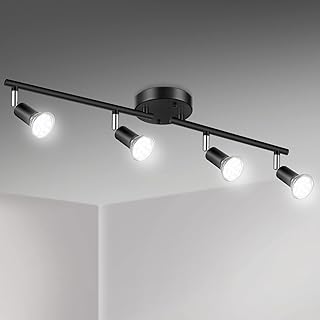
4-Light Black Kit, Bulbs Not Included
A clean, compact four-head bar for smaller rooms, and leaving the bulbs to you is a feature rather than a compromise. Fit 2700K dimmables in a bedroom or den; save the daylight bulbs for a workshop.
Frequently Asked Questions
Is track lighting a bad choice for a bedroom?
Not at all, provided you specify warm color temperature and dimming. Aim the heads toward the ceiling or a wall rather than the bed, and treat the system as ambient light — not as the thing you switch on at full blast an hour before sleep.
Should I buy 5000K daylight bulbs?
Only for spaces you use during daylight hours or for detail work. Cool white in the evening is the lighting equivalent of an espresso — useful when you need alertness, counterproductive when you’re winding down.
Can I install a track kit myself?
Most kits mount to an existing ceiling box with a mounting plate and a few wire connections. Kill the breaker first, verify with a tester, and call an electrician if you’re adding a new circuit or a dimmer switch.
How many heads do I actually need?
Count the tasks, not the square footage. A galley kitchen usually needs four to six; a long open-plan run benefits from eight to twelve heads dimmed low, since spreading light across more sources reduces glare and shadows.
Final Thoughts
If you want one system that handles both daytime function and evening calm, the VANoopee 12-light kit is the strongest all-rounder here thanks to its dimmable 3000K heads and high color accuracy. For longer runs on a tighter budget, the AUQUEE 8-light matte black bar gives you full control over bulb choice, while the Bojim 6-light gold kit is the pick when you want diffused, low-glare warmth in a smaller, more decorative space.