Key takeaways
- Measure the diagonal, not just the wings: An L-shaped desk’s advertised length describes its longest side, but the piece you have to live with is the diagonal sweep across the corner. Chalk the outline on your floor first and confirm you can still walk past your bed without turning sideways.
- Insist on reversibility: A reversible chassis lets you orient the long wing away from your headboard rather than pointing at it. In a shared or awkwardly shaped bedroom, that single flip decides whether your desk feels like a boundary or an intrusion.
- Treat lighting as a spec, not a bonus: Integrated LEDs are genuinely useful if they dim and shift warm. Fixed cool-white strips at eye level in the evening will suppress melatonin as effectively as any phone screen, so look for adjustable colour and brightness or plan to run a warm task lamp instead.
- Prioritise closable, opaque storage: Drawers, fabric bins and cabinets let you put work out of sight in thirty seconds. Open shelving looks lighter but keeps visual to-do lists in your peripheral vision from pillow height — a known contributor to pre-sleep rumination.
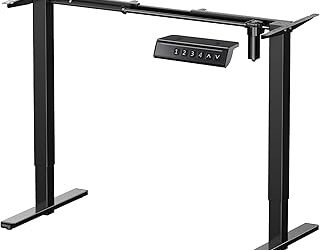
- Consider height adjustment for daytime alertness: Standing through your post-lunch dip reduces the temptation to nap late in the afternoon, which is what typically pushes bedtime back. A powered sit-stand corner desk costs more but earns its place in a room doing double duty.
What's inside
Most of us don’t think of a desk as sleep equipment, but in my work with clients who struggle to wind down, the workstation is often the culprit hiding in plain sight. When a laptop lives on the nightstand or a folding table sprawls across the foot of the bed, the brain loses the spatial cue that says this is where work happens, and that is where rest happens. Small rooms make this worse: there simply isn’t a wall long enough for a conventional desk, so work bleeds into the sleep zone by default. The result is a bedroom that never fully signals “off,” and a nervous system that stays half-alert at midnight.
A corner desk solves a geometry problem and a physiology problem at once. By claiming the two shortest walls in a room, it carves out a defined work perimeter without eating into the space around your bed — and that separation is the single cheapest sleep intervention I recommend. This guide covers the corner desks I’d actually put in a bedroom or studio apartment in 2026, with attention to footprint, storage that lets you close down at the end of the day, adjustable lighting, and sit-stand options that keep daytime energy where it belongs. Below are the current standouts.
As an Amazon Associate we earn from qualifying purchases.


How to Choose a Corner Desk (2026)
- Measure the diagonal, not just the wings: An L-shaped desk’s advertised length describes its longest side, but the piece you have to live with is the diagonal sweep across the corner. Chalk the outline on your floor first and confirm you can still walk past your bed without turning sideways.
- Insist on reversibility: A reversible chassis lets you orient the long wing away from your headboard rather than pointing at it. In a shared or awkwardly shaped bedroom, that single flip decides whether your desk feels like a boundary or an intrusion.
- Treat lighting as a spec, not a bonus: Integrated LEDs are genuinely useful if they dim and shift warm. Fixed cool-white strips at eye level in the evening will suppress melatonin as effectively as any phone screen, so look for adjustable colour and brightness or plan to run a warm task lamp instead.
- Prioritise closable, opaque storage: Drawers, fabric bins and cabinets let you put work out of sight in thirty seconds. Open shelving looks lighter but keeps visual to-do lists in your peripheral vision from pillow height — a known contributor to pre-sleep rumination.
- Consider height adjustment for daytime alertness: Standing through your post-lunch dip reduces the temptation to nap late in the afternoon, which is what typically pushes bedtime back. A powered sit-stand corner desk costs more but earns its place in a room doing double duty.
The Best Corner Desks (2026) Reviewed
Casaottima 63″ L-Shaped Electric Standing Desk
This is my first recommendation for anyone whose bedroom is also their full-time office, because powered height adjustment lets you break up long sedentary stretches that flatten your circadian amplitude. The reversible white frame keeps the visual weight low in a small room, and a clean top surface means nothing lingers on it overnight.
DurayLoly 63″ Triangular Corner Desk with Hutch
The true triangular footprint is the most efficient corner geometry here, tucking into an angle that most L-shaped desks waste. Two fabric drawers and lower wooden shelves give you soft-fronted, opaque storage — ideal for sweeping paperwork out of sight before you switch the lights down.
Tribesigns 55″ Reversible L-Shaped Desk with Drawer
At 55 inches this is the gentlest intrusion on a tight bedroom, and the built-in monitor stand raises your screen to eye level so you’re not craning your neck forward all evening. The pale wood-and-metal palette reads as furniture rather than office kit, which matters more than people expect in a room meant for rest.
SEDETA 58″ L-Shaped Desk with 3 Drawers and Bookshelf
Three drawers plus a bookshelf make this the strongest pure-storage option for people who need everything to disappear at the end of the day. The integrated LED is bright, so set it warm and low after sunset rather than leaving it on its default.
SEDETA L-Shaped Gaming Corner Desk with Hutch and Pegboard
Gamers are the group I see with the most delayed sleep timing, and this desk’s onboard power outlet at least keeps chargers off the nightstand where late-night scrolling starts. The pegboard hutch corrals cables and accessories vertically, freeing the desktop for a genuine shutdown ritual.
Frequently Asked Questions
Is it really a problem to have a desk in the bedroom?
It’s not inherently harmful, but it weakens the association between your bedroom and sleep. The fix is spatial: give work a defined corner you can turn your back on, and keep the bed itself entirely work-free.
Should I avoid desks with built-in LED lighting?
Not necessarily — just check that the lights dim and offer warm tones. Cool blue-white light within a couple of hours of bed delays melatonin release, so treat evening desk lighting the way you’d treat a bright overhead: sparingly.
Do I need a standing desk if I only work part-time from home?
Probably not. Height adjustment mainly helps people sitting more than six hours a day, where afternoon slumps and late naps disrupt bedtime. Otherwise, put the money toward better storage and a supportive chair.
Which corner desk suits the smallest rooms?
A true triangular design or a sub-56-inch L-shape. Both leave clear walking room around a bed, which reduces the low-grade friction that makes a cramped bedroom feel unrestful.
Final Thoughts
If you work full days from a bedroom, the Casaottima electric standing desk is the investment I’d make first, purely for what movement does to daytime alertness and nighttime sleep pressure. For genuinely tight corners, the DurayLoly triangular desk uses space no other shape can reach, while the Tribesigns 55″ L-shape strikes the best balance between a usable work surface and a room that still looks — and feels — like somewhere you sleep.