Key takeaways
- Peltier versus compressor: Peltier units have no moving parts except a small fan, so they hover around 35 dB — roughly a whisper across a room. They also pull far less water per day. Choose Peltier for a bedroom, closet, or bathroom; choose a compressor for a basement, and accept some noise.
- Capacity matched to the space, not maxed out: An oversized compressor unit reaches its target humidity fast, then cycles on and off all night. Those transitions are what wake people. Size it correctly and let it run longer at a lower speed.
- Continuous drainage: A hose port removes the two things that interrupt a quiet night: the full-tank alarm and the shuffle to the sink. If gravity drainage is possible, use it.
- Fan-speed control and modes: Look for a distinct sleep or quiet mode that lowers fan RPM rather than merely dimming the display. A three-mode unit gives you a genuine low setting for overnight and a stronger one for daytime catch-up.
- Light discipline: Bright LED panels and status lights suppress melatonin at close range. Prefer models whose display dims or shuts off, or whose ambient lighting can be switched off entirely.
What's inside
Nobody buys a dehumidifier because they want another appliance humming in the corner. They buy one because the bedroom smells faintly of damp towels, because the closet wall has gone chalky, because the basement guest room feels like a cave in July. And then, too often, the cure becomes its own problem: a compressor that kicks on at 2 a.m. with a shudder you can feel through the floorboards. From a sleep-wellness standpoint, that trade is a bad one. Intermittent noise — sound that starts, stops, and changes character — fragments sleep far more effectively than steady background noise at the same volume, because the sleeping brain is built to notice change, not loudness.
So the goal isn’t silence in an absolute sense. It’s predictability. This guide looks at the dehumidifiers that either run on genuinely near-silent thermoelectric (Peltier) technology or use compressors damped and speed-controlled well enough to disappear into a room’s baseline. Below you’ll find the current picks, followed by the specifications that actually correlate with quiet operation, short reviews of the top five, and answers to the questions that come up most often once the unit is in the room.
As an Amazon Associate we earn from qualifying purchases.


How to Choose a Silent Dehumidifier (2026)
- Peltier versus compressor: Peltier units have no moving parts except a small fan, so they hover around 35 dB — roughly a whisper across a room. They also pull far less water per day. Choose Peltier for a bedroom, closet, or bathroom; choose a compressor for a basement, and accept some noise.
- Capacity matched to the space, not maxed out: An oversized compressor unit reaches its target humidity fast, then cycles on and off all night. Those transitions are what wake people. Size it correctly and let it run longer at a lower speed.
- Continuous drainage: A hose port removes the two things that interrupt a quiet night: the full-tank alarm and the shuffle to the sink. If gravity drainage is possible, use it.
- Fan-speed control and modes: Look for a distinct sleep or quiet mode that lowers fan RPM rather than merely dimming the display. A three-mode unit gives you a genuine low setting for overnight and a stronger one for daytime catch-up.
- Light discipline: Bright LED panels and status lights suppress melatonin at close range. Prefer models whose display dims or shuts off, or whose ambient lighting can be switched off entirely.
The Best Silent Dehumidifiers (2026), Reviewed
Eva-Dry EDV-1200 Electric Dehumidifier
The only truly bedside-appropriate option here: a 22.5 W Peltier design with no compressor, rated at 35 dB, covering up to 133 sq ft with a 30 oz tank. Its moisture removal is modest by design, so treat it as a humidity manager for a closet, small bedroom, RV, or boat rather than a fix for a wet basement.
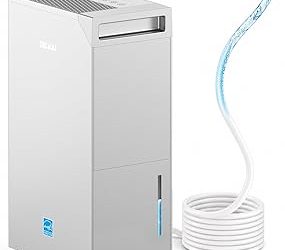
HOGARLABS 30 Pint Dehumidifier
A well-judged compressor unit for basements and larger rooms, with three working modes, overflow protection, and auto shut-off and restart after a power interruption. The included drain hose and digital panel make it a genuine set-and-forget machine, and its lowest mode is quiet enough for an adjacent room.
KNKA 34 Pint Dehumidifier (2,500 Ft²)
The most flexible pick for whole-floor coverage, pairing intelligent humidity control with a 24-hour timer — a useful combination if you’d rather the unit work hard while you’re out and idle while you sleep. The dry-clothes mode is a practical bonus in flats without outdoor drying space.
105 Pint Energy Star Dehumidifier (5,500 Sq Ft)
Specify this only for a large, persistently damp basement or crawlspace; at that capacity, quiet is relative, and it belongs behind a closed door rather than in a living space. The Energy Star efficiency rating matters here, since a unit this size will otherwise dominate your running costs.
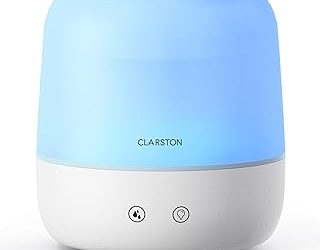
95 oz Dehumidifier with 7-Color Ambient Light
Rated for around 1,000 sq ft with a generous 95 oz tank and auto shut-off, available in black or grey. The ambient light is pleasant in a den or basement lounge, but switch it off for sleeping — warm-tinted or not, light at eye level works against sleep pressure.
Frequently Asked Questions
How quiet is quiet enough for a bedroom?
Aim for under 40 dB and, more importantly, for continuous rather than cycling operation. A steady 38 dB is far less disruptive than a unit that alternates between silence and 45 dB every twenty minutes.
What humidity level should I set overnight?
Somewhere between 40 and 50 percent suits both comfort and mold prevention. Below 40 percent, airways and sinuses dry out; above 55 percent, dust mites and mildew thrive.
Will a Peltier unit dry out a damp basement?
No. Thermoelectric models remove ounces per day, not pints, and they lose efficiency in cool air. Use a compressor unit below grade and reserve Peltier for enclosed, already-manageable spaces.
Can I run it against a wall to reduce noise?
Avoid it. Blocked intakes force the fan to work harder and can cause overheating. Leave several inches of clearance and place the unit on carpet or a rubber mat, which damps vibration far more effectively than repositioning.
Final Thoughts
For anyone whose real complaint is noise at night, the Eva-Dry EDV-1200 is the honest answer: near-silent, low-draw, and appropriately scoped for a bedroom or closet. If you need meaningful water removal without sacrificing rest, the HOGARLABS 30 Pint offers the best balance of capacity and restraint, while the KNKA 34 Pint is the one to choose when a timer and wider coverage matter more than absolute quiet.