Key takeaways
- Look for a published dB figure: “Quiet operation” is marketing language; a stated number is a commitment. Anything at or below the mid-30s dB range disappears into room ambience, while 45 dB and up will be audible during light sleep stages.
- Oversize slightly, then run it low: A unit rated well beyond your square footage can hold your target humidity on its lowest fan speed. Undersized machines run flat out all night, which is where noise complaints almost always originate.
- Insist on a real sleep mode: The feature should dim or extinguish the display and lock the fan to its lowest setting. Light exposure at night suppresses melatonin, and a bright blue panel two feet from your face defeats the purpose entirely.
- Plan your drainage before you buy: Continuous gravity drainage means no tank-full alarm chirping at 4 a.m. If a hose isn’t practical, choose the largest reservoir you can accommodate.
- Consider vibration, not just volume: Compressor units transmit low-frequency hum through floors. A pad of dense foam or rubber underneath costs almost nothing and removes a surprising amount of perceived noise.
What's inside
Most people trace a bad night’s sleep to caffeine, screens, or stress. Far fewer think about the moisture sitting in the air around them — yet a bedroom hovering above 60% relative humidity makes your body work harder to shed heat, which is exactly the opposite of what sleep architecture requires. Core temperature needs to drop roughly one to two degrees for you to fall asleep and stay in deep, restorative stages. Damp air blunts evaporative cooling, and the result is the familiar pattern of sticky, restless 3 a.m. wake-ups, congested mornings, and pillows that never quite feel dry.
The obvious fix — a dehumidifier — often introduces a second problem: compressor drone, fan whoosh, and glowing displays that keep the nervous system in a low-grade state of alertness. This guide approaches the category from a sleep-wellness perspective rather than a pure appliance one. Below, I look at which 2026 models actually stay quiet enough for a nightstand or basement bedroom, which have genuine sleep modes and dimmable panels, and how to match capacity to your room so the unit spends most of the night idling instead of cycling loudly.
As an Amazon Associate we earn from qualifying purchases.


How to Choose a Quiet Dehumidifier (2026)
- Look for a published dB figure: “Quiet operation” is marketing language; a stated number is a commitment. Anything at or below the mid-30s dB range disappears into room ambience, while 45 dB and up will be audible during light sleep stages.
- Oversize slightly, then run it low: A unit rated well beyond your square footage can hold your target humidity on its lowest fan speed. Undersized machines run flat out all night, which is where noise complaints almost always originate.
- Insist on a real sleep mode: The feature should dim or extinguish the display and lock the fan to its lowest setting. Light exposure at night suppresses melatonin, and a bright blue panel two feet from your face defeats the purpose entirely.
- Plan your drainage before you buy: Continuous gravity drainage means no tank-full alarm chirping at 4 a.m. If a hose isn’t practical, choose the largest reservoir you can accommodate.
- Consider vibration, not just volume: Compressor units transmit low-frequency hum through floors. A pad of dense foam or rubber underneath costs almost nothing and removes a surprising amount of perceived noise.
The Best Quiet Dehumidifiers of 2026, Reviewed
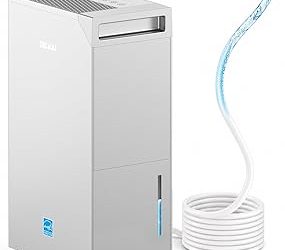
Deye Smart Dehumidifier, 36 Pints
At a rated 33 dB, this is the closest thing in the category to genuinely inaudible, and the 36-pint capacity means it rarely needs to leave its lowest setting in a typical bedroom or finished basement. The dual LED display and app control are conveniences, but the real win for sleep is being able to adjust settings from your phone without turning on a lamp.
Midea Cube 35 Pint
The Cube’s stacking design lets you expand reservoir capacity dramatically, which is the single best defense against overnight tank alarms if you can’t run a hose. Coverage up to 3,500 sq. ft. gives it enormous headroom in a bedroom, so it settles into a quiet, low-duty rhythm rather than short-cycling.
Midea 22 Pint
My pick for smaller bedrooms and nurseries where a full-size unit would be overkill and physically intrusive. It handles 1,500 sq. ft. comfortably, supports continuous drainage, and the reusable filter keeps particulates down — useful if your sleep disruption is partly allergic rather than purely thermal.
Waykar 80 Pints
This is a whole-house solution, and the reason it belongs in a sleep guide is indirect but important: dehumidifying a large basement or hallway lowers the moisture load reaching upstairs bedrooms, letting you skip an in-room unit altogether. Precise 30–80% targeting and auto-defrost make it dependable in cool, damp spaces year-round.
ToLife Dehumidifier, 1000 Sq Ft
The most sleep-conscious design here for the money, with a dedicated sleep mode, auto shutoff, and a 7-color LED that can be switched off entirely. The generous 95 oz tank and compact footprint suit apartments, bathrooms, and bedside placement where hose access isn’t an option.
Frequently Asked Questions
What humidity level is best for sleep?
Aim for 40–50% relative humidity. Below 30% you invite dry sinuses and throat irritation; above 60% you compromise thermal comfort and encourage dust mites and mold. A cheap hygrometer placed at mattress height is worth more than any spec sheet.
Should the dehumidifier run all night or shut off?
Set a target humidity and let it cycle. Continuous operation is louder and unnecessary once the room stabilizes — most well-sized units spend the small hours idling.
Where should I place it in a bedroom?
Several feet from the bed, away from walls and curtains, with clear airflow on all sides. Distance reduces perceived noise considerably and prevents drafts across your face.
Do small electronics need their own dehumidifier?
They can. If you sleep with hearing aids or earbuds, a dedicated dryer such as the Redux Home Hearing Aid Dryer removes overnight moisture from the devices themselves — a different job entirely from conditioning room air.
Final Thoughts
For most bedrooms, the Deye 36-pint is the one to beat on the strength of its 33 dB rating alone. Choose the Midea Cube 35 Pint if hose drainage isn’t possible and you want the largest practical reservoir, or the ToLife if you need a compact, genuinely sleep-friendly unit for a smaller room without spending much.