Key takeaways
- Match tank size to room volume, not square footage: A vaulted-ceiling bedroom holds far more air than the same floor plan with 8-foot ceilings. For a typical 200–350 sq ft bedroom, a 4–6L tank gets you through the night comfortably; 8L units are for open-plan spaces or people who refuse to refill daily.
- Insist on a real hygrometer, not a timer: Units that simply run until empty routinely overshoot past 60 percent humidity, which invites dust mites and mold. A built-in sensor with auto mode holds you in the 40–50 percent window that sleep researchers consistently associate with fewer nighttime awakenings.
- Judge noise at arm’s length: Published decibel figures are measured in anechoic chambers. What matters is whether the unit produces a steady broadband hum — which the brain habituates to — or intermittent gurgling and clicks, which it does not. Warm mist models are inherently quieter than fan-driven evaporative types.
- Check the cleaning geometry before you buy: Narrow-necked tanks and hidden reservoir channels are where biofilm establishes itself. Top-fill designs with a wide opening, or stainless steel interiors you can reach with a cloth, will still be in service in year three.
- Decide whether you want light and connectivity, or the absence of them: Smart app control is genuinely useful for pre-humidifying a room before bed. Ambient RGB lighting is not sleep-friendly unless it can be switched off completely — verify that a full-dark mode exists.
What's inside
Anyone who has woken at 3 a.m. with a cracked throat, a nosebleed, or a cough that only shows up in bed knows the problem isn’t the mattress — it’s the air. Once indoor relative humidity slides below roughly 30 percent, the mucosal lining of your nose and throat stops working properly. That tissue is your first line of defense against airborne irritants, and when it dries out, you snore more, wake more, and breathe through your mouth, which dries you out further. It’s a self-reinforcing loop, and heating season makes it worse: every degree of forced-air warmth pulls more moisture out of the room.
Warm mist humidifiers address this differently than their cool mist cousins. By boiling or gently heating water before releasing it, they deliver moisture that doesn’t drop the ambient temperature of a bedroom — a real advantage if you already sleep cool — and the heating step kills most waterborne bacteria before the vapor ever reaches you. This guide covers what actually matters when shopping in 2026: runtime, sensor accuracy, noise floor at sleeping distance, and how honest a manufacturer is about cleaning. Below you’ll find the models worth your money, followed by a buying framework and answers to the questions people ask after their first humidifier disappoints them.
As an Amazon Associate we earn from qualifying purchases.




How to Choose a Warm Moisture Humidifier (2026)
- Match tank size to room volume, not square footage: A vaulted-ceiling bedroom holds far more air than the same floor plan with 8-foot ceilings. For a typical 200–350 sq ft bedroom, a 4–6L tank gets you through the night comfortably; 8L units are for open-plan spaces or people who refuse to refill daily.
- Insist on a real hygrometer, not a timer: Units that simply run until empty routinely overshoot past 60 percent humidity, which invites dust mites and mold. A built-in sensor with auto mode holds you in the 40–50 percent window that sleep researchers consistently associate with fewer nighttime awakenings.
- Judge noise at arm’s length: Published decibel figures are measured in anechoic chambers. What matters is whether the unit produces a steady broadband hum — which the brain habituates to — or intermittent gurgling and clicks, which it does not. Warm mist models are inherently quieter than fan-driven evaporative types.
- Check the cleaning geometry before you buy: Narrow-necked tanks and hidden reservoir channels are where biofilm establishes itself. Top-fill designs with a wide opening, or stainless steel interiors you can reach with a cloth, will still be in service in year three.
- Decide whether you want light and connectivity, or the absence of them: Smart app control is genuinely useful for pre-humidifying a room before bed. Ambient RGB lighting is not sleep-friendly unless it can be switched off completely — verify that a full-dark mode exists.
The Best Warm Moisture Humidifiers of 2026, Reviewed
Levoit OasisMist 4.5L Smart Warm and Cool Mist
The most balanced bedroom unit here: 45 hours of runtime, a genuinely accurate auto-humidity algorithm, and a 26dB noise floor that disappears behind a ceiling fan. The top-fill tank and wide opening make weekly descaling a two-minute job rather than a chore you postpone.
DREO 8L Smart Humidifier (HM717S)
Built for large or open rooms, with an 80-hour runtime that makes it near-maintenance-free in a guest suite or living area. Set the RGB lighting to off and let the precise humidity control do its work — the app scheduling is the standout feature for anyone who wants the room conditioned before they walk in.
DREO 6L Smart Humidifier for Bedroom
The sensible middle sibling: 60 hours of quiet operation and 500ml/h output covering most primary bedrooms without dominating a nightstand. Alexa and Google integration means you can raise output without opening your eyes.
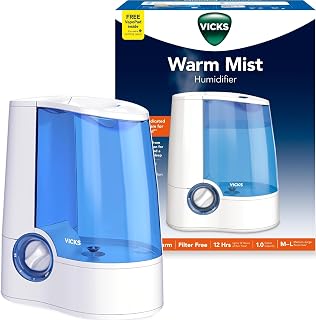
Vicks Warm Mist Humidifier
A filter-free, mechanically simple boiler that has earned its longevity — the gallon tank and true steam output make it the pick during a chest cold, especially paired with a VapoPad. Skip it if you need precise humidity targeting; it has no sensor and will happily overshoot.
Livatro 3L Stainless Steel Warm Mist Humidifier
The hygiene-first choice. A stainless interior resists biofilm in a way plastic reservoirs simply cannot, and the sleep mode plus auto shut-off make it a low-anxiety bedside unit. The 3L capacity suits small rooms and nurseries.
Frequently Asked Questions
Is warm mist actually better for sleep than cool mist?
For most sleepers, yes — marginally. Warm mist won’t lower your room temperature, and the heating stage reduces the microbial load in the vapor. Cool mist is safer around curious toddlers and uses less electricity, so the trade-off is real.
What humidity level should I target overnight?
Between 40 and 50 percent. Below 30 percent invites dry airways and static; above 60 percent encourages dust mites, mold, and condensation on cold window glass.
Do I need distilled water?
Warm mist units tolerate tap water better than ultrasonic cool mist models, which aerosolize dissolved minerals as white dust. You’ll still get scale buildup on the heating element, so expect a monthly vinegar soak.
How often should I clean it?
Empty and dry the tank daily, and descale weekly. Standing water in a warm reservoir is exactly the environment you don’t want feeding your bedroom air.
Final Thoughts
For most bedrooms, the Levoit OasisMist 4.5L is the one to buy — accurate sensing, near-silent operation, and a tank you’ll actually clean. Scale up to the DREO 8L HM717S if you’re humidifying an open-plan space and want to refill twice a week instead of nightly, and choose the Livatro stainless steel unit if hygiene and simplicity outrank capacity in your priorities.