Key takeaways
- Acoustic behavior: Look for explicit low-noise or silent-operation claims, and prioritize units where the flame effect can run independently of the heater — the LED motor is almost always quieter than the blower. In a bedroom, flame-only mode is the setting you’ll use most.
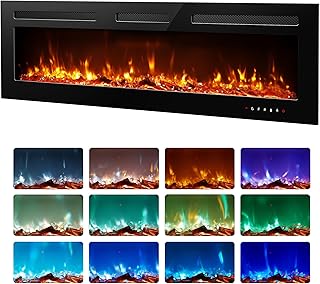
- Flame dimming range: Adjustable color is common; genuinely deep dimming is not. Bright amber flame at full output puts real light into a dark room. Check that brightness is adjustable in steps, not just on or off, and favor warmer color themes in the evening over the blue and violet options.
- Thermostat and timer granularity: Sleep quality drops sharply in a room that drifts warm. A true thermostat that holds a setpoint beats a simple two-stage heater, and a multi-hour sleep timer lets the unit take the chill off bedtime, then shut itself down before the small hours.
- Wall depth and stud compatibility: Ultra-thin inserts that fit standard 2×4 framing save you a bump-out or a structural change. Confirm the required rough opening and depth before you open the drywall, and verify whether the model needs a dedicated circuit.
- Control method: Remotes with backlit buttons, app control, and voice assistants all beat getting out of bed. Avoid units where the only fine adjustment lives on a touch panel behind the glass at floor or knee level.
What's inside
Most people shop for a linear fireplace with their eyes: they picture the ribbon of flame stretched across a feature wall, the shadows it throws on a winter evening, the way it anchors a room. What almost nobody accounts for is the sound. A fireplace insert lives at chest height in the room where you unwind — and in many homes, in the room where you sleep. Fan whine, blower rattle, and the faint electrical tick of a cycling heating element are the kinds of low-grade stimuli that keep the nervous system on alert long after you’ve stopped consciously noticing them. If you’ve ever wondered why a beautiful bedroom still doesn’t feel restful, this is the sort of thing worth auditing.
Coming at this from a sleep-wellness perspective changes the shortlist considerably. Below, units are assessed on three things that matter after dark as much as the aesthetics do: how quietly they run, how far down the flame brightness and color temperature can be dialed, and whether the timer and thermostat give you enough control to avoid overheating a bedroom past the point of comfortable sleep. All six models here are genuinely handsome pieces of hardware; the ordering reflects which ones you’d still be happy with at 11pm.
As an Amazon Associate we earn from qualifying purchases.




How to Choose a Electric Linear Fireplace (2026)
- Acoustic behavior: Look for explicit low-noise or silent-operation claims, and prioritize units where the flame effect can run independently of the heater — the LED motor is almost always quieter than the blower. In a bedroom, flame-only mode is the setting you’ll use most.
- Flame dimming range: Adjustable color is common; genuinely deep dimming is not. Bright amber flame at full output puts real light into a dark room. Check that brightness is adjustable in steps, not just on or off, and favor warmer color themes in the evening over the blue and violet options.
- Thermostat and timer granularity: Sleep quality drops sharply in a room that drifts warm. A true thermostat that holds a setpoint beats a simple two-stage heater, and a multi-hour sleep timer lets the unit take the chill off bedtime, then shut itself down before the small hours.
- Wall depth and stud compatibility: Ultra-thin inserts that fit standard 2×4 framing save you a bump-out or a structural change. Confirm the required rough opening and depth before you open the drywall, and verify whether the model needs a dedicated circuit.
- Control method: Remotes with backlit buttons, app control, and voice assistants all beat getting out of bed. Avoid units where the only fine adjustment lives on a touch panel behind the glass at floor or knee level.
The Best Electric Linear Fireplaces of 2026, Reviewed
72″ Ultra-Thin Silence Linear Electric Fireplace
The clearest bedroom pick here: a 72-inch span that fits both 2×4 and 2×6 stud bays, with noise suppression treated as a headline feature rather than an afterthought. Adjustable flame color and speed plus a timed 750/1500W heater make it easy to set up a wind-down routine and then forget about it.
Dimplex IgniteXL 60″ (XLF60)
The premium build in this group, and the one whose flame effect reads most convincingly at low output thanks to the acrylic ember bed and eight color themes. Note the 240V option and higher 8530 BTU ceiling — excellent for a large living space, though it’s more heater than most bedrooms need.
PuraFlame Bernice 42″ Smart
The smartest unit of the six, with Alexa and Google Assistant support that means you can drop the flame or kill the heater by voice without moving. The hidden vent design keeps the face clean, and 42 inches suits smaller rooms where a 72-inch insert would overwhelm the wall.
Vitesse 72″ Ultra Thin
A narrow-bezel 72-inch insert with an 8-hour sleep timer built in — a rare and genuinely useful spec — alongside low-noise operation and both remote and on-screen control. Strong value for a primary bedroom or a bedroom-adjacent lounge.
Electactic 60″ Ultra-Thin Insert
The thermostat is the reason to choose this one: holding a steady setpoint is far kinder to sleep than a heater that swings between blasting and off. Ultra-thin depth, touch-screen and remote control, and a timer round out a well-specified 60-inch package.
Frequently Asked Questions
Is it safe to run an electric fireplace overnight?
Electric inserts have no combustion, no emissions, and no open flame, so the carbon monoxide risk that rules out gas and wood in bedrooms doesn’t apply. Still, use the timer rather than leaving the heater running until morning, and keep bedding and curtains well clear of the vent.
Will the heater make my bedroom too warm to sleep in?
It can, easily. Most people sleep best in a cool room, so treat the heater as a pre-bed warm-up: run it on the lower 750W setting, set a two- to four-hour timer, and let the room drift back down as the night goes on.
Can I use the flame without the heat?
Yes — every model here separates the two, which is the single most useful feature for evening use. Flame-only mode draws minimal power, runs far quieter than heat mode, and gives you ambience without a temperature penalty.
Does the flame light interfere with sleep?
Bright light at night suppresses melatonin, and a full-output flame effect on a large insert is not a trivial light source. Dim it well down after sunset, stick to warm amber tones rather than the cooler color themes, and switch it off entirely once you’re in bed.
Final Thoughts
For a bedroom or a quiet evening room, the 72″ Ultra-Thin Silence model is the most sensible starting point — it prioritizes low noise at a scale that suits a feature wall. The Vitesse 72″ is the value alternative, and its 8-hour sleep timer does real work. If the fireplace is destined for a large open-plan living space where output and flame realism matter more than acoustics, spend up on the Dimplex IgniteXL 60″.