Key takeaways
- Temperature range, not just “hot”: Look for adjustable settings spanning roughly 175°F to 212°F. Delicate greens and white teas want the low end; rooibos and valerian root need a full boil to extract properly. A single-temperature unit forces a compromise every night.
- Acoustic footprint: Rapid-heat coils can hiss and crack; tank-style boilers cycle their heating elements with an audible click. If the dispenser lives within earshot of a bedroom, favor insulated tank designs over on-demand flash heaters, or place the unit on a silicone mat to damp vibration.
- Standby energy and timers: A keep-warm tank that idles at 195°F all night burns real electricity. Energy-saving timers and sleep modes let the unit power down during hours you’d never use it and reheat before you wake.
- Safety locks and spill design: Non-drip taps, locking lids, and child locks matter disproportionately when you’re operating half-asleep in dim light. Scald injuries cluster in the late evening and early morning for exactly this reason.
- Capacity matched to use: Two to three liters is ample for a household evening ritual. Eight liters and up belongs in an office, café, or catering setting — an oversized tank at home just means reheating water you never drank.
What's inside
Most people think of a hot water dispenser as a kitchen convenience. I’ve come to see it as a sleep tool. In clinical practice, the single most reliable predictor of whether someone actually follows through on a wind-down routine isn’t motivation — it’s friction. A person who has to stand at the stove for eight minutes waiting on a whistling kettle, under harsh overhead lighting, at 9:45 p.m., will skip the chamomile roughly four nights out of five. Remove those eight minutes and the ritual survives.
This guide looks at instant and thermostatic hot water dispensers through that lens: how quietly they run, how precisely they hold temperature (green tea steeped at boiling is bitter enough to jolt anyone awake), whether they light up your kitchen like a surgical suite, and whether they’re safe to leave plugged in overnight. I’ve also included high-throughput commercial units, because plenty of readers are outfitting a tea bar or a break room rather than a nightstand-adjacent countertop. Below, six machines worth your attention in 2026, followed by the criteria I’d weigh before buying.
As an Amazon Associate we earn from qualifying purchases.



How to Choose a/an Hot Water Dispenser Best (2026)
- Temperature range, not just “hot”: Look for adjustable settings spanning roughly 175°F to 212°F. Delicate greens and white teas want the low end; rooibos and valerian root need a full boil to extract properly. A single-temperature unit forces a compromise every night.
- Acoustic footprint: Rapid-heat coils can hiss and crack; tank-style boilers cycle their heating elements with an audible click. If the dispenser lives within earshot of a bedroom, favor insulated tank designs over on-demand flash heaters, or place the unit on a silicone mat to damp vibration.
- Standby energy and timers: A keep-warm tank that idles at 195°F all night burns real electricity. Energy-saving timers and sleep modes let the unit power down during hours you’d never use it and reheat before you wake.
- Safety locks and spill design: Non-drip taps, locking lids, and child locks matter disproportionately when you’re operating half-asleep in dim light. Scald injuries cluster in the late evening and early morning for exactly this reason.
- Capacity matched to use: Two to three liters is ample for a household evening ritual. Eight liters and up belongs in an office, café, or catering setting — an oversized tank at home just means reheating water you never drank.
The Best Hot Water Dispenser Best (2026)s Reviewed
Zojirushi CD-LFC30 Micom Water Boiler & Warmer
The one I recommend most often for evening use: four keep-warm setpoints, a genuinely useful energy-saving timer, and a panorama gauge you can read without turning on the kitchen lights. It runs quietly, holds temperature with real precision, and the 3.0-liter capacity is right for a household rather than a restaurant.
AIRHOP 3L Instant Hot Water Dispenser
Three-second heating across five temperatures and three volume presets makes this the lowest-friction option here — press once and your cup is filled before you’ve finished putting the tea bag in. The child lock and BPA-free removable tank are welcome, though the flash-heating element is slightly more audible than a tank boiler.
InSinkErator HOT150 Instant Hot Water Dispenser
An under-sink tank with a dedicated chrome faucet, so nothing occupies your counter and nothing hums beside you. It’s the most elegant long-term solution if you’re willing to commit to plumbing, and near-boiling water arrives instantly at the tap.
NutriChef 8L Water Boiler & Dispenser
A sensible bridge between home and light commercial: eight liters, a safety-lock lid, non-drip tap, and a warm function, all in food-grade stainless. Best suited to gatherings, offices, or households that go through a lot of hot water in a single sitting.
Bleou 1800W Commercial Countertop Dispenser
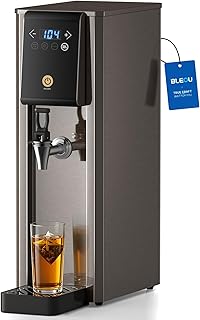
Twenty liters per hour with adjustable output from 104°F to 212°F, built in 304 stainless — this is boba-shop and hotel-lobby hardware, not nightstand equipment. If you’re supplying a coffee bar or busy break room, the throughput and temperature latitude justify the size.
Frequently Asked Questions
Is it safe to leave a hot water dispenser on overnight?
Tank-style boilers from reputable manufacturers are designed for continuous operation and include dry-boil and overheat protection. That said, using a timer or sleep mode reduces both standby energy draw and the small residual risk of leaving any heating appliance unattended.
What temperature should I use for a bedtime tea?
Herbal infusions — chamomile, lemon balm, valerian, rooibos — want 205°F to 212°F for full extraction. Green and white teas do better at 175°F to 185°F. If you drink a caffeinated tea in the evening, remember that steeping time drives caffeine more than temperature does.
Does drinking hot water before bed actually help sleep?
The warm beverage itself has a modest physiological effect: peripheral warming can accelerate the core-temperature drop that precedes sleep onset. The larger benefit is behavioral — a consistent, low-effort ritual is a strong sleep cue. Keep the volume small to avoid nighttime waking.
How often should I descale one?
Every one to three months depending on water hardness. Scale insulates the heating element, which lengthens heat-up time and makes the unit noisier — a practical reason to stay on top of it if the dispenser sits near a bedroom.
Final Thoughts
For most readers building an evening ritual, the Zojirushi CD-LFC30 is the pick — quiet, precise, and timer-driven in a way that respects both your sleep and your electric bill. If you want zero wait and a smaller footprint, the AIRHOP 3L delivers a cup in seconds with a child lock included, while the InSinkErator HOT150 is the cleanest permanent solution for anyone ready to plumb one in and reclaim the counter entirely.